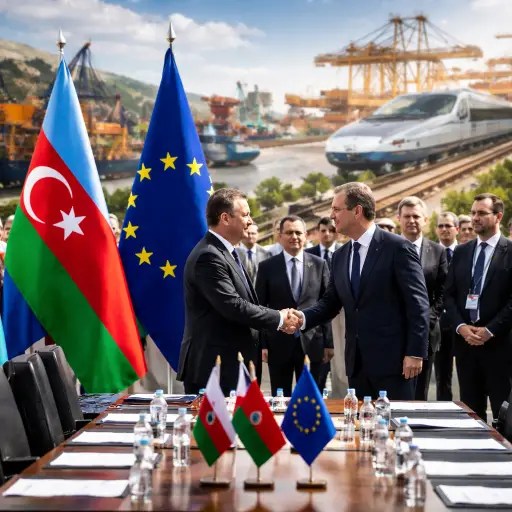
Global Gateway investment and connectivity plans signal a new phase in Brussels–Baku relations amid shifting geopolitical realities
Brussels and Baku have entered a new phase of engagement, broadening their cooperation beyond traditional energy ties and positioning their relationship within a wider geopolitical and economic framework. At the center of this renewed momentum is the Global Gateway initiative, the European Union’s flagship strategy to promote sustainable investment, infrastructure development, and connectivity with partner countries beyond the bloc.
The latest understandings between the EU and Azerbaijan reflect a pragmatic alignment of interests. For Brussels, Azerbaijan represents a strategic partner at the crossroads of Europe and Asia, with growing relevance in transport corridors, energy diversification, and regional stability. For Baku, deeper cooperation with the EU offers access to investment, technology, and political dialogue at a time when global trade routes and alliances are being redefined.
Diplomatic sources describe the discussions as constructive and forward-looking, with an emphasis on long-term cooperation rather than short-term transactional gains. While energy security remains an important pillar of EU–Azerbaijan relations, the scope of engagement is expanding to include transport infrastructure, digital connectivity, and climate-resilient development.
The Global Gateway framework provides the political and financial architecture for this shift. Designed as a values-based alternative to purely transactional infrastructure investment models, the initiative aims to support high-quality projects that are sustainable, transparent, and aligned with international standards. Azerbaijan’s geographic position makes it a natural partner for connectivity projects linking the South Caucasus with the Black Sea region, Central Asia, and the European market.
Transport connectivity has emerged as a particularly prominent area of cooperation. The EU sees potential in strengthening east–west corridors that can facilitate trade flows while reducing overdependence on single routes. Azerbaijan, for its part, has invested heavily in port infrastructure, railways, and logistics hubs, seeking to position itself as a regional transit center. European support under the Global Gateway could accelerate these ambitions while embedding them within broader European networks.
Beyond infrastructure, investment cooperation is also gaining momentum. European institutions and companies are exploring opportunities in renewable energy, energy efficiency, and digital transformation. Azerbaijan has signaled interest in diversifying its economy and leveraging its renewable potential, particularly in wind and solar power. Cooperation in these areas aligns with the EU’s climate objectives and Azerbaijan’s own development priorities.
Politically, the deepening of ties reflects a mutual desire to maintain open channels of dialogue in a complex regional environment. The South Caucasus remains a region shaped by unresolved tensions and competing external influences. The EU has increasingly sought a more visible diplomatic role, emphasizing stability, economic development, and connectivity as tools for long-term peace. Azerbaijan’s engagement with the EU is part of a broader strategy to balance its foreign relations and expand its international partnerships.
European officials stress that cooperation under the Global Gateway is not limited to government-to-government relations. A strong emphasis is placed on involving the private sector, financial institutions, and local stakeholders. This approach is intended to ensure that projects are economically viable and socially inclusive, rather than purely politically driven.
From Baku’s perspective, closer engagement with the EU also carries symbolic weight. It signals recognition of Azerbaijan’s role as a regional actor and a bridge between different economic spaces. While differences remain on certain political and governance issues, both sides appear committed to managing these divergences through dialogue rather than confrontation.
As global connectivity becomes an increasingly strategic asset, the EU–Azerbaijan partnership illustrates how infrastructure and investment are being woven into foreign policy. The broadening of cooperation under the Global Gateway suggests a relationship that is evolving in scope and ambition, shaped less by single-issue priorities and more by a shared understanding of interdependence.
Looking ahead, the success of this renewed engagement will depend on implementation. Translating political commitments into tangible projects will require coordination, financing, and sustained political will. If delivered effectively, the partnership could strengthen economic links, enhance regional connectivity, and anchor EU–Azerbaijan relations more firmly in a rapidly changing global landscape.

 The Tower Post