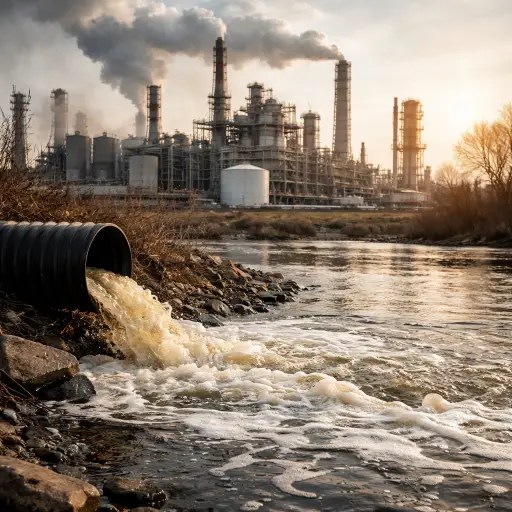
A new study warns that unchecked PFAS pollution could saddle the EU with hundreds of billions in costs, reframing environmental regulation as an urgent economic safeguard.
Across Europe’s rivers, soils, and drinking water supplies, a largely invisible class of chemicals has been quietly accumulating for decades. Known as PFAS—per- and polyfluoroalkyl substances—these compounds are prized by industry for their resistance to heat, water, and oil. That same durability, however, has earned them a darker nickname among scientists and campaigners: “forever chemicals.”
A newly released pan-European study has brought the economic consequences of this persistence into sharp focus. According to the analysis, allowing PFAS contamination to continue largely unchecked could cost the European Union as much as €440 billion by the middle of the century. The estimate aggregates cleanup expenses, health care costs, environmental remediation, and lost economic productivity—painting a picture of a slow-moving crisis with a very real price tag.
The findings land at a sensitive moment for European policymakers. As the EU balances industrial competitiveness, strategic autonomy, and public health, the study argues that strong environmental regulation is not a drag on growth but a form of fiscal prudence.
A contamination that respects no borders
PFAS are used in thousands of products, from non-stick cookware and waterproof textiles to firefighting foams and semiconductor manufacturing. Their carbon-fluorine bonds are among the strongest in chemistry, meaning they do not readily break down in nature. Once released, they migrate through water and air, spreading far from their original sources.
The study maps contamination across multiple EU member states, finding PFAS in groundwater near industrial sites, airports, and military bases, but also in agricultural land and urban drinking water systems. In several regions, pollution has crossed national borders via shared river basins, complicating responsibility and remediation.
Researchers warn that the scale of contamination makes reactive cleanup alone an unrealistic strategy. Pump-and-treat systems for groundwater can take decades, while soil excavation and disposal are costly and disruptive. Without upstream controls, newly cleaned sites risk being recontaminated.
Counting the real costs
The headline figure of €440 billion is not a single bill that arrives all at once. Instead, it represents a cumulative burden spread over years: medical treatment for PFAS-linked illnesses, monitoring and filtration of drinking water, environmental damage to fisheries and farmland, and the opportunity costs of land rendered unusable.
Epidemiological studies have associated certain PFAS with cancers, immune system suppression, hormonal disruption, and developmental effects. While the precise health impacts vary by compound and exposure level, the economic modeling in the study factors in increased public health spending and reduced workforce productivity.
Water utilities face particularly steep challenges. Advanced filtration technologies such as activated carbon or high-pressure membranes can remove PFAS, but retrofitting plants and maintaining these systems requires sustained investment. For smaller municipalities, the costs can be overwhelming without national or EU-level support.
Regulation as economic insurance
The study’s authors argue that the debate over PFAS should be reframed. Rather than asking how much regulation will cost industry, policymakers should ask how much inaction will cost society.
Several EU institutions are already considering a broad restriction on PFAS, with limited exemptions for uses deemed essential and lacking viable alternatives. Industry groups have pushed back, warning of supply chain disruptions and the expense of reformulating products. But the new analysis suggests that delayed action simply shifts costs from manufacturers to taxpayers and future generations.
Historical comparisons strengthen the argument. Europe’s past experiences with asbestos, leaded petrol, and certain pesticides show that early warnings were often ignored, only for governments to later spend vast sums on cleanup and compensation. PFAS, the study suggests, risk following the same trajectory—on a continental scale.
Innovation under pressure
A comprehensive phase-down of PFAS would not be painless. Some sectors, including medical devices and renewable energy technologies, still rely on specific fluorinated compounds for performance and safety. The challenge lies in distinguishing between truly essential uses and those driven by convenience or cost savings.
At the same time, regulation can act as a catalyst for innovation. Several European companies and research institutes are already developing alternative materials and processes that avoid PFAS altogether. Clear, predictable rules, the study notes, could accelerate this transition by giving businesses the certainty needed to invest.
A choice about the future
Beyond the balance sheets, the PFAS debate raises deeper questions about Europe’s environmental and social priorities. Contamination often disproportionately affects communities near industrial hubs or military installations, where residents may face higher health risks without having benefited economically from the polluting activities.
The study concludes that the EU stands at a crossroads. One path accepts mounting contamination and escalating costs, managed through piecemeal remediation. The other treats preventive regulation as an investment—one that protects public health, ecosystems, and long-term economic stability.
As awareness of PFAS grows among the public, pressure on decision-makers is likely to intensify. The chemicals may be invisible, but the bill for ignoring them, the study makes clear, will not be.




 The Tower Post