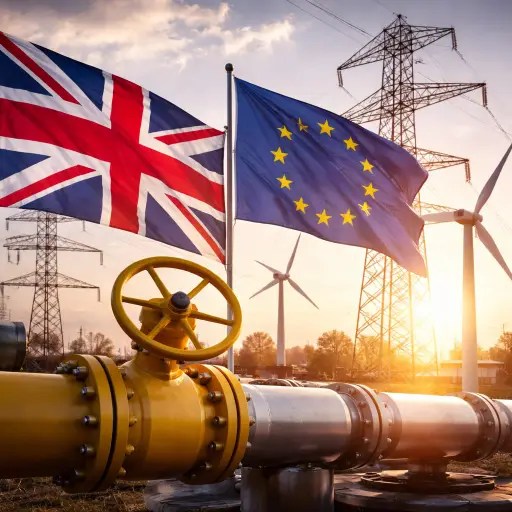
Brussels draws firm conditions on any post-Brexit energy accord, linking market access to financial solidarity
As winter lingers across Europe, energy security has once again moved to the forefront of political debate. This time, the focus is not on gas storage levels or electricity prices, but on the unresolved relationship between the European Union and the United Kingdom. Brussels has made clear that any new post-Brexit energy agreement will come at a price — and not merely a political one.
EU leaders and senior officials have signaled that closer energy cooperation with the UK will not advance unless London agrees to contribute financially to European solidarity mechanisms designed to support less affluent member states. The message is blunt: access to the EU’s vast energy market cannot be separated from shared financial responsibility. For many in Brussels, this stance reflects both economic logic and the hard lessons drawn since the UK’s departure from the bloc.
At stake is a potential framework governing electricity trading, cross-border infrastructure, and coordinated responses to supply shocks. Since Brexit, energy relations between the EU and the UK have been managed through temporary and fragmented arrangements. While the lights have stayed on, industry leaders on both sides of the Channel argue that the lack of a comprehensive deal has led to inefficiencies, higher costs, and regulatory uncertainty.
The European Commission has framed its position as an extension of existing principles rather than a new demand. In the EU’s internal energy market, wealthier countries contribute to funds that help stabilize prices, finance infrastructure, and cushion poorer members from volatility. According to EU officials, allowing a non-member state to benefit from the system without contributing would undermine its political and financial foundations.
For the UK government, the issue touches a raw nerve. Brexit was sold domestically as a means of regaining control over laws, borders, and spending. Any new payments to EU-linked funds are likely to provoke fierce debate in Parliament and the press. British ministers have so far emphasized cooperation without “automatic alignment” or “open-ended financial commitments,” careful language that reflects the political sensitivity of the topic.
Yet energy experts note that geography and physics care little for sovereignty slogans. The UK remains physically connected to the continent through undersea electricity interconnectors and gas pipelines. Power flows according to supply and demand, not political boundaries. In recent years, Britain has at times relied heavily on imported electricity during peak demand, while exporting surplus power when renewable generation is strong.
From the EU perspective, this interdependence strengthens the case for shared rules and shared costs. Officials point to recent crises as evidence that solidarity mechanisms are not theoretical constructs but practical tools that prevent blackouts and extreme price spikes. They argue that contributions from the UK would be proportionate, transparent, and tied specifically to energy cooperation rather than broader EU budgets.
Diplomats involved in the discussions describe a familiar post-Brexit dynamic. Technical talks often make progress, only to stall when they reach questions of governance and money. Trust, still fragile after years of negotiation and renegotiation, remains a decisive factor. Several EU capitals are wary of granting concessions without firm guarantees, citing past disputes over trade, fisheries, and regulatory divergence.
Industry voices, however, are growing louder. Energy companies, grid operators, and large industrial consumers warn that prolonged uncertainty benefits no one. They argue that a stable framework would encourage investment in interconnectors, offshore renewables, and hydrogen infrastructure — areas where cooperation could accelerate the energy transition on both sides.
Some analysts see the current standoff as part of a broader recalibration rather than a deadlock. The EU, more assertive after navigating successive crises, is increasingly unwilling to offer sector-by-sector access without horizontal commitments. The UK, meanwhile, is balancing its desire for flexibility with the economic realities of being outside a neighboring market of hundreds of millions of consumers.
Publicly, both sides maintain a measured tone. Officials speak of “constructive dialogue” and “mutual interests,” avoiding language that would suggest an imminent breakdown. Privately, expectations are more cautious. Few anticipate a rapid breakthrough, but neither side appears eager to let the issue drift indefinitely.
For European leaders, insisting on financial contributions is as much about precedent as about revenue. Allowing special arrangements without solidarity payments could invite similar demands from others and weaken the cohesion of the bloc. For the UK, the challenge lies in explaining to voters why pragmatic cooperation may require compromises once deemed unacceptable.
As discussions continue, the broader lesson of the post-Brexit era is once again on display. Separation did not end interdependence; it merely changed the terms under which it must be managed. In energy, where cables and pipelines bind neighbors together, those terms are proving particularly hard to redraw.
Whether London and Brussels can bridge the gap will depend not only on economics, but on political will and public trust. Until then, the prospect of a comprehensive post-Brexit energy deal remains connected — like the grids themselves — but not yet synchronized.



 The Tower Post