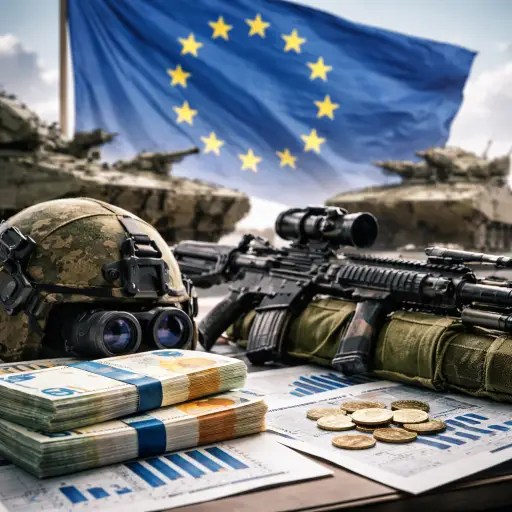
As security pressures mount, eurozone officials explore whether a €430 billion rescue fund could be repurposed to ease military spending without reopening fiscal fault lines.
By early February 2026, a fund once synonymous with bailouts and austerity has returned to the centre of Europe’s political conversation. The European Stability Mechanism (ESM), the euro area’s permanent crisis backstop, is being discussed not as a shield against financial contagion but as a potential support for defence spending.
The idea, floated publicly by the ESM’s chief executive, reflects the scale of Europe’s security reassessment. With defence budgets under strain and national balance sheets already stretched by years of pandemic support and energy subsidies, policymakers are searching for instruments that can deliver rapid funding without igniting market anxiety.
Created in the aftermath of the sovereign debt crisis, the ESM was designed to safeguard financial stability in the eurozone. Its mandate focused on providing conditional loans to countries that had lost market access, a role that made it both indispensable and politically sensitive. The memory of tough reform programmes in Greece, Portugal and Ireland still shapes perceptions of the fund in several capitals.
Yet the proposal now under discussion would mark a significant evolution rather than a rupture. Instead of emergency rescues, the ESM could offer precautionary credit lines or low‑interest loans earmarked for defence-related expenditure. Supporters argue that this would allow governments with limited fiscal space to invest in security while avoiding abrupt increases in borrowing costs.
The context is a European Union grappling with a more volatile security environment. Russia’s war in Ukraine has reset strategic assumptions, while uncertainty over the future shape of transatlantic relations has reinforced calls for greater European responsibility. For many governments, boosting defence is no longer optional, but financing it remains contentious.
According to officials familiar with the discussions, the ESM would not replace national defence budgets or EU‑level initiatives. Instead, it would function as a safety valve, available to countries facing market pressure or sudden expenditure needs. Because the fund can borrow at very low rates, it could pass on favourable terms to members, reducing the immediate fiscal impact.
Critics caution that such a move risks blurring the ESM’s original purpose. They warn that using a crisis instrument for defence could stretch its mandate and reopen debates over conditionality and moral hazard. Others fear that once the door is opened, political pressure could grow to use the fund for additional policy goals.
Governance is another hurdle. Any change to the ESM’s use would require unanimous approval from eurozone members. This includes countries with traditions of military neutrality, for whom the symbolism of a rescue fund supporting defence spending may be particularly sensitive. Diplomatic sources say careful legal framing would be essential to secure broad consent.
Market reaction is also a consideration. While investors generally view the ESM as a stabilising force, clarity would be needed to ensure that defence support is seen as prudent risk sharing rather than fiscal slippage. Proponents counter that predictable, low‑cost financing could in fact enhance stability by preventing disorderly budget adjustments.
The debate underscores a broader shift in Europe’s economic governance. Instruments created for crisis management are increasingly being reconsidered in light of structural challenges, from climate investment to security. Whether the ESM becomes part of this new toolkit will depend on political will as much as legal interpretation.
For now, the proposal remains at an exploratory stage. But its emergence signals how deeply defence has entered Europe’s fiscal thinking. A mechanism born out of financial turmoil may yet find a new role in underwriting the continent’s security, reflecting a union still adapting to a changed world.



 The Tower Post