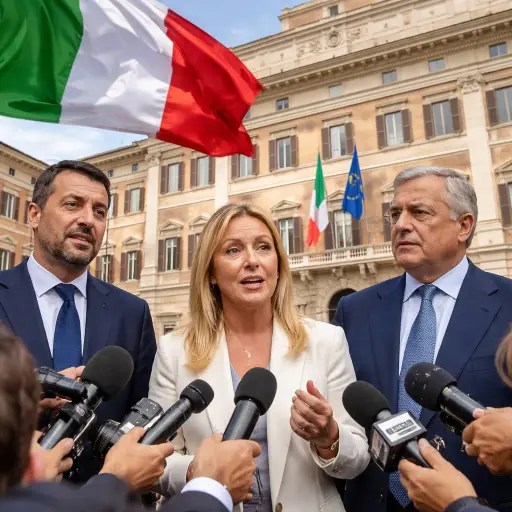
Prime Minister Giorgia Meloni argues proposed changes would bring stability, as critics warn of a dangerous concentration of power and coalition partners navigate uneasy compromises.
Italy’s governing coalition is entering a decisive phase as proposed constitutional reforms sharpen divisions within the ruling majority and revive a long-running national debate over how power should be distributed in Rome. The initiative, championed by Prime Minister Giorgia Meloni, is presented by the government as a necessary step to improve stability and clarity in executive leadership. Yet it has also exposed ideological fault lines among coalition partners and drawn fierce opposition criticism, ensuring the issue will dominate Italy’s political agenda in the weeks ahead.
At the heart of the reform effort is a vision long associated with the Italian right: strengthening the executive to reduce the chronic instability that has plagued the country since the post-war era. Italy has seen dozens of governments rise and fall in rapid succession, often undone by fragile parliamentary majorities. Meloni argues that constitutional change is the only way to guarantee voters that the government they elect can actually govern.
“This is about giving Italians certainty,” the prime minister has said in recent public remarks, framing the reforms as a democratic correction rather than a power grab. Supporters within her Brothers of Italy party describe the proposal as a modernizing step that would finally align Italy with other European democracies where executive authority is clearer and more durable.
The details of the reform package are still being refined, but they are widely understood to include measures that would enhance the role of the prime minister, potentially through direct election or stronger guarantees that the head of government remains in office for a full term. Such ideas have circulated in Italian politics for decades, but previous attempts have foundered amid public skepticism and political infighting.
This time, Meloni’s commanding position within the coalition gives the proposal new momentum. Brothers of Italy emerged as the dominant force in the last general election, overshadowing its partners, the League and Forza Italia. That imbalance of power, however, is also a source of tension. While coalition leaders have pledged unity, their priorities and political instincts differ sharply.
The League, traditionally strong in northern Italy, has long advocated institutional reforms but remains cautious about changes that might weaken parliamentary influence or sideline regional interests. Some League figures worry that a stronger central executive could dilute the autonomy of local governments, a sensitive issue for a party built on federalist rhetoric.
Forza Italia, still redefining itself after the death of its founder Silvio Berlusconi, finds itself walking a tightrope. The party has historically supported presidential-style reforms, yet it also positions itself as a liberal, pro-European force wary of any move that might raise concerns in Brussels. Senior figures have emphasized the need for broad consensus and safeguards to prevent what they describe as “excessive personalization” of power.
Opposition parties, meanwhile, have seized on the reforms as evidence of an authoritarian drift. Center-left leaders accuse Meloni of attempting to rewrite the rules of the game to entrench her power and marginalize parliament. They warn that concentrating authority in the hands of the executive could weaken checks and balances, especially in a political culture already marked by strong personalities and polarized debate.
Civil society groups and constitutional scholars have echoed those concerns. Several prominent jurists argue that Italy’s instability stems less from constitutional design than from political practice. In their view, changing the constitution without addressing party fragmentation and electoral laws risks creating new problems without solving old ones.
Public opinion appears divided. Polls suggest many Italians are frustrated with revolving-door governments and are open to reforms promising stability. At the same time, memories of past constitutional referendums — notably those rejected by voters — serve as a reminder that institutional change is a hard sell. Any reform is likely to face intense scrutiny and, ultimately, a popular vote.
Within the coalition, negotiations continue behind closed doors as leaders seek to present a united front. Meloni has stressed that the process will be inclusive and respectful of constitutional guarantees, signaling willingness to compromise on specific mechanisms. Yet her determination to leave a lasting institutional legacy is unmistakable.
European partners are watching closely. While constitutional reform is a domestic matter, Italy’s political stability has implications for the eurozone and the European Union as a whole. Diplomats say there is concern that a bruising internal battle could distract Rome from economic reforms and foreign policy commitments at a delicate moment for the continent.
As the debate intensifies, the stakes are high. For Meloni, success would cement her reputation as a leader capable of delivering long-promised reforms. For her coalition partners, the challenge lies in shaping the outcome without appearing obstructionist or submissive. And for Italy, the coming weeks may determine whether constitutional change becomes a source of renewed stability — or another chapter in the country’s long history of political contention.




 The Tower Post