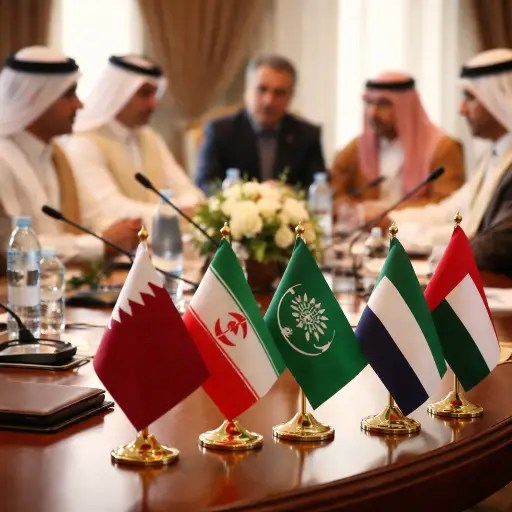
As tensions involving Iran ripple across the Middle East, Doha positions itself as a key diplomatic bridge, underscoring the rising influence of small states in global crisis management.
By early February 2026, the Gulf region finds itself navigating another period of heightened uncertainty, with tensions involving Iran once again testing fragile diplomatic balances. In this volatile environment, Qatar has moved decisively to reinforce its role as a mediator, engaging regional partners in quiet but persistent efforts aimed at de-escalation and dialogue.
Diplomatic sources in Doha describe a concerted push to keep communication channels open between Iran and its neighbors, particularly as rhetoric hardens and military posturing risks miscalculation. Qatar’s leadership, long accustomed to operating in the narrow space between rival powers, is emphasizing preventive diplomacy—an approach focused on reducing misunderstandings before they harden into confrontation.
The current crisis has multiple layers. Regional anxieties over Iran’s strategic intentions have intensified amid broader geopolitical shifts, ongoing conflicts in the Middle East, and uncertainty in global energy markets. While no single trigger defines the present moment, officials across the Gulf speak of a cumulative pressure that makes mediation both more difficult and more necessary.
Qatar’s approach relies heavily on relationships built over decades. Unlike some of its neighbors, Doha has maintained working ties with Tehran while also hosting strategic partnerships with Western powers and cultivating trust within the Gulf Cooperation Council. This unique positioning allows Qatari diplomats to act as intermediaries when direct dialogue between adversaries becomes politically sensitive or publicly untenable.
According to regional analysts, Qatar’s message to its partners has been consistent: escalation would carry unpredictable costs, while dialogue—however limited—remains the only sustainable path to stability. In closed-door meetings, Qatari officials are said to be urging restraint, confidence-building measures, and a recommitment to existing diplomatic frameworks.
The mediation effort is not framed as a grand peace initiative, but rather as a series of incremental steps. These include facilitating indirect exchanges, clarifying intentions through back channels, and encouraging regional actors to avoid actions that could be interpreted as provocations. The emphasis is on buying time and space for diplomacy to work.
For Qatar, the stakes are high. The country’s security and economic prosperity are closely tied to regional stability, particularly the uninterrupted flow of energy exports through sensitive maritime corridors. Any broader conflict involving Iran would reverberate far beyond the Gulf, affecting global markets and international security.
Yet Qatar’s motivations extend beyond self-interest. Over the past decade, the country has consistently sought to carve out a role as a diplomatic broker, from conflicts in Afghanistan and Sudan to negotiations involving various regional factions. This strategy has elevated Doha’s international profile and demonstrated how smaller states can exert influence through diplomacy rather than military power.
The current Iran-related tensions provide another test of that model. Skeptics note that mediation can only succeed if all parties see value in compromise, and that external pressures—from domestic politics to alliance commitments—often limit diplomatic flexibility. Still, even critics acknowledge that the absence of dialogue would likely increase the risk of unintended escalation.
Regional partners appear cautiously receptive. While deep mistrust persists, there is broad recognition that communication channels, however indirect, are preferable to silence. Qatar’s efforts are reportedly coordinated with other regional and international actors, reflecting a shared concern about the consequences of further destabilization.
The initiative also highlights a broader trend in international relations: the growing role of small and medium-sized states as conveners and facilitators. In an era marked by great-power competition and fragmented multilateral institutions, nimble diplomatic actors can sometimes move where larger powers cannot.
As February unfolds, Qatar’s mediation push remains largely behind the scenes, measured more in conversations held than statements issued. Success, if it comes, may be defined not by a dramatic breakthrough but by the simple absence of crisis—an outcome that rarely makes headlines but carries profound significance for the region.
For now, Doha continues its balancing act, leveraging trust, discretion, and persistence in an attempt to ease one of the Middle East’s most enduring fault lines. In doing so, Qatar is reaffirming a central lesson of modern diplomacy: even in times of acute tension, small states can play an outsized role in keeping the door to dialogue open.



 The Tower Post