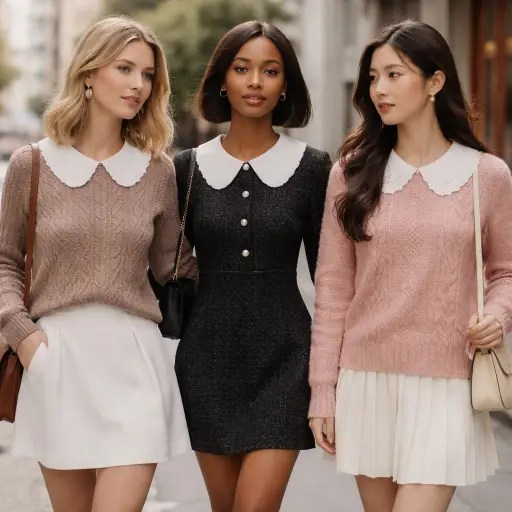
A nostalgic neckline steps back into the spotlight, reshaped for modern wardrobes in early 2026.
In the opening weeks of the year, fashion’s mood has been unmistakably expressive. After seasons dominated by minimal silhouettes and quiet luxury, 2026 is revealing a renewed appetite for detail—and few elements capture this shift as clearly as the Peter Pan collar. Once associated with school uniforms and mid-century innocence, the rounded neckline is now reappearing across collections, social feeds, and city streets, reframed as a symbol of playful elegance rather than nostalgia alone.
The resurgence is not about costume or retro excess. Instead, designers are treating the Peter Pan collar as a precise styling tool, capable of softening sharp tailoring or adding contrast to otherwise understated looks. In knitwear, it often peeks out from beneath layered sweaters, offering a gentle curve against structured wool or cashmere. In dresses, it provides a focal point that draws attention upward, balancing clean lines with a sense of approachability.
What makes the trend particularly relevant right now is its versatility. The collars appearing this season are not uniform in scale or fabric. Some are crisp and architectural, cut in cotton poplin or recycled technical blends. Others are fluid, rendered in silk or sheer organza, lending movement and lightness. This diversity allows the detail to move easily between day and evening, work and leisure, tradition and experimentation.
Street style has played a significant role in accelerating the trend. Influencers and editors have embraced the collar as a way to personalize otherwise classic outfits. A simple monochrome dress gains character with a rounded white neckline. A chunky knit layered over a collared blouse becomes a study in proportion and texture. These combinations feel intentional yet effortless, aligning with a broader cultural desire for clothes that communicate personality without excess.
The timing of the revival is also telling. As winter slowly gives way to thoughts of transitional dressing, the Peter Pan collar offers a visual lightness that hints at renewal. It frames the face, softens heavy fabrics, and introduces contrast at a moment when wardrobes begin to shift. In this sense, the trend feels attuned to the emotional rhythm of the season, offering comfort and optimism in equal measure.
Beyond aesthetics, the collar’s return reflects a deeper change in how fashion is being consumed. Shoppers are increasingly drawn to pieces that feel expressive and distinctive, even when built on familiar foundations. Rather than chasing entirely new silhouettes, many are rediscovering the power of small details to transform what they already own. A detachable collar, for instance, can refresh a dress or sweater, extending its life and relevance.
Sustainability conversations have quietly influenced this approach. By emphasizing modular and adaptable elements, designers encourage longer use cycles and creative restyling. The Peter Pan collar fits neatly into this philosophy: it is decorative yet functional, subtle yet impactful. Its presence suggests care and intention, qualities that resonate with a more considered approach to fashion.
Critically, the 2026 interpretation avoids sentimentality. While the name evokes childhood, the styling is decidedly grown-up. Collars are paired with sharp boots, tailored coats, and modern accessories. The result is a look that acknowledges the past without being confined by it, blending softness with confidence.
As fashion continues to move toward individuality and emotional resonance, the Peter Pan collar stands out as more than a fleeting detail. It represents a willingness to embrace charm, nuance, and craft in everyday dressing. In early 2026, that quiet curve at the neckline feels like a small but meaningful statement—proof that even the most familiar elements can be reimagined for the present moment.



 The Tower Post