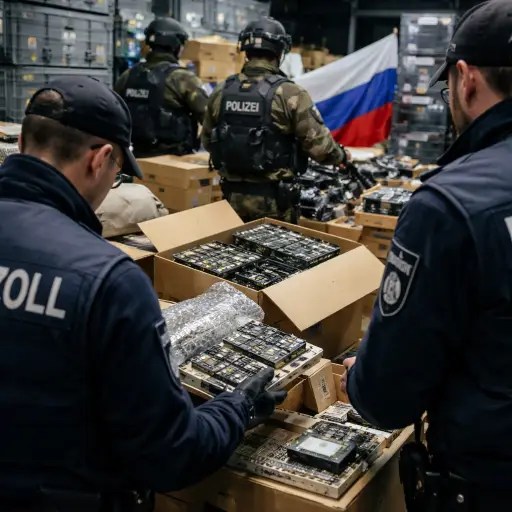
A sprawling covert network allegedly funneled European technology to Russia’s arms industry, spotlighting Europe’s intensifying battle to enforce wartime embargoes.
Germany has carried out a major enforcement action against what investigators describe as one of the most sophisticated sanctions-evasion networks uncovered since the start of the war in Ukraine. Federal prosecutors confirmed that five individuals were arrested on suspicion of illegally exporting sensitive European technology to Russian defense manufacturers, in direct violation of European Union sanctions.
The arrests followed a lengthy, multi-agency investigation involving customs authorities, financial crime units, and intelligence services. According to officials familiar with the case, the suspects are accused of orchestrating a complex web of front companies, falsified end-user certificates, and indirect shipping routes designed to conceal the final destination of the goods.
At the heart of the allegations is a steady flow of advanced components—some with both civilian and military applications—that prosecutors say ultimately strengthened Russia’s weapons production capabilities. Investigators estimate that the network generated more than €30 million in illicit shipments, supplying at least two dozen Russian firms linked to the country’s defense and aerospace sectors.
German authorities describe the operation as a textbook example of how sanctions can be undermined without constant vigilance. Rather than shipping goods directly to Russia, the suspects allegedly routed products through intermediary countries, exploiting regulatory gaps and overburdened customs systems. Paperwork was manipulated to suggest civilian uses or benign destinations, while payments were laundered through layered financial structures across several jurisdictions.
“This case shows how adaptive and well-financed these networks have become,” a senior German official said. “They operate in the shadows of legal trade, deliberately blurring the line between civilian and military technology.”
Since the outbreak of the war in Ukraine, the European Union has imposed sweeping export controls aimed at depriving Russia of critical components needed for weapons systems, drones, and advanced electronics. While these measures have significantly disrupted Russian supply chains, Western officials acknowledge that enforcement is a constant race against increasingly creative circumvention tactics.
The German investigation reportedly uncovered evidence that some of the smuggled technology ended up in facilities producing missile guidance systems, armored vehicles, and communications equipment for the Russian military. Prosecutors are also examining whether additional actors—both inside and outside the EU—played supporting roles in logistics, financing, or regulatory cover.
The arrests come amid a broader tightening of Europe’s sanctions regime. Several EU member states have recently expanded customs screening powers, increased penalties for export violations, and stepped up cooperation with allies to track suspicious trade flows. Germany, as one of Europe’s largest exporters, has been under particular pressure to ensure that its industrial output does not indirectly fuel Russia’s war effort.
Security analysts say the case underscores the limits of sanctions when enforcement mechanisms lag behind globalized trade. “Dual-use technology is especially hard to control,” said a European defense expert. “Many of these components are essential for modern industry, but they can also be repurposed for military systems with minimal modification.”
For Berlin, the arrests carry both legal and political weight. Domestically, they demonstrate a willingness to pursue complex, resource-intensive cases that go beyond symbolic enforcement. Internationally, they send a signal to allies that Germany is serious about closing loopholes that could weaken the collective pressure on Moscow.
The suspects now face charges related to sanctions violations, illegal exports, and participation in an organized criminal enterprise. If convicted, they could receive lengthy prison sentences and substantial financial penalties. Authorities have also moved to seize assets believed to be linked to the alleged smuggling operation.
As the war in Ukraine grinds on, European officials warn that similar cases are likely to emerge. Each investigation, they say, reveals new methods and new vulnerabilities. The challenge, according to prosecutors, is not only punishing past violations but staying ahead of the next attempt to quietly reroute technology from Europe’s factories to Russia’s battlefields.


 The Tower Post