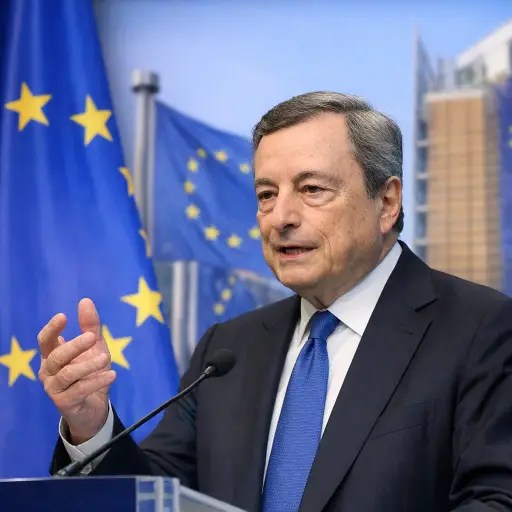
Warning that the old global order has collapsed, the former ECB president argues that only deeper political, military, and industrial integration can preserve Europe’s power and unity.
Europe stands at a historic crossroads, and hesitation, Mario Draghi argues, is no longer a viable option.
Speaking in early February, the former Italian prime minister and long-serving president of the European Central Bank delivered one of his starkest assessments yet of the European Union’s future. The EU, he said, must evolve from what is effectively a loose confederation into a genuine federation if it hopes to remain influential in an increasingly fragmented and confrontational world.
“The traditional global order is over,” Draghi warned, describing an international system no longer governed by shared rules, predictable alliances, or multilateral guarantees. In this new environment, power is exercised through scale, speed, and strategic coherence—qualities Europe risks lacking unless it decisively deepens its integration.
Draghi’s message was not framed as an abstract federalist ideal. Instead, it was a practical diagnosis of Europe’s diminishing leverage. In a world shaped by geopolitical rivalry, technological competition, and industrial policy, he argued, the European Union can no longer afford fragmentation in areas that define sovereignty itself: defence, foreign policy, and strategic industry.
A WORLD THAT NO LONGER WAITS FOR EUROPE
For decades, Europe benefited from a relatively stable international framework anchored by transatlantic cooperation and global trade rules. That framework, Draghi said, has now collapsed under the pressure of great-power competition, regional conflicts, and economic nationalism.
In this environment, individual European states—no matter how large—are simply too small to defend their interests alone. Draghi cautioned that without collective power, Europe risks becoming a passive arena where others set the rules, control supply chains, and dictate security outcomes.
“The danger,” he implied, “is not irrelevance alone, but subordination.”
This vulnerability is already visible. Europe depends heavily on external actors for energy, advanced technologies, raw materials, and defence capabilities. While member states continue to debate institutional reforms, global competitors move quickly, aligning industrial policy with national security and projecting power through unified strategies.
SOVEREIGNTY SHARED IS SOVEREIGNTY STRENGTHENED
One of Draghi’s central arguments is rooted in the EU’s own history. Where Europe has chosen to pool sovereignty, it has gained influence and respect. The single market transformed the continent into a global trading power. The euro, despite its imperfections, elevated Europe’s monetary weight on the world stage.
“Where Europe speaks with one voice, it is listened to,” Draghi observed. “Where it is divided, it is ignored.”
By contrast, areas still governed primarily by national decision-making—such as defence procurement, foreign policy positions, and industrial strategy—remain fragmented, slow, and often ineffective. This division, Draghi warned, undermines Europe’s strategic autonomy and weakens its credibility with both allies and rivals.
The solution, in his view, is not the erosion of national identities, but their protection through collective strength. A federal Europe, he suggested, would allow member states to retain their democratic traditions while exercising real power together on the global stage.
DEFENCE, DIPLOMACY, AND INDUSTRY: THE FEDERAL TEST
Draghi identified three domains where Europe’s future will be decided.
First, defence. Europe’s military capabilities remain scattered across national armies, overlapping systems, and uncoordinated spending. Without a shared defence framework, he argued, Europe cannot guarantee its own security or contribute meaningfully to global stability.
Second, foreign policy. The requirement for unanimity on key decisions continues to paralyze European diplomacy. Draghi warned that a continent unable to respond quickly and coherently to crises invites external pressure and internal division.
Third, industry and technology. In a world where economic power is increasingly shaped by state-backed industrial strategies, Europe’s reliance on fragmented national approaches leaves it exposed. From semiconductors to clean energy and artificial intelligence, Draghi argued that Europe must act at continental scale or risk permanent dependence.
Together, these challenges form what he described as a single political question: whether Europe is willing to act as a federation in practice, not just in rhetoric.
THE COST OF INACTION
Draghi was blunt about the consequences of delay. Without deeper integration, he warned, Europe will face a slow erosion of influence, growing internal tensions, and increasing vulnerability to external shocks.
Fragmentation, he said, does not preserve freedom—it dilutes it. Competing national strategies weaken bargaining power, raise costs, and create divisions that external actors are quick to exploit.
The risk is not a dramatic collapse, but a gradual marginalization: a Europe that remains prosperous yet politically weak, economically dependent, and strategically divided.
A POLITICAL MOMENT THAT MAY NOT RETURN
Draghi’s intervention comes at a time of mounting pressure on European leaders to clarify the EU’s long-term direction. Citizens face economic uncertainty, security concerns, and a growing sense that decisions affecting their lives are made elsewhere.
Whether Europe seizes this moment remains uncertain. Federal integration has long been politically sensitive, constrained by national interests and public skepticism. Yet Draghi suggested that reality itself is now forcing the issue.
“The choice,” he implied, “is no longer between more Europe or less Europe, but between shaping our future or having it shaped for us.”
In Draghi’s view, the European Union was never meant to be static. It was designed to evolve in response to history. Today, history is moving fast—and Europe, he concluded, must decide whether it is ready to move with it.
 The Tower Post