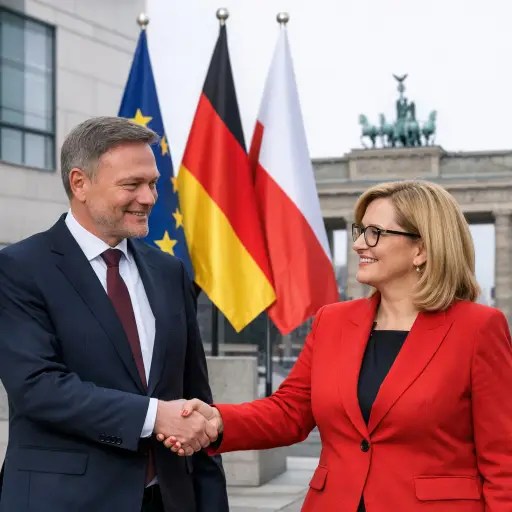
Warsaw and Berlin signal a renewed partnership to strengthen EU competitiveness as global pressures mount.
In early February, Europe’s two central economic pillars, Poland and Germany, moved to project a sense of renewed momentum at a time when the continent’s growth outlook remains fragile. Speaking with a shared urgency shaped by slowing global demand, intensifying competition from major powers, and persistent geopolitical uncertainty, the finance ministers of the two countries pledged closer cooperation to help steer Europe toward economic recovery.
Their message was clear: Europe cannot afford fragmentation or complacency. With industrial policy, fiscal coordination, and regulatory reform once again at the center of political debate, Berlin and Warsaw are positioning themselves as joint advocates of a more competitive, resilient European Union.
For Germany, the initiative comes at a delicate moment. Long regarded as Europe’s economic engine, the country has faced structural challenges ranging from energy costs and industrial transition to weakening export demand. Poland, by contrast, has emerged over recent years as one of the EU’s fastest-growing large economies, benefiting from investment inflows, a strong manufacturing base, and its strategic position on the Union’s eastern flank.
The convergence of interests between the two neighbors reflects a broader realization: Europe’s economic revival will depend not only on national reforms but on coordinated action at the EU level.
At the heart of the discussions was a shared call to streamline EU regulations. Both ministers argued that while common rules remain essential to protect consumers, workers, and the environment, excessive complexity now risks stifling innovation and deterring investment. In their view, European businesses face an uneven playing field when competing with firms from the United States and China, where regulatory frameworks are often more flexible and state support more direct.
The officials emphasized that regulatory simplification should not mean deregulation at any cost. Instead, they framed it as a targeted effort to remove redundancies, accelerate approval processes, and make it easier for companies—especially small and medium-sized enterprises—to scale across borders. Faster permitting for infrastructure and energy projects, they suggested, would be a tangible first step toward restoring confidence.
Competitiveness was another recurring theme. Poland and Germany both see industrial strength as a cornerstone of Europe’s strategic autonomy, particularly in sectors such as automotive manufacturing, green technologies, digital services, and defense-related industries. As global supply chains continue to realign under the pressure of geopolitical tensions, the two countries argue that Europe must secure its own production capacities without retreating into protectionism.
The ministers highlighted the importance of investment in innovation, skills, and cross-border infrastructure. From modern rail links and logistics corridors to shared energy grids and digital networks, they portrayed economic revival as inseparable from physical and technological connectivity within the Union.
Beyond economic policy, the talks carried a strong political undertone. Both officials underscored the need for stronger EU unity in the face of external economic pressure. The United States, with its expansive industrial subsidies and assertive trade policy, and China, with its scale, state-backed industries, and growing technological reach, were repeatedly cited as benchmarks Europe must respond to collectively.
Rather than framing these challenges as threats alone, the ministers presented them as a catalyst for reform. Europe, they argued, still possesses immense strengths: a vast single market, a highly skilled workforce, and global standards-setting power. What is required now is faster decision-making and a clearer sense of shared purpose.
For Poland, alignment with Germany on economic priorities also signals a desire to play a more prominent role in shaping EU policy. As one of the Union’s largest member states by population, Poland has increasingly sought to translate its economic growth into political influence, particularly on issues related to competitiveness, security, and eastern neighborhood stability.
Germany, meanwhile, appears keen to rebuild trust and partnerships across the EU after years marked by crises and internal divisions. Cooperation with Poland carries symbolic weight, bridging western and eastern perspectives within the Union and reinforcing the idea that Europe’s future growth will be broadly shared.
Analysts note that translating political declarations into concrete policy will not be easy. Regulatory reform at the EU level often faces resistance from multiple stakeholders, and fiscal coordination remains a sensitive topic among member states with differing economic philosophies. Nonetheless, the public alignment between Berlin and Warsaw may help create momentum ahead of upcoming European debates on competitiveness and growth.
As Europe enters the year confronting slow growth, strategic uncertainty, and intensifying global rivalry, the joint stance from Poland and Germany offers a cautiously optimistic signal. It suggests that two of the EU’s most influential economies recognize the scale of the challenge—and the necessity of acting together.
Whether this renewed cooperation can deliver tangible results will depend on sustained political will and broader buy-in across the Union. For now, however, the message from early February is unmistakable: Europe’s economic revival, if it is to succeed, must be built on unity, competitiveness, and the courage to reform.
 The Tower Post