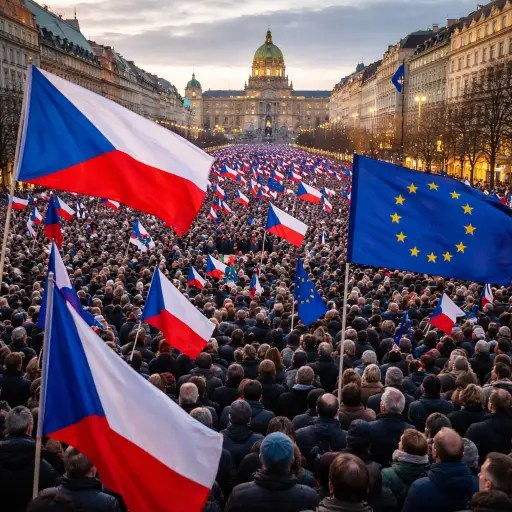
Mass demonstrations back President Petr Pavel, signaling public resistance to an emerging eurosceptic turn in government.
Prague has once again become the stage for a powerful display of civic mobilization, as tens of thousands of people filled the city’s central squares and avenues in a show of support for President Petr Pavel. The demonstrations, peaceful yet unmistakably resolute, reflect a deepening political rift in the Czech Republic, where tensions between the head of state and a newly formed eurosceptic government coalition are rapidly reshaping the national debate.
From early afternoon, crowds converged from across the country, many carrying Czech and European Union flags side by side. Blue and yellow banners in support of Ukraine were also prominent, underscoring a broader message that went beyond domestic politics. For many demonstrators, the rally was not only about a single political dispute, but about the direction of the country itself — its place in Europe, its democratic values, and its stance in a time of regional insecurity.
The immediate trigger for the protests was President Pavel’s refusal to approve a controversial nominee for environment minister. The candidate, put forward by parties within the new governing coalition, has been linked to extremist symbolism in past activities, a connection the president described as incompatible with the constitutional responsibility of a cabinet member. His decision, while welcomed by civil society groups and parts of the opposition, has drawn fierce criticism from government leaders, who accuse the president of overstepping his role.
What might once have remained an institutional dispute has instead ignited a broader confrontation. The government coalition, elected on a platform that emphasized national sovereignty and skepticism toward Brussels, has framed the president’s stance as obstructionist. President Pavel, a former military leader with a strong pro-European profile, has responded by stressing his duty to safeguard democratic standards and international credibility.
On the streets of Prague, that message resonated strongly. Speakers from academic, cultural, and civic organizations addressed the crowd, warning against what they described as a gradual erosion of democratic norms. Applause rippled through the square when references were made to the country’s post-1989 trajectory and the importance of remaining anchored within European institutions.
Many demonstrators expressed concern that the current political trajectory could isolate the Czech Republic at a time when unity within the European Union is seen as critical. The presence of Ukrainian flags was particularly symbolic, reflecting widespread public support for Kyiv and anxiety over any perceived softening of Prague’s foreign policy stance under the new coalition.
The government, for its part, has downplayed the protests, insisting that it retains a democratic mandate and accusing the president’s supporters of exaggerating the implications of the ministerial dispute. Coalition leaders argue that past controversies surrounding the nominee have been misrepresented and that the president’s refusal sets a problematic precedent.
Yet the scale of the rally suggests that the issue has struck a nerve. Analysts note that the demonstrations echo earlier moments in Czech history when public pressure influenced political outcomes, even if indirectly. While no immediate policy shift is expected, the protests have clearly strengthened President Pavel’s moral authority and highlighted the limits of eurosceptic rhetoric in a society that remains broadly pro-European.
As night fell over Prague, the crowd dispersed calmly, leaving behind candles, flags, and a lingering sense of unease about what comes next. The standoff between Prague Castle and the government benches is far from resolved, but one message was unmistakable: a significant portion of the Czech public is prepared to take to the streets to defend a European, democratic vision of the country’s future.


 The Tower Post