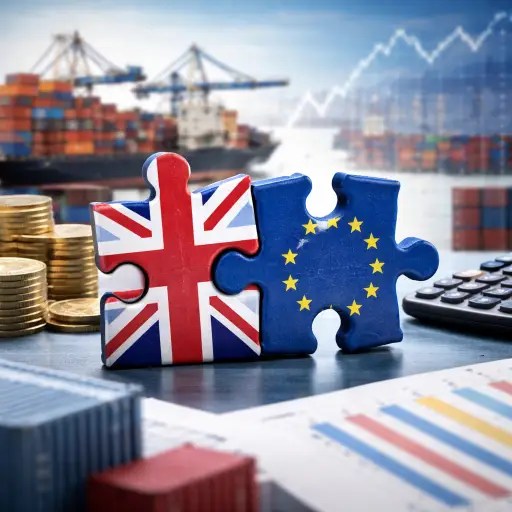
Brussels keeps the door ajar on deeper trade cooperation while Labour debates how far to go in resetting post-Brexit relations
Brussels has signalled a cautious but notable openness to discussing a potential customs union with the United Kingdom, reopening a debate that many assumed was politically frozen after Brexit. A senior EU official said this week that the European Union has an “open mind” about exploring new frameworks for trade and cooperation, should London decide to seek them.
The remarks come at a sensitive moment for both sides. In the EU, policymakers are weighing how to stabilise economic relations with a close neighbour whose regulatory choices continue to affect the bloc’s single market. In the UK, the Labour Party faces growing internal pressure to test the limits of what a post-Brexit reset could realistically achieve, particularly as businesses complain of persistent trade frictions.
While no formal negotiations have been announced, the tone from Brussels marks a subtle shift. EU officials have long insisted that the existing Trade and Cooperation Agreement sets the outer boundary of relations unless the UK is willing to accept clearer alignment with EU rules. The latest comments suggest that, at least in principle, the EU would be prepared to listen if the UK came forward with a more ambitious proposal.
According to EU sources, any discussion of a customs union would be framed as part of a broader conversation on cooperation, not as a quick fix. A customs union would remove tariffs and quotas on goods and reduce checks at the border, but it would also require the UK to align with the EU’s common external tariff, limiting its ability to strike independent trade deals.
For Brussels, the issue is less about ideology than about predictability. EU officials remain wary of a piecemeal approach that eases trade in some sectors while allowing regulatory divergence in others. “The integrity of the single market is non-negotiable,” said one diplomat familiar with the discussions, adding that any deeper partnership would have to include robust governance mechanisms.
In London, the political calculus is complicated. Labour’s leadership has pledged not to rejoin the EU or the single market, and has ruled out freedom of movement. Yet within the party, trade unions and business-facing MPs are increasingly vocal about the economic costs of the current arrangements. They argue that a customs union, or something close to it, could deliver tangible benefits without crossing Labour’s self-imposed red lines.
The pressure is not purely ideological. Exporters in manufacturing, agri-food, and chemicals continue to report delays and higher costs linked to customs paperwork and regulatory checks. Industry groups say that even modest improvements in market access could unlock investment that has been on hold since Brexit.
EU officials point out that a customs union would likely be only one element of a wider package. Formal talks, if they begin, could extend cooperation in areas such as product standards, sanitary and phytosanitary rules, and emissions trading. Alignment in these fields would go a long way toward smoothing trade flows, but would also bind the UK more closely to EU rule-making.
Climate policy is emerging as a particularly important area. The EU’s carbon border adjustment mechanism, which places a levy on imports based on their carbon intensity, has sharpened the incentive for closer coordination. Linking emissions trading systems could help UK exporters avoid additional costs while supporting shared climate goals.
Market access for services, however, remains a harder sell. The EU has consistently argued that meaningful access to its services market requires adherence to common rules and supervision. UK officials privately acknowledge that gains in this area would be limited compared to goods, reinforcing the view that any reset would be incremental rather than transformative.
From Brussels’ perspective, the sequencing matters. EU officials stress that it is up to the UK to define what it wants. “We are open to listening,” the senior official said, “but the initiative has to come from London.” That stance reflects a desire to avoid reopening Brexit debates unless there is a clear political mandate on the UK side.
For Labour, that mandate is still taking shape. Publicly, party leaders emphasise pragmatism and stability, framing closer ties as a way to reduce costs and improve cooperation rather than to reverse Brexit. Privately, the debate is more intense, with some arguing that the party should be bolder in spelling out the trade-offs involved.
Analysts caution that expectations should be managed. Negotiating a customs union would be complex and politically sensitive, requiring concessions on both sides and, in the UK, a willingness to confront the limits of post-Brexit autonomy. Even so, the fact that Brussels is signalling openness suggests that the conversation has moved on from the stalemate of recent years.
As both sides look to the months ahead, the message from the EU is one of conditional engagement. The door is not wide open, but it is no longer firmly shut. Whether the UK chooses to step through may depend less on Brussels’ openness than on London’s readiness to make difficult choices about its economic future.

 The Tower Post