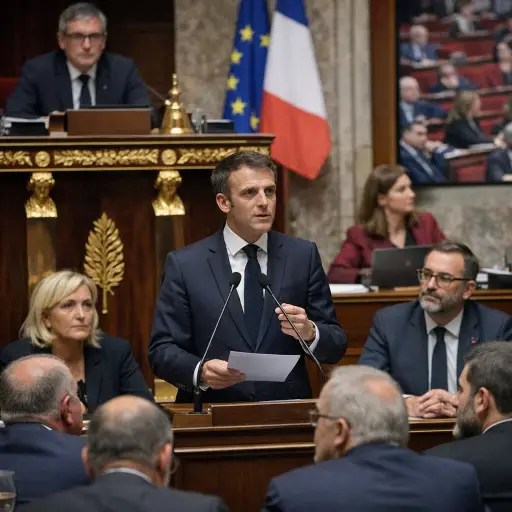
After a winter of brinkmanship and backroom deals, Paris forces through a long-delayed national budget, reshaping defence priorities and setting the tone for an already volatile pre‑election landscape.
France has drawn a line under one of the most destabilising political episodes in recent years, finally adopting a national budget after months of bitter parliamentary infighting. The breakthrough ends a prolonged period of uncertainty that had weighed on financial markets, strained public services, and exposed the fragility of the governing coalition.
The budget’s passage did not come through consensus. Instead, it was pushed through using special constitutional powers, allowing the government to bypass a full parliamentary vote. The move has reignited debate over executive authority in the Fifth Republic and sharpened political divisions that are likely to define the run‑up to the next presidential contest.
For the government, the outcome is being framed as an act of responsibility. Ministers argue that failure to adopt a budget would have risked paralysing the state at a time of international instability and domestic economic pressure. “The country could not afford drift,” a senior official said shortly after the decision, describing the manoeuvre as a constitutional tool used “in the national interest.”
Yet for opponents, the episode has become a symbol of democratic strain. Left‑wing parties accused the executive of governing by force rather than persuasion, while sections of the right warned that repeated recourse to exceptional procedures undermines parliamentary legitimacy. Street protests, though limited in scale, reflected broader public unease with a political system many voters already view as distant and unresponsive.
The roots of the crisis lie in a fragmented National Assembly, where no single bloc commands a stable majority. Since the last legislative elections, governing has depended on ad hoc alliances and tactical compromises, particularly on fiscal matters. The budget, delayed well into the winter, became the focal point of these tensions, with each faction seeking to impose red lines on spending, taxation, and debt.
Defence spending emerged as one of the least negotiable items. Against the backdrop of ongoing conflict on Europe’s eastern flank and rising global instability, the budget require a clear increase in military allocations. Funds are earmarked for equipment modernisation, personnel, and industrial capacity, reinforcing France’s ambition to remain a leading European military power.
Supporters of the defence boost argue that it reflects strategic reality rather than ideological choice. France’s armed forces have been stretched by overseas commitments and the demands of alliance politics. Military leaders have repeatedly warned that without sustained investment, readiness and credibility would suffer. In that sense, the budget signals continuity with recent strategic reviews, even as other areas faced cuts or tighter controls.
Social spending, by contrast, proved far more contentious. Opposition parties sought stronger protections for households grappling with high living costs, while fiscal hawks pressed for restraint to reassure investors and European partners. The final text reflects a delicate balance: modest support measures combined with an insistence on keeping the overall deficit in check.
Economists are divided on whether the compromise will deliver stability. Some welcome the clarity after months of limbo, noting that even an imperfect budget is preferable to none at all. Others caution that the political cost of forcing the bill through may outweigh its economic benefits, especially if it fuels further polarisation.
Beyond the immediate fiscal implications, the episode carries heavy political consequences. By invoking constitutional powers, the executive has effectively acknowledged the limits of its parliamentary base. That admission may embolden opposition forces, who see an opportunity to campaign on themes of democratic renewal and institutional reform.
The far right has been particularly quick to capitalise, portraying the crisis as evidence of a system that no longer works for ordinary citizens. On the left, calls have intensified for changes to budgetary procedures and a stronger role for Parliament. Even within the governing camp, some lawmakers privately express discomfort with a strategy that relies on procedural muscle rather than political persuasion.
Public opinion remains fluid. Surveys suggest widespread frustration with political elites, but also a desire for stability after years marked by protests, pandemic fallout, and international shocks. The budget’s adoption may calm immediate anxieties, yet it does little to resolve deeper questions about how France is governed in an era of fragmented politics.
As the country looks ahead to the next presidential race, the budget saga is likely to loom large. Candidates across the spectrum are already shaping narratives around authority, accountability, and national priorities. For the incumbent leadership, the challenge will be to argue that decisiveness, even when unpopular, is preferable to paralysis. For their rivals, the task is to convince voters that another way is possible.
For now, the crisis is officially over. Ministries can plan, contracts can be signed, and France can present a united fiscal front to its partners. But the scars of the standoff remain visible, a reminder that while the budget has been passed, the underlying political reckoning is only just beginning.


 The Tower Post