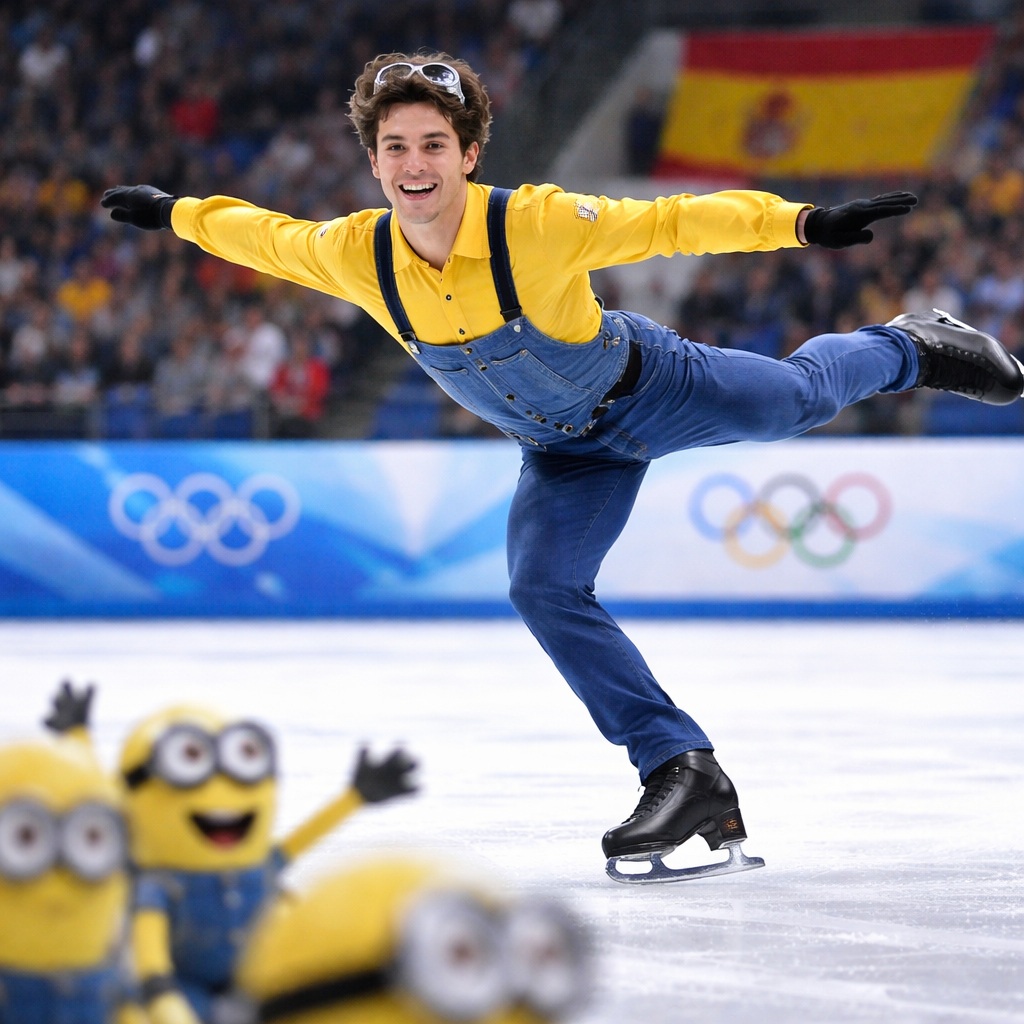
Tomàs-Llorenç Guarino Sabaté keeps his Minions-inspired Olympic routine intact after Universal Studios grants last-minute permission, resolving a rare artistic dispute on the eve of the Games.
In the high-pressure world of Olympic preparation, athletes expect to battle nerves, injuries, and rivals from across the globe. Few anticipate a legal hurdle threatening to unravel years of creative work just days before the world’s biggest winter sporting event. Yet that was the unexpected challenge facing Spanish figure skater Tomàs-Llorenç Guarino Sabaté as the Winter Olympics in northern Italy approached.
Guarino Sabaté, one of Spain’s most recognizable figures on the ice, found himself at the center of an unusual copyright dispute involving the music chosen for his free skating program. His routine, built around the playful and cinematic soundscape associated with the Minions franchise, had become a signature of his season. The choreography blended technical precision with humor and character, a combination designed to stand out in a discipline often dominated by dramatic classical scores.
As Olympic accreditation deadlines and final rehearsals loomed, questions emerged over whether the music could be used on the Games’ global stage. Olympic performances are not just athletic displays; they are broadcast worldwide, archived, replayed, and monetized in multiple forms. This elevates music licensing from a formality to a legal necessity, and the absence of explicit permission can force athletes into last-minute changes.
For Guarino Sabaté, the stakes could not have been higher. Altering a program so close to competition is widely regarded as a nightmare scenario in figure skating. Music dictates timing, rhythm, and emotional cues; changing it requires reworking choreography, jump entries, and even costume details. Coaches often say that a skater “learns” a program in their muscles, and any sudden shift risks disrupting that finely tuned memory.
The uncertainty triggered concern not only within the Spanish delegation but also among fans who had followed Guarino Sabaté’s journey throughout the season. Clips of his Minions-inspired routine had circulated widely on social media, drawing praise for its originality and accessibility. Supporters feared that a bureaucratic obstacle could strip the Olympics of one of its more joyful performances.
Public backing quickly gathered momentum. Fans, commentators, and fellow athletes highlighted the broader issue at stake: the growing tension between artistic expression in sport and the increasingly complex world of intellectual property rights. Figure skating, with its reliance on music, costumes, and storytelling, sits squarely at that intersection.
Behind the scenes, negotiations intensified. Representatives worked to secure the necessary authorization from Universal Studios, the rights holder associated with the Minions music. While such permissions are often handled quietly and well in advance, the proximity to the Games added urgency and visibility to the process.
Ultimately, the dispute reached a positive resolution. Universal Studios granted permission for the music to be used, allowing Guarino Sabaté to retain his original program without modification. The decision was welcomed as a pragmatic and athlete-centered outcome, preserving months of preparation and avoiding a disruption that could have affected competitive fairness.
For Guarino Sabaté, the clearance brought palpable relief. In statements shared through the Spanish team, he emphasized gratitude toward supporters and a renewed focus on performance rather than paperwork. Training sessions that followed were marked by a return to normalcy, with attention redirected to refining jumps, spins, and presentation rather than contingency plans.
The episode has sparked wider discussion within the skating community. As athletes increasingly seek distinctive themes drawn from popular culture, questions arise about how licensing frameworks can adapt to the realities of modern sport. The Olympics, in particular, present unique challenges due to their scale and visibility.
Experts note that while copyright law aims to protect creators, rigid application can sometimes clash with the spirit of international competition. Unlike commercial productions, Olympic routines are short, transformative, and deeply personal expressions. Yet they exist within a broadcast ecosystem that demands legal clarity.
The timing of the resolution is also significant. With the Milano Cortina Winter Games about to open, athletes are entering the final psychological phase of preparation. Stability and routine are prized commodities at this stage, and any uncertainty can ripple through performance.
Guarino Sabaté’s case may prompt federations and organizing bodies to revisit how music rights are handled, encouraging earlier coordination with rights holders and clearer guidance for athletes. It also underscores the importance of communication between sport and the entertainment industry, two fields that increasingly overlap on the Olympic stage.
For audiences, the outcome means they will witness the program as it was intended: a technically demanding routine infused with lightness and humor. In a sport where margins are razor-thin, that authenticity can be as crucial as any quad jump.
As the Olympic flame prepares to be lit in Italy, the Spanish skater’s experience serves as a reminder that modern athletes navigate far more than physical challenges. They operate within legal, cultural, and commercial frameworks that can shape their path in unexpected ways.
In the end, the clearing of a copyright snag may seem minor compared to the quest for medals. But for Tomàs-Llorenç Guarino Sabaté, it represents the preservation of creative identity at the moment it matters most. When he steps onto the ice, the music will play as planned, and the focus can return to what the Olympics are meant to celebrate: performance, expression, and the pursuit of excellence.



 The Tower Post