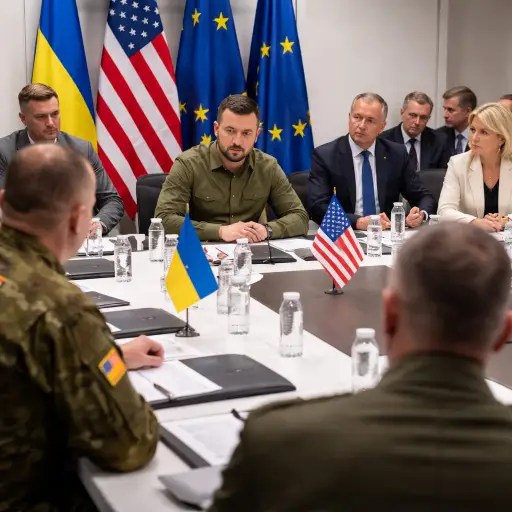
Kyiv and its Western partners outline a graduated response framework to deter violations, blending diplomacy, military readiness, and coalition pressure as talks aimed at ending the war continue.
Ukraine and its European and U.S. allies have agreed on a multi-tiered framework designed to enforce any future cease-fire with Russia, signaling a shift from purely declarative diplomacy toward a more structured system of deterrence and response.
According to officials briefed on the agreement, the plan establishes a layered enforcement mechanism that would come into effect immediately after a cease-fire is declared. It combines diplomatic warnings, military preparedness, and coordinated coalition measures intended to respond quickly to violations and prevent a return to large-scale hostilities.
The agreement reflects growing concern among Kyiv and its partners that any pause in fighting could be exploited without credible enforcement. Previous cease-fire efforts during the conflict have repeatedly collapsed amid mutual accusations of violations, often without clear mechanisms to hold parties accountable.
Under the framework, any alleged breach would first trigger a rapid verification process involving Ukraine and its Western partners. If violations are confirmed, the plan предусматриes an initial diplomatic response, including a formal warning delivered within a 24-hour window through agreed international channels.
Officials say this early diplomatic step is designed to provide an opportunity for de-escalation while establishing a clear record of non-compliance. If violations persist or escalate beyond isolated incidents, the framework allows for graduated responses, including enhanced military support to Ukraine and coordinated actions by allied forces.
While details remain classified, Western officials emphasized that the plan does not automatically mandate direct military intervention. Instead, it sets out a spectrum of options, ranging from increased air defense deployments and intelligence sharing to broader coalition measures intended to restore deterrence.
“The objective is to remove ambiguity,” said a European diplomat familiar with the discussions. “A cease-fire cannot rely on goodwill alone. There must be a shared understanding of consequences if commitments are broken.”
For Kyiv, the agreement represents an effort to balance its desire for a sustainable halt to fighting with deep skepticism about Russian intentions. Ukrainian officials have repeatedly warned that cease-fire proposals without enforcement risk freezing the conflict on unfavorable terms while allowing Russia time to regroup.
The multi-tier approach also reflects lessons learned by Western governments over the course of the war. Early in the conflict, enforcement options were often discussed only after violations occurred, leading to delays and disagreements among allies. By pre-agreeing on a response framework, officials hope to act more swiftly and cohesively.
The plan was developed through intensive consultations involving Ukraine, key European capitals, and Washington. Defense and foreign policy officials worked in parallel to align military planning with diplomatic messaging, aiming to ensure that responses at each stage reinforce one another rather than escalate unintentionally.
In parallel with the enforcement agreement, diplomatic efforts to end the war are continuing. Talks involving representatives from Kyiv, Moscow, and Washington are set to resume in Abu Dhabi, a venue chosen for its relative neutrality and its growing role as a hub for international mediation.
While expectations for a comprehensive breakthrough remain cautious, officials say the discussions are increasingly focused on practical mechanisms rather than broad political declarations. The cease-fire enforcement framework is seen as one such mechanism, intended to support negotiations by increasing confidence that any agreement will be respected.
Russian officials have not publicly commented on the details of the plan, but analysts say Moscow is likely to view it with suspicion. Some Russian commentators have previously argued that Western involvement in enforcement undermines neutrality, while Western governments counter that enforcement is necessary precisely because past agreements lacked credibility.
Security experts note that the inclusion of potential military responses marks a significant evolution in cease-fire thinking. Rather than treating enforcement as a post-agreement issue, the framework embeds deterrence into the cease-fire itself.
“This is about shaping behavior,” said a defense analyst based in Brussels. “If violations carry predictable and coordinated consequences, the incentive to test the cease-fire diminishes.”
The agreement also underscores the enduring role of the United States in European security, even as European governments take on greater responsibility for military assistance to Ukraine. U.S. officials have framed the plan as a collective effort, emphasizing alliance unity and shared decision-making.
For European leaders, the framework offers a way to reconcile domestic pressure for diplomacy with continued support for Ukraine. By presenting a cease-fire as enforceable rather than symbolic, they hope to address concerns that negotiations could come at the expense of Ukrainian security.
Despite the progress, officials caution that the plan is not a guarantee of peace. Enforcement depends on political will, reliable intelligence, and sustained coordination among allies—factors that can be strained during prolonged crises.
Still, supporters argue that the framework represents a step toward a more credible cease-fire process. As negotiations continue in Abu Dhabi, the existence of an agreed enforcement plan may help narrow gaps between rhetoric and reality.
Whether it ultimately leads to a durable halt in fighting remains uncertain. But for Ukraine and its partners, the message is clear: any cease-fire must be backed not only by words, but by a shared readiness to act if those words are ignored.



 The Tower Post