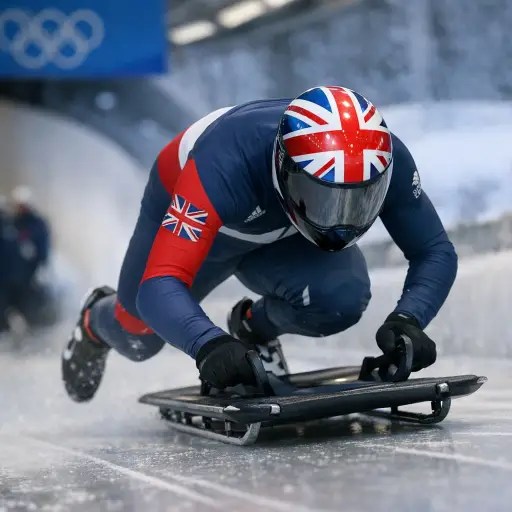
British officials challenge an equipment decision weeks before the Winter Olympics, warning of safety and competitive implications.
British skeleton racing has been thrust into a legal and sporting confrontation after officials confirmed an appeal to the Court of Arbitration for Sport (CAS) over a ban on a newly developed helmet design, a decision that could reverberate through the Olympic Winter Games later this month.
At the centre of the dispute is a helmet developed through a collaboration between British Skeleton, engineers and athlete representatives, aimed at improving head protection while maintaining aerodynamic efficiency in one of the fastest and most unforgiving sports on ice. The sport’s international governing body ruled the design illegal during pre-Games equipment inspections, arguing that elements of its shape and surface treatment went beyond existing technical regulations.
British officials dispute that interpretation, insisting the helmet complies with both the letter and spirit of the rules. They argue the ban not only undermines months of sanctioned development work, but also risks setting a precedent that discourages safety-led innovation across sliding sports.
“This is not about gaining an unfair advantage,” one senior figure close to the appeal said. “It is about protecting athletes in a discipline where margins are measured in hundredths of a second and where crashes can have life‑changing consequences.”
Skeleton athletes reach speeds exceeding 130 kilometres per hour, travelling head‑first down narrow ice tracks lined with concrete and steel. Helmets are among the few pieces of protective equipment available, and incremental improvements in shock absorption, stability and visibility are viewed by teams as essential rather than optional.
The governing body’s ruling, however, focused on concerns that the helmet’s external profile could influence airflow in a way that confers a performance benefit. Regulations in skeleton, as in other sliding sports, are designed to preserve parity by tightly controlling equipment dimensions and materials. Any deviation, officials say, risks turning competition into an arms race driven by technology rather than athletic skill.
British Skeleton counters that the helmet was tested openly, submitted for review, and never flagged as non‑compliant until athletes were deep into final Olympic preparations. The timing of the ban has intensified frustration within the British camp, with some athletes forced to revert to older models during crucial training runs.
For competitors, the issue is as much psychological as physical. “Changing helmets this late affects confidence,” said one British athlete, speaking on condition of anonymity. “You spend years trusting a piece of equipment. Being told days before the Games that you can’t use it is hugely disruptive.”
The appeal to CAS seeks an expedited ruling, reflecting the compressed Olympic timeline. Legal experts say such cases are not uncommon before major events, but outcomes are far from predictable. CAS panels tend to balance strict regulatory interpretation with principles of fairness, athlete welfare and consistency of governance.
Beyond Britain’s immediate medal prospects, the case has sparked broader debate within the winter sports community. Several teams are watching closely, aware that the decision could clarify how far innovation is permitted under current rules, particularly when safety enhancements intersect with performance considerations.
As the Milano Cortina Winter Games approach, British athletes continue to train amid uncertainty, preparing contingency plans should the appeal fail. Officials insist they will respect any final ruling, but remain adamant that the issue needed to be challenged.
“The Olympics are meant to showcase the best of sport,” the British official said. “That includes a commitment to athlete safety and to fair, transparent regulation. We believe this appeal is necessary to uphold both.”
With competition days looming, the CAS decision is expected to arrive swiftly. Whatever the outcome, the case has already highlighted the fragile balance between innovation, regulation and athlete welfare at the very highest level of winter sport.




 The Tower Post