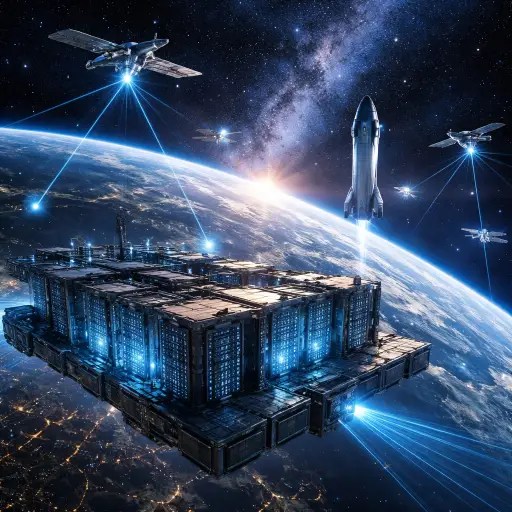
By blending SpaceX’s orbital muscle with xAI’s artificial intelligence ambitions, Elon Musk is testing whether the future of cloud computing might orbit the Earth rather than sit on it.
In recent weeks, a bold idea has begun circulating through Silicon Valley and the aerospace world alike: what if the next generation of data centers didn’t live on land at all? Instead, they could orbit the planet, powered by solar energy, cooled by the vacuum of space, and connected by a web of satellites. At the center of this idea is Elon Musk, whose latest strategic move signals a convergence between rocket science and artificial intelligence that could reshape how data is processed, stored, and moved around the world.
The initiative, still emerging but already sparking intense debate, brings together the launch, satellite, and orbital infrastructure of SpaceX with the fast-growing AI research and deployment goals of xAI. The vision is nothing less than to extend cloud computing beyond Earth’s surface, creating data centers in orbit that serve both terrestrial users and future off-world missions.
For Musk, the logic is straightforward. Artificial intelligence is becoming ravenously hungry for computing power, electricity, and connectivity. Traditional data centers, clustered in industrial parks and cooled by water-hungry systems, are increasingly constrained by energy grids, land availability, and environmental concerns. Space, by contrast, offers near-limitless solar energy, natural cooling, and a strategic vantage point for global networking.
The idea hinges on satellites not just as relays, but as active nodes of computation. SpaceX’s experience with large-scale satellite constellations provides a foundation: thousands of interconnected units already circle the planet, demonstrating that orbital infrastructure can be deployed rapidly and operated at scale. Integrating AI processing into such a network would allow data to be handled closer to where it is collected, reducing latency for certain applications and easing pressure on ground-based facilities.
Supporters argue that orbital data centers could be particularly valuable for AI workloads that demand massive parallel processing. Training large models, running simulations, or managing global sensor networks could all benefit from distributed computing in space. In this scenario, Earth-based data centers would not disappear, but they would be complemented by an off-world layer of infrastructure—an orbital extension of the cloud.
There are also geopolitical and strategic implications. Data centers in orbit would not be bound by national borders in the traditional sense, potentially complicating questions of regulation, jurisdiction, and data sovereignty. For governments and corporations alike, access to space-based computing could become a new axis of competition, much as access to energy or rare materials has been in the past.
Critics, however, warn that the technical and economic hurdles are enormous. Launching hardware into orbit remains expensive, even with reusable rockets. Maintaining, upgrading, or repairing space-based servers poses challenges far beyond those faced by terrestrial facilities. There are also concerns about space debris, orbital congestion, and the long-term sustainability of placing ever more infrastructure above the planet.
Environmental questions cut both ways. While orbital data centers could reduce the land and water footprint of computing on Earth, they would increase launch activity and contribute to the growing problem of cluttered orbits. Balancing these trade-offs would require new standards, international cooperation, and careful engineering.
Still, Musk has built a reputation on pursuing ideas that initially seemed impractical, only to push them into the mainstream through relentless iteration. Electric vehicles, reusable rockets, and large-scale satellite networks all faced skepticism before gaining traction. The proposed merger of space infrastructure and AI computing fits squarely within this pattern: audacious, controversial, and potentially transformative.
For xAI, access to dedicated, scalable computing resources could be a decisive advantage in the intensifying race to develop more powerful and efficient artificial intelligence systems. For SpaceX, expanding beyond launches and connectivity into orbital computing would open a new revenue stream and deepen its role as a backbone of global digital infrastructure.
If successful, the effort could redefine what “the cloud” means. Instead of a metaphor for distant servers hidden in warehouses, it could become a literal layer of machines circling the planet, quietly processing data as they move across the sky. In the longer term, such systems could support lunar bases, Mars missions, and other interplanetary endeavors, creating a unified data network that spans worlds.
Whether Musk’s mega-merger vision ultimately proves viable remains an open question. But by pushing the conversation beyond Earth-bound assumptions, it forces technologists, policymakers, and investors to rethink the physical limits of the digital age. The future of data, it seems, may be written not just in code, but in orbit.




 The Tower Post