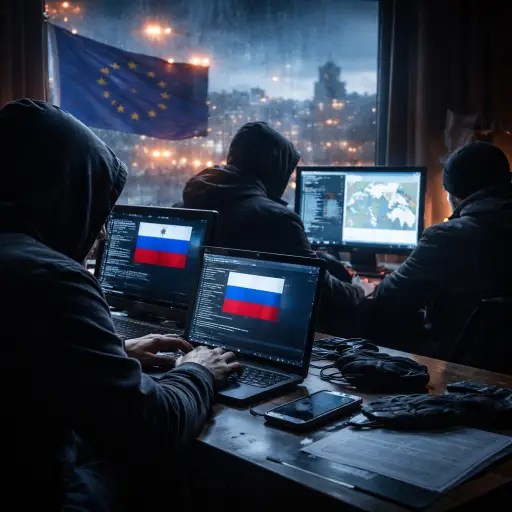
A new report details how Russian military intelligence has quietly enlisted young Europeans—often without their full awareness—to carry out acts of sabotage, arson, and vandalism across the continent, aiming to erode Western cohesion from within.
An investigative report circulating among European security services has lifted the veil on a shadow campaign unfolding across the continent. According to the findings, Russian military intelligence has been systematically recruiting young Europeans as covert operatives, tasking them with acts of sabotage, arson, and vandalism designed to undermine public confidence and weaken the logistical and political support structures backing Ukraine and broader Western security efforts.
The report paints a picture not of seasoned spies operating under false passports, but of students, gig workers, and digitally native young adults—many with no prior criminal records—drawn into destabilising activity through the same online spaces they use for gaming, messaging, and freelance work. In numerous cases, investigators say, the recruits were not initially aware they were acting on behalf of a foreign intelligence service.
At the centre of the strategy is plausible deniability. Rather than deploying trained agents, handlers rely on anonymous online platforms and encrypted messaging services to issue instructions in small, compartmentalised tasks. A vandalised rail cabinet here, a fire set in a warehouse yard there, a smear of paint on a municipal building—each incident minor in isolation, but cumulatively disruptive. The aim, the report argues, is to stretch security resources thin while sowing doubt about the resilience of European infrastructure.
Security officials describe the recruitment process as deceptively mundane. Initial contact often comes in the form of a vague online advertisement or message offering quick cash for “simple jobs” requiring discretion. Tasks are framed as activism, pranks, or freelance errands. Only later, if at all, does the broader context emerge. By then, some recruits are already entangled—having accepted payments, shared personal details, or carried out acts that make withdrawal psychologically or legally difficult.
“What makes this campaign effective is that it exploits everyday digital behaviour,” said one European counterintelligence official familiar with the report. “These are not classic ideological recruits. Many are motivated by money, boredom, or curiosity. Some believe they are acting against corporations or abstract ‘systems,’ not on behalf of a foreign military service.”
The geographic spread outlined in the report is striking. Poland features prominently, with dozens of individuals arrested over the past year in connection with arson attacks, attempted sabotage of transport infrastructure, and coordinated vandalism. Investigators there say several suspects were students or recent graduates who had been contacted online and paid in cryptocurrency.
France and Germany also appear repeatedly in the findings. In France, authorities have linked a series of small but persistent acts of infrastructure vandalism and warehouse fires to online coordination consistent with the methods described in the report. In Germany, security services have quietly investigated incidents involving rail signalling disruptions and attacks on energy-related facilities, some of which now appear connected through shared digital footprints.
While the physical damage from many of these acts has been limited, their symbolic and psychological impact is harder to measure. Rail delays, temporary power outages, and images of burning property circulate rapidly on social media, amplifying a sense of vulnerability. The report suggests this amplification is not accidental: recruits are often encouraged to document their actions, feeding a cycle of visibility and imitation.
A particularly troubling aspect highlighted by investigators is the age profile of many recruits. Teenagers and people in their early twenties are seen as especially susceptible, both because of their digital fluency and their relative lack of experience with state-level manipulation. The report notes cases where individuals believed they were participating in edgy political expression or underground art, only realising the implications after arrests or interrogations.
European governments are now grappling with how to respond. Law enforcement crackdowns have led to arrests, but officials acknowledge that punishment alone will not address the underlying vulnerability. There is growing recognition that public awareness campaigns, digital literacy education, and closer cooperation with online platforms will be necessary to disrupt recruitment pipelines.
At the same time, policymakers face a delicate balance. Overstating the threat risks fuelling panic or inadvertently magnifying the impact of minor incidents. Understating it, however, could leave societies exposed to a form of low-level warfare designed precisely to stay below the threshold of conventional response.
The report concludes with a stark assessment: this is not a temporary tactic, but part of a longer-term effort to normalise instability. By turning ordinary citizens into unwitting tools, the campaign blurs the line between foreign aggression and domestic disorder. For Europe, the challenge is not only to identify and stop individual acts of sabotage, but to recognise the broader strategy at work—and to inoculate its societies against manipulation in an age where a message on a screen can be as potent as any weapon.
As winter gives way to an uncertain spring, security officials warn that vigilance must extend beyond borders and battlefields. The front line, they say, now runs through smartphones, chat rooms, and the everyday digital spaces where the next silent recruit may already be scrolling.



 The Tower Post