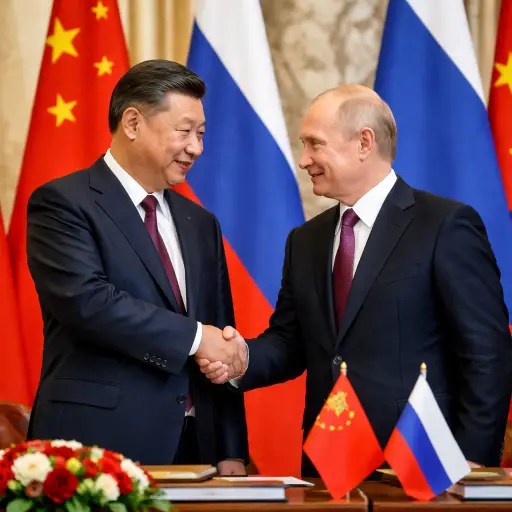
Leaders expand economic and military coordination as geopolitical rivalries intensify and Western influence faces new challenges
China and Russia have moved to reinforce their strategic partnership, with Presidents Xi Jinping and Vladimir Putin holding high-level talks aimed at broadening economic and military collaboration and aligning their approaches to major global conflicts. The meeting underscores a growing convergence between the two powers at a time when Western governments are seeking to persuade Beijing to distance itself from Moscow.
The discussions signal a recalibration of global alliances as international tensions and regional conflicts reshape diplomatic priorities. Both leaders emphasized what they described as a long-term and stable partnership designed to counterbalance Western dominance in political, economic, and security affairs. Their dialogue focused on strengthening bilateral trade, expanding energy cooperation, and enhancing joint military coordination, reflecting an increasingly complex geopolitical environment.
Economic cooperation remains at the core of the partnership. China continues to serve as one of Russia’s most important economic partners, particularly as Moscow faces restrictions and economic pressure from Western countries. Energy supplies form a key pillar of this relationship, with Russia providing large volumes of oil and natural gas to fuel China’s growing industrial and technological sectors. In return, China has expanded exports of consumer goods, machinery, and technological components to Russia, creating a mutually reinforcing trade dynamic.
Financial cooperation between the two countries has also expanded, with both sides promoting transactions in national currencies to reduce reliance on Western financial systems. Analysts view this trend as part of a broader effort to reshape international financial mechanisms and reduce exposure to global sanctions regimes. The increased use of alternative payment structures is seen as a strategic move that could gradually shift global economic practices, especially if adopted by other nations seeking to diversify their financial partnerships.
Military coordination represents another significant dimension of the strengthening partnership. China and Russia have intensified joint exercises, naval patrols, and strategic consultations, demonstrating a shared commitment to enhancing defense capabilities. These operations are widely interpreted as signals of solidarity and deterrence, particularly in regions where both nations have strategic interests. Military analysts note that such exercises serve not only to improve operational compatibility but also to project political unity in response to Western security alliances.
The two leaders also discussed their respective positions on ongoing international conflicts, emphasizing the importance of dialogue and negotiation while criticizing what they perceive as unilateral interventions by Western powers. Although Beijing has sought to present itself as a neutral actor in global disputes, its continued engagement with Moscow has attracted scrutiny from European governments and North American allies. Western leaders have urged China to limit support for Russia, arguing that Beijing’s cooperation could influence the trajectory of international conflicts and sanctions enforcement.
European nations, in particular, have intensified diplomatic outreach to China, seeking to balance economic ties with strategic concerns. European policymakers recognize China’s central role in global trade and supply chains, yet remain wary of Beijing’s deepening alignment with Moscow. This delicate balancing act reflects Europe’s broader challenge of maintaining economic engagement with China while addressing security risks linked to geopolitical competition.
For China, the partnership with Russia offers strategic advantages beyond economic gains. Moscow provides Beijing with a reliable source of energy and military cooperation, while also reinforcing China’s vision of a multipolar world order. Chinese officials have repeatedly emphasized the need for global governance structures that reflect what they describe as greater fairness and inclusivity, positioning their partnership with Russia as part of this broader diplomatic narrative.
Russia, meanwhile, views its relationship with China as a critical counterweight to Western political and economic pressure. The strengthening ties allow Moscow to diversify its international partnerships and maintain influence in global affairs despite ongoing diplomatic isolation from many Western nations. Russian leaders have portrayed the partnership as evidence that global power structures are evolving toward a more balanced distribution of influence.
Observers note that while the partnership between China and Russia is grounded in shared strategic interests, it is not without complexities. Economic imbalances, differing regional priorities, and historical mistrust remain underlying factors that require careful diplomatic management. Nevertheless, the current trajectory of cooperation suggests that both nations see significant value in maintaining close ties amid shifting global conditions.
The expanding partnership has implications for international institutions and alliances. As China and Russia coordinate their policies more closely, global governance bodies may face increasing polarization. Competing visions of international order, security frameworks, and economic regulation are becoming more pronounced, raising questions about the future of multilateral cooperation.
Experts warn that the strengthening axis between Beijing and Moscow could contribute to a more fragmented global system characterized by competing geopolitical blocs. Such divisions may complicate efforts to address transnational challenges, including climate change, economic stability, and regional security crises. However, supporters of the emerging alignment argue that it reflects a natural evolution toward a more diverse and balanced global power structure.
As global tensions continue to evolve, the China-Russia partnership stands as one of the defining features of contemporary international relations. The outcomes of their cooperation will likely influence diplomatic strategies, economic policies, and security frameworks across multiple regions. While Western governments continue to seek engagement with Beijing, the strengthening ties between China and Russia underscore the growing complexity of the modern geopolitical landscape.
The evolving partnership illustrates how global alliances are being reshaped by economic interests, security concerns, and competing visions of international governance. As world powers adjust their strategies, the relationship between Beijing and Moscow is expected to remain a central factor in determining the future direction of global political dynamics.



 The Tower Post