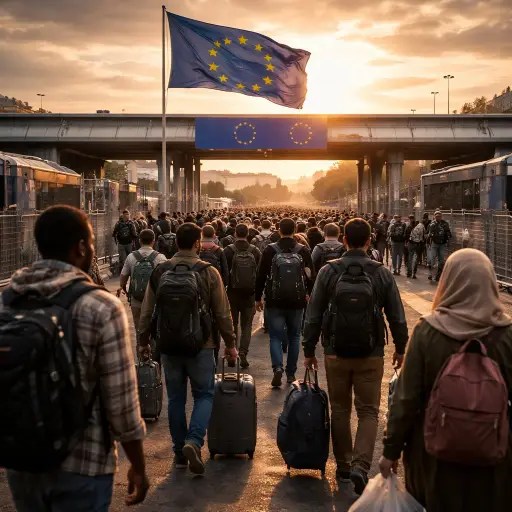
As far-right migration proposals gain traction, European governments face legal dilemmas, political realignment, and renewed electoral pressure
Across Europe, the language and policy ideas surrounding migration are undergoing a notable transformation. Concepts that were once confined largely to far-right political movements are increasingly entering mainstream political discourse, signaling a shift in how migration is debated, regulated, and contested across the continent. Among these ideas, the notion of “remigration” has emerged as one of the most controversial and influential policy frameworks shaping political conversations, electoral strategies, and legislative proposals.
Remigration, broadly defined as the systematic return or deportation of migrants, including some individuals who have obtained legal residence or citizenship under certain conditions, has become a focal point in debates about national identity, border security, and integration policies. Although interpretations of the concept vary, it often includes stricter deportation measures, incentives for voluntary return, and in some cases, proposals that challenge established norms regarding asylum and long-term settlement.
The growing visibility of remigration reflects broader political currents in Europe, where migration continues to rank among the most polarizing and mobilizing issues for voters. Economic uncertainty, security concerns, and cultural anxieties have created fertile ground for political actors advocating stricter migration policies. As these narratives gain support, they are influencing policy agendas well beyond the parties that originally championed them.
Germany has become a central arena for the debate surrounding remigration, largely because of its role as one of Europe’s primary destinations for asylum seekers and migrants. The country’s legal framework, built upon constitutional protections and international obligations, presents significant hurdles for sweeping deportation policies. Nevertheless, political parties and public figures have increasingly pushed discussions about expanding deportation rules and redefining eligibility for residency and protection.
Legal experts in Germany caution that implementing broad remigration policies would face formidable constitutional challenges. The country’s Basic Law places strong emphasis on human dignity, equal treatment, and the protection of fundamental rights. These principles limit the scope of deportations, particularly for individuals who have established long-term residency or whose return might expose them to persecution or severe hardship. Additionally, Germany’s commitments to European Union law and international conventions governing refugees impose further constraints.
Despite these legal barriers, political momentum behind stricter migration enforcement continues to grow. Advocates of remigration argue that current asylum systems are overstretched and undermine public confidence in immigration governance. They contend that clearer rules, stronger enforcement mechanisms, and expanded deportation procedures would restore public trust and reduce the appeal of irregular migration routes.
Opponents, however, warn that remigration policies risk undermining social cohesion and violating international human rights standards. They emphasize the complexity of modern migration patterns, which often involve individuals deeply integrated into European societies through employment, education, and family ties. Critics also argue that mass deportation strategies are logistically difficult, financially burdensome, and politically divisive, potentially damaging Europe’s global reputation as a defender of human rights.
Beyond Germany, remigration discourse is influencing political debates in several European countries. Parties across the ideological spectrum are adopting tougher rhetoric on migration, even when they do not explicitly endorse comprehensive remigration programs. Analysts note that this shift reflects electoral calculations, as migration remains a key issue shaping voter preferences and campaign strategies.
The broader European Union faces its own set of challenges as remigration proposals intersect with collective asylum policies and internal freedom of movement. Member states remain divided over how to balance national sovereignty with shared European responsibilities. Efforts to reform asylum procedures, strengthen external border controls, and coordinate return policies have produced incremental progress but continue to spark disagreement among governments.
Public opinion across Europe remains deeply divided on migration policy. Surveys and electoral trends suggest that while many citizens support humanitarian protections for refugees, there is also widespread demand for stricter enforcement of migration laws. This duality has encouraged political leaders to pursue policies that attempt to reconcile security concerns with humanitarian commitments, often resulting in complex and contested legislative proposals.
The influence of remigration ideas also highlights the evolving nature of political discourse in Europe. Policies once considered politically marginal are increasingly debated within parliamentary institutions and mainstream media. This normalization of previously fringe ideas illustrates how migration continues to reshape political alliances and ideological boundaries.
For migrants themselves, the intensification of return-focused policies introduces new layers of uncertainty. Advocacy organizations report rising anxiety among migrant communities, particularly among individuals with temporary legal status or pending asylum applications. Social service providers and integration programs are also adjusting to a climate in which long-term residency is perceived as less secure.
As European governments navigate these tensions, the future of migration policy remains uncertain. Policymakers must balance legal obligations, economic realities, and public sentiment while responding to evolving geopolitical dynamics that continue to drive migration flows. Conflicts, climate-related displacement, and global inequality are expected to sustain migratory pressures, ensuring that migration will remain a defining political issue across Europe.
The prominence of remigration in contemporary debates underscores the shifting political landscape of the continent. Whether these proposals translate into concrete legislation or remain primarily rhetorical tools will depend on electoral outcomes, judicial rulings, and international cooperation. What is clear, however, is that migration policy will continue to serve as a central battleground in Europe’s political future, shaping governance, public debate, and the continent’s broader vision of identity and solidarity.




 The Tower Post