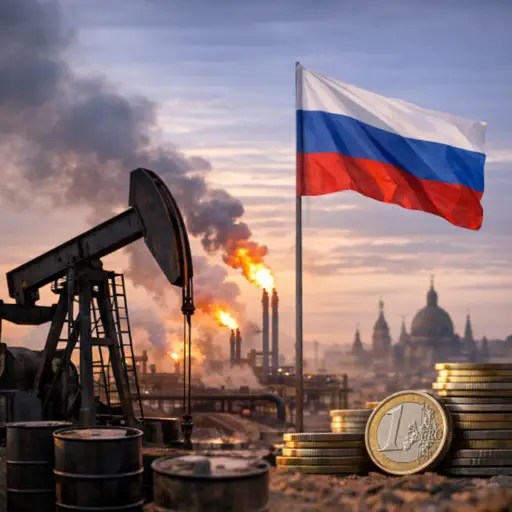
Falling oil revenues and escalating military expenditure tighten Moscow’s finances, raising concerns over regional energy markets and economic stability
As geopolitical tensions remain elevated and global energy markets continue to shift, Russia is confronting a growing fiscal challenge that may reverberate well beyond its borders. The country’s national budget deficit is showing signs of widening, driven by declining oil revenues and sustained increases in military spending. Analysts warn that the resulting financial strain could reshape energy dynamics and economic stability across Europe in the coming period.
Russia’s federal budget has long relied heavily on hydrocarbon exports, with oil and natural gas revenues serving as the backbone of government income. However, global demand patterns have undergone notable changes. A combination of price fluctuations, supply diversification by international buyers, and evolving sanctions-related constraints has significantly altered Moscow’s export landscape.
Energy analysts report that demand for Russian crude has softened in several key markets. One of the most consequential developments has been the gradual reduction of purchases by India, which previously emerged as a major buyer following earlier disruptions to traditional export routes. Although India continues to import Russian oil, market signals suggest increased diversification toward alternative suppliers as pricing conditions shift and logistical complexities intensify.
This reduction in export volumes and pricing advantages is beginning to erode Russia’s fiscal buffers. Government revenue derived from energy sales has come under pressure, forcing policymakers to rely more heavily on domestic borrowing and reserve funds to sustain public expenditure.
At the same time, Russia’s defense spending remains elevated. Military operations and broader security commitments continue to require significant financial resources, redirecting funds that might otherwise support infrastructure development or economic diversification. The dual pressure of shrinking energy income and expanding defense outlays has created a structural imbalance in the national budget.
Financial observers note that Russia has previously demonstrated resilience during periods of external economic pressure. The country maintains substantial foreign currency reserves and has adapted fiscal rules designed to stabilize public finances during commodity price volatility. Nevertheless, economists warn that prolonged revenue contraction combined with persistent high expenditure could gradually weaken these safeguards.
The evolving fiscal landscape is also generating uncertainty across European energy markets. Although many European countries have reduced direct dependence on Russian energy supplies, the broader global energy system remains interconnected. Any disruption to Russian output or export capacity can influence pricing dynamics worldwide, indirectly affecting European consumers and industries.
Energy traders point out that Russian oil continues to play a role in balancing global supply. If declining revenues lead Moscow to adjust production levels or export strategies, the consequences could ripple through international markets. Higher price volatility may emerge, potentially complicating Europe’s ongoing efforts to stabilize energy costs and transition toward alternative sources.
European industrial sectors, particularly those with energy-intensive production processes, remain sensitive to fluctuations in global oil and gas prices. Increased market instability could elevate operational costs and influence inflation trajectories in several European economies. Policymakers are therefore closely monitoring Russia’s fiscal developments as part of broader economic risk assessments.
Another layer of concern involves financial contagion. Russia’s economic performance, while increasingly isolated from Western financial systems, still holds relevance for regional trade flows and commodity markets. Neighboring countries and emerging European markets that maintain economic ties with Russia may experience indirect financial stress if Moscow tightens capital controls or reduces import demand.
Furthermore, Russia’s domestic economic environment may face mounting challenges. Reduced government spending in non-defense sectors could slow economic growth, potentially weakening consumer demand and industrial output. A prolonged slowdown in Russia could, in turn, dampen trade opportunities for certain European exporters operating in Eastern markets.
Currency stability also remains a focal point. A widening deficit can place downward pressure on the national currency if investors perceive rising fiscal risks. Exchange rate volatility may influence Russia’s import costs and inflation levels, with secondary effects on cross-border trade patterns that involve European partners.
European energy diversification strategies are accelerating in response to such uncertainties. Investments in renewable energy infrastructure, liquefied natural gas terminals, and expanded pipeline networks from alternative suppliers are gaining momentum. While these measures aim to reduce vulnerability to geopolitical disruptions, the transition period continues to expose European economies to external price shocks.
Market participants are particularly attentive to how Russia might respond to its fiscal constraints. Potential measures include adjusting taxation policies within the energy sector, modifying production quotas, or intensifying efforts to cultivate new export markets in Asia, Africa, and the Middle East. Each of these strategies carries implications for global energy balances and competitive dynamics.
There is also speculation regarding Russia’s use of sovereign wealth funds to offset budget deficits. Although these reserves provide temporary financial cushioning, sustained withdrawals could limit the country’s ability to respond to future economic crises. The pace at which reserve funds are utilized will be a critical indicator for international observers evaluating Russia’s long-term fiscal sustainability.
European financial institutions and multinational corporations are likewise assessing exposure to potential market volatility. Risk management strategies are increasingly factoring in scenarios involving prolonged instability in Russian public finances and their indirect effects on global commodity pricing.
Despite these challenges, some analysts argue that Russia retains considerable leverage in the energy sector. The country’s vast natural resource base and established export infrastructure continue to position it as a significant global supplier. However, the balance between maintaining production levels and managing fiscal sustainability is becoming increasingly delicate.
As the situation evolves, the interaction between Russia’s fiscal health and Europe’s economic stability underscores the persistent interconnectedness of global energy markets. The coming period is likely to test both Russia’s financial resilience and Europe’s capacity to navigate external economic pressures while pursuing long-term energy transformation goals.
Observers across financial and policy circles emphasize that developments in Russia’s budget dynamics should not be viewed in isolation. Instead, they represent a key component of a broader global economic puzzle, where geopolitical realities, energy transitions, and fiscal sustainability intersect with potentially far-reaching consequences.


 The Tower Post