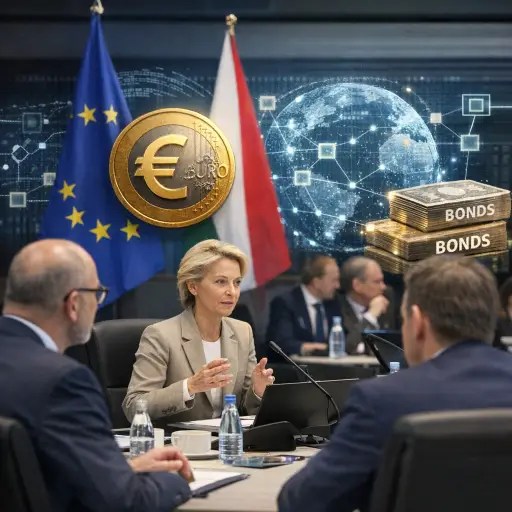
From stablecoins to shared borrowing, policymakers explore how digital finance and collective issuance could strengthen Europe’s currency in a shifting global order.
As global finance enters a new phase shaped by digital technology, geopolitical fragmentation, and shifting trade patterns, euro-area finance ministers are preparing to debate an ambitious strategy to elevate the international role of the euro. The discussion, expected to take place in mid-February, centers on a combination of digital money initiatives and renewed consideration of jointly issued European debt—two ideas that, taken together, could redefine how the single currency functions beyond the bloc’s borders.
At the heart of the talks is a recognition that the global monetary system is evolving faster than many regulatory frameworks. Digital assets, tokenisation, and instant cross-border payments are increasingly challenging traditional banking rails. For eurozone policymakers, this moment presents both a risk and an opportunity: either Europe adapts and shapes the next generation of money, or it remains dependent on systems dominated by the U.S. dollar.
Officials involved in the preparatory work say the goal is not to displace the dollar overnight, but to reduce strategic vulnerabilities. Today, most global trade, financial contracts, and payment infrastructures rely heavily on dollar-based systems. This dependence exposes European companies and governments to higher transaction costs, currency risks, and potential political pressure during periods of international tension.
One pillar of the emerging strategy is the use of private and regulated digital instruments, including euro-denominated stablecoins and tokenised bank deposits. Unlike volatile cryptocurrencies, these tools are designed to maintain a stable value linked to official currencies. If properly regulated and widely adopted, they could make euro payments faster, cheaper, and more accessible across borders, particularly in regions where traditional banking services are limited.
Tokenised deposits—essentially digital representations of commercial bank money recorded on distributed ledgers—are also gaining attention. Supporters argue that they could combine the safety of regulated banking with the efficiency of blockchain-based settlement. For cross-border trade and wholesale finance, such instruments may reduce settlement times from days to minutes, while keeping transactions within the European regulatory perimeter.
Finance ministers are expected to discuss how these innovations can be aligned with existing European rules on financial stability, consumer protection, and anti-money-laundering. Regulators are wary of repeating past mistakes, when financial innovation raced ahead of oversight. The challenge now is to strike a balance: encouraging experimentation without undermining trust in the financial system.
Alongside digital payments, policymakers are revisiting the idea of joint European debt issuance. Shared borrowing gained prominence during past crises, when collective issuance helped stabilize markets and lower funding costs for weaker member states. Now, some officials see joint debt not only as a crisis tool, but as a structural instrument to support the euro’s global standing.
A deeper and more liquid market for common European bonds could provide international investors with a credible alternative to U.S. Treasuries. Such assets are considered a cornerstone of any currency that aspires to reserve status. Without them, global investors often struggle to park large sums in euro-denominated instruments without fragmenting across national issuers.
Proponents argue that expanding joint issuance—carefully and within agreed limits—could reduce borrowing costs across the euro area while reinforcing financial integration. Critics, however, remain cautious, warning of moral hazard and political resistance from countries wary of sharing fiscal risks. These tensions are expected to resurface during the upcoming discussions.
The digital dimension and the debt debate are closely linked. A more internationally used euro, supported by modern payment infrastructure and deep capital markets, could improve Europe’s resilience in a world of competing economic blocs. It could also give European firms greater autonomy in trade and investment, reducing reliance on external financial channels.
Yet officials stress that progress will be incremental. Any expansion of digital euro-based instruments will require coordination between finance ministries, central banks, supervisors, and private-sector actors. Similarly, steps toward broader joint debt issuance would likely unfold gradually, shaped by political compromise and market conditions.
As ministers prepare for their mid-February meeting, the sense in Brussels and other European capitals is that the status quo is no longer sufficient. Digital innovation and geopolitical uncertainty are forcing long-standing questions about monetary sovereignty back onto the agenda.
Whether these discussions translate into concrete policy shifts remains to be seen. But the direction of travel is clear: Europe wants a stronger, more autonomous currency fit for a digital age—one that can operate confidently in a multipolar financial system, rather than merely adapting to rules set elsewhere.




 The Tower Post