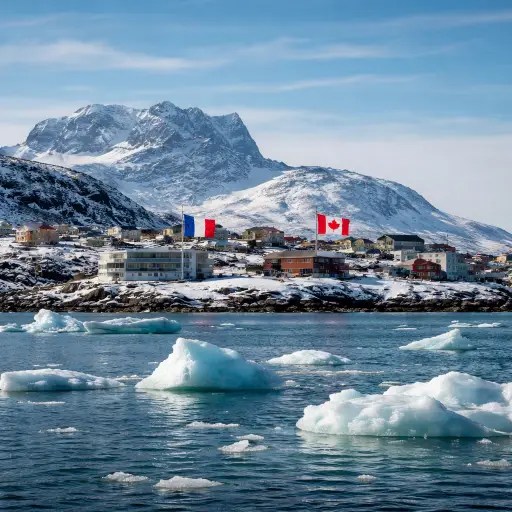
Paris and Ottawa strengthen their northern footprint in Nuuk, signaling renewed commitment to Arctic stability, Indigenous engagement, and Denmark’s sovereignty amid intensifying global competition.
France and Canada have taken a decisive step in Arctic diplomacy by opening new diplomatic consulates in Nuuk, Greenland, a move that underscores the growing strategic importance of the High North. The parallel initiatives, unveiled this week, place both countries more firmly on the Arctic map at a time when climate change, resource prospects, and geopolitical rivalry are converging in the polar region.
For France, the opening marks a historic first. Paris has become the first European Union member state to establish a consulate general in Greenland, elevating its long-standing scientific and political engagement in the Arctic to a permanent diplomatic presence. Canada, already an Arctic nation by geography and identity, has expanded its own footprint in Nuuk, reinforcing ties with Greenlandic institutions and signaling sustained attention to circumpolar affairs.
The twin announcements were welcomed by Danish and Greenlandic authorities, who view the new consulates as tangible expressions of international support for Denmark’s sovereignty over Greenland, while respecting the island’s broad self-governing powers. Officials in Copenhagen emphasized that a stronger diplomatic presence by close partners contributes to regional stability at a moment when external interest in the Arctic is visibly intensifying.
Greenland, the world’s largest island, occupies an outsized role in global strategic thinking. Its location between North America and Europe, combined with its proximity to emerging Arctic sea routes and untapped natural resources, has drawn increasing attention from global powers. Against this backdrop, France and Canada have framed their moves not as competitive maneuvers, but as investments in cooperation, multilateralism, and sustainable development.
French diplomats described the new consulate as a platform for deepening collaboration on climate research, environmental protection, and Arctic governance. France has been active in polar science for decades and maintains research stations and scientific partnerships across the region. By establishing a permanent diplomatic hub in Nuuk, Paris aims to better align its scientific presence with political dialogue, particularly on issues such as melting ice sheets, biodiversity loss, and the global implications of Arctic warming.
Canada’s expanded presence carries both symbolic and practical weight. As a country whose northern regions are home to many Indigenous communities and sensitive ecosystems, Canada has consistently argued that Arctic policy must be grounded in the lived realities of northern peoples. Canadian officials noted that the Nuuk consulate will serve as a bridge between Inuit communities across borders, supporting cultural exchange, economic cooperation, and shared approaches to sustainable development.
The timing of the announcements is notable. Across the Arctic, melting ice is reshaping maritime geography, gradually opening routes that were once impassable for much of the year. While commercial shipping through the High North remains limited and risky, the long-term implications are driving governments to reassess their strategic postures. At the same time, interest in critical minerals and energy resources has added a new economic dimension to Arctic diplomacy.
In this context, the presence of additional Western diplomatic missions in Greenland is widely interpreted as a signal of alignment. France and Canada have both stressed their commitment to international law, freedom of navigation, and peaceful cooperation in the Arctic. Their moves stand in contrast to more assertive postures adopted by some global actors, reinforcing a vision of the Arctic as a region governed by dialogue rather than confrontation.
Local reactions in Greenland have been cautiously optimistic. Greenlandic leaders have welcomed deeper engagement that brings investment, expertise, and political attention, while reiterating the importance of respecting local decision-making and environmental priorities. The new consulates are expected to work closely with Greenland’s autonomous government, particularly on education, research, and infrastructure projects suited to Arctic conditions.
Analysts note that diplomacy in the Arctic is increasingly about presence as much as policy. Establishing a flag, a building, and a team on the ground sends a message of long-term commitment. For France, it reinforces its role as a global actor with interests extending well beyond Europe. For Canada, it complements a broader strategy of Arctic renewal that blends security, development, and reconciliation with Indigenous peoples.
As geopolitical competition sharpens worldwide, the Arctic is no longer a distant periphery. The opening of the French and Canadian consulates in Nuuk reflects a shared assessment that the region will play a central role in shaping future global dynamics. By choosing diplomacy and partnership, Paris and Ottawa are betting that engagement, rather than rivalry, will define the Arctic’s next chapter.


 The Tower Post