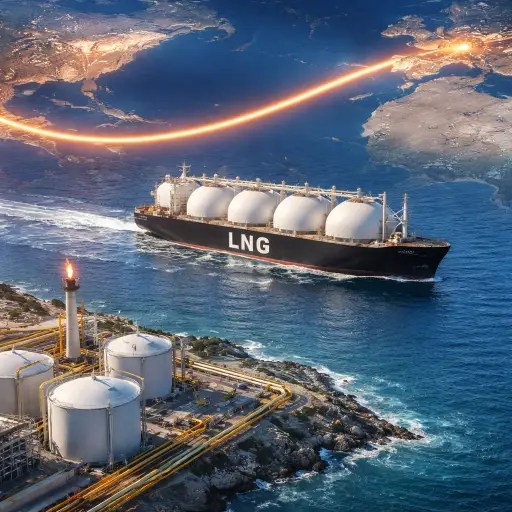
Joint initiative aims to lock in transatlantic gas flows as the continent accelerates its break from Russian supply
A Greece-led gas distribution venture is moving to secure a long-term supply of liquefied natural gas from the United States, positioning itself at the center of Europe’s next phase of energy diversification. The initiative, currently under negotiation, seeks a multi-decade LNG purchase agreement that would underpin energy security across Southern and Central Europe at a moment of heightened geopolitical and market uncertainty.
The talks come as European governments and utilities prepare for a structural shift in gas sourcing. With policymakers committed to ending reliance on Russian pipeline gas, the pressure is mounting to establish alternative, reliable supply routes that can withstand price volatility and political risk. LNG from the United States, already a major contributor to Europe’s gas balance, is increasingly viewed as a cornerstone of that transition.
According to people familiar with the discussions, the Greek-led joint venture is engaging with several U.S. LNG suppliers to explore a long-term offtake arrangement extending over roughly two decades. Such a deal would go beyond the short- and medium-term contracts that dominated the market in recent years, offering predictable volumes and pricing structures for buyers while providing producers with long-term demand certainty.
The initiative reflects Greece’s growing role as an energy gateway for the wider region. Investments in LNG import infrastructure, storage capacity and interconnections have transformed the country into a critical entry point for gas flows moving northward into the Balkans and further into Central Europe. By anchoring those flows with a long-term U.S. supply agreement, the venture aims to strengthen the resilience of a regional network that has become increasingly important since the disruption of traditional supply routes.
Negotiations are taking place against a backdrop of cautious optimism in global gas markets. While prices have eased from the extreme volatility seen earlier in the decade, market participants remain acutely aware of how quickly conditions can change. Long-term contracts are once again gaining favor among buyers seeking to balance flexibility with security, particularly in regions still heavily dependent on gas for power generation, heating and industrial use.
Discussions have intensified in recent weeks through a series of meetings with U.S. producers and European counterparties. A key gathering in Washington brought together representatives from the Greek-led venture, American LNG exporters and potential regional buyers, underscoring the strategic dimension of the talks. Participants described the atmosphere as constructive, though complex issues remain under negotiation, including contract structure, delivery terms and alignment with Europe’s evolving regulatory framework.
For U.S. suppliers, Europe continues to represent a premium and strategically important market. Long-term commitments from European buyers can support investment decisions in new liquefaction capacity, even as producers seek to balance sales between Europe and fast-growing Asian markets. A two-decade agreement with a regional European hub could therefore carry weight well beyond the immediate parties involved.
European officials have consistently emphasized that diversification does not mean replacing one dependency with another. Instead, the strategy centers on building a portfolio of suppliers, routes and contract types. In that context, a long-term U.S. LNG deal linked to Greek infrastructure would be one element of a broader mosaic that includes renewables, energy efficiency and, over time, alternative gases.
Still, gas is expected to remain a significant part of Europe’s energy mix for years to come, particularly as a balancing fuel for intermittent renewable generation. Securing stable supplies during this transitional period is viewed by many policymakers as essential to avoiding future shocks.
The Greek-led venture’s effort illustrates how regional players are stepping forward to shape Europe’s post-Russian gas landscape. By leveraging geography, infrastructure and transatlantic partnerships, the initiative seeks not only to safeguard national supply but to reinforce energy security across multiple neighboring markets.
While no final agreement has yet been announced, stakeholders involved in the process say the momentum is real. If successful, the deal would mark one of the most significant long-term LNG commitments between Europe and the United States to date, signaling a new phase in the continent’s evolving energy relationship with its transatlantic ally.




 The Tower Post