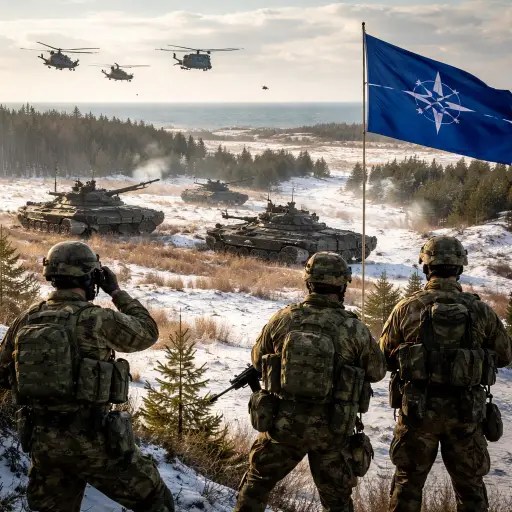
A recent alliance simulation underscores vulnerabilities in command, leadership, and reinforcement as deterrence faces a fast‑moving test in Northern Europe.
In a stark internal exercise conducted by the North Atlantic Treaty Organization, alliance planners confronted a sobering scenario: a fast‑moving crisis in Northern Europe where hesitation, fragmented command, and delayed reinforcements allowed an adversary to seize ground before collective defense could fully engage.
The classified‑style wargame, described by officials familiar with its conclusions, explored a hypothetical conflict in the Baltic region. The results were unsettling. Under conditions where political decision‑making lagged and military coordination across capitals proved uneven, defending forces struggled to prevent a rapid breakthrough. In the simulation, the Baltic states were overrun in a matter of days when Western response mechanisms faltered.
While the scenario was fictional, the implications were anything but academic. The exercise was designed to stress‑test NATO’s ability to move from warning to action under pressure, and to expose the seams that could be exploited in a real confrontation. Participants say the findings reinforced a long‑standing concern within the alliance: speed matters more than mass in the opening phase of modern warfare.
According to officials briefed on the wargame, the most critical weakness was not equipment or troop quality, but decision‑making velocity. Multiple national chains of command, differing rules of engagement, and political caution combined to slow the transition from deterrence to defense. In the simulation, even short delays proved decisive.
The Baltic theater is uniquely demanding. Geography compresses timelines, leaving little strategic depth and few second chances. Any attacker capable of mobilizing quickly could attempt to present NATO with a fait accompli, betting that the alliance would struggle to agree and respond before territory was lost. The wargame suggested that such a gamble might succeed if reforms are not accelerated.
Another key finding was the challenge of rapid reinforcement. While NATO maintains substantial forces across Europe, moving them quickly to the northeastern flank remains complex. Logistical bottlenecks, infrastructure limitations, and coordination across borders slowed deployments in the exercise. Airlift and sealift capacity were stretched, and pre‑positioned stocks proved unevenly distributed.
The simulation also highlighted gaps in unified command. Although NATO has made progress in integrating regional plans, the wargame showed moments of uncertainty over authority and prioritization during the opening hours of the crisis. Participants noted that clarity at the top — who decides, who commands, and how quickly orders flow — can be as decisive as firepower.
Officials emphasize that the exercise should not be read as a prediction, but as a warning. Since earlier assessments raised similar alarms, NATO has taken steps to strengthen its eastern defenses, including forward deployments, enhanced battle groups, and updated regional plans. Yet the wargame indicates that improvements in hardware must be matched by reforms in mindset and process.
At the political level, the findings add urgency to debates over defense spending, readiness, and burden sharing. Several allies have increased military budgets and pledged faster mobilization, but translating commitments into deployable capability remains uneven. The exercise suggests that the first hours of a crisis could expose those gaps mercilessly.
For military planners, the lesson is clear: deterrence depends on the credibility of immediate action. If an adversary believes that NATO can respond decisively and cohesively from the outset, the incentive to test the alliance diminishes. If doubt persists, risk‑taking becomes more likely.
As tensions in Europe continue to shape strategic thinking, the wargame serves as a reminder that collective defense is not just a treaty obligation but an operational challenge. Speed, unity, and preparedness are not abstract concepts; they are the difference between holding the line and losing it before the world has time to react.
The exercise’s conclusions are now feeding into ongoing reviews of NATO posture and planning. Officials say the goal is not to alarm, but to adapt — ensuring that in any future crisis, the alliance can move faster than the threat it seeks to deter.




 The Tower Post