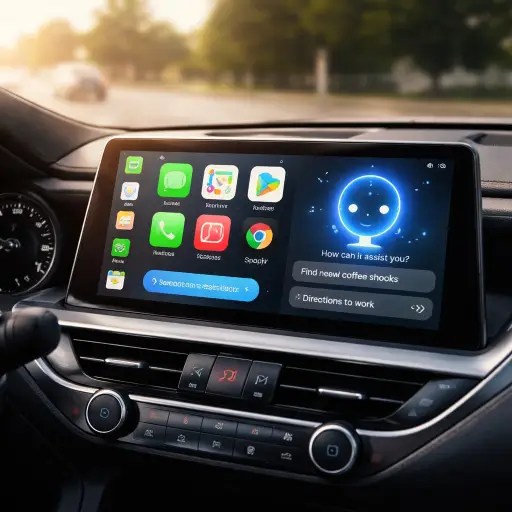
A potential policy shift could allow third-party assistants to operate inside the dashboard, broadening in-car intelligence and challenging Apple’s walled-garden approach.
Apple is preparing to loosen its grip on one of its most strategically important automotive platforms. According to people familiar with the matter cited by Reuters, the company plans to allow third-party AI chat assistants to operate within Apple CarPlay, a move that would represent a notable departure from Apple’s historically closed ecosystem.
If implemented, the change would enable drivers to choose external conversational AI systems—beyond Apple’s own Siri—to handle tasks such as navigation queries, messaging, media selection, and contextual vehicle commands. For users, the shift promises deeper personalization and access to rapidly evolving AI capabilities that may outpace Apple’s in-house development cadence.
CarPlay, which is installed in millions of vehicles worldwide, has long functioned as a tightly controlled extension of the iPhone. While Apple has allowed third-party apps for music, maps, and messaging, control of voice interaction has remained firmly centralized. Opening that layer to outside AI systems signals a recalibration of priorities at a time when artificial intelligence has become a primary battleground across consumer technology.
Industry observers say the reported plan reflects growing pressure on Apple to keep pace with rivals that are embedding generative AI more aggressively into vehicles. Automakers and drivers alike are showing interest in assistants capable of multi-step reasoning, natural dialogue, and proactive suggestions—features increasingly associated with large language models developed outside Apple.
For car manufacturers, the move could be equally significant. Allowing multiple AI assistants within CarPlay could reduce dependence on a single vendor and enable differentiation through software experiences. It may also help automakers respond to consumer demand for choice, particularly as vehicles become longer-term technology platforms rather than simple transportation tools.
The reported change does not mean Apple is stepping back from CarPlay. Instead, sources suggest the company would retain control over privacy, security, and interface guidelines, while permitting approved external assistants to operate within defined boundaries. This hybrid approach would preserve Apple’s emphasis on user trust while acknowledging the pace of innovation happening beyond its walls.
Privacy remains a central concern. Apple has built its brand on minimizing data collection and processing information on-device where possible. Third-party AI assistants, many of which rely heavily on cloud-based computation, could complicate that narrative. Any rollout is expected to involve strict permission controls and transparency requirements, ensuring users understand which assistant is handling their data at any given moment.
From a strategic standpoint, the reported plan underscores how AI is reshaping even Apple’s most guarded platforms. As conversational interfaces become the primary way users interact with technology—especially while driving—maintaining exclusivity may prove less valuable than offering the best possible experience.
While Apple has not publicly confirmed the initiative, the direction aligns with broader signals from the company, including increased references to “open collaboration” and “responsible AI integration” in recent communications. If CarPlay does open its doors to external AI chatbots, it would mark one of the clearest signs yet that the AI era is forcing a rethink of long-standing platform philosophies.
For drivers, the change could soon translate into dashboards that feel less like a single-company product and more like a customizable digital cockpit—one where the assistant you trust most rides shotgun, regardless of who built it.




 The Tower Post