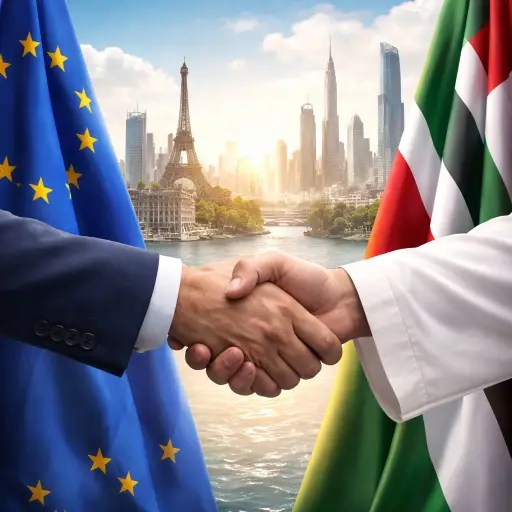
Brussels seeks closer ties with Gulf states as Europe looks to diversify partners and steady exports amid global trade tensions
Brussels is moving to inject fresh political momentum into a long‑stalled free‑trade agreement with the Gulf’s leading economies, betting that closer commercial ties with the Middle East can help cushion Europe from intensifying global trade pressures. European officials say the effort reflects a broader recalibration of trade policy as the European Union looks to diversify partners, protect its exporters and reduce exposure to increasingly volatile relationships with the world’s largest economies.
At the heart of the push is a desire to bring negotiations with the Gulf Cooperation Council back to life after years of stop‑start diplomacy. Talks between the two sides have been formally frozen for more than a decade, hampered by disagreements over market access, export duties and regulatory standards. Now, senior European figures argue that the global context has changed enough to justify a renewed and accelerated approach.
The EU’s calculus is shaped by a confluence of pressures. Trade tensions have resurfaced across major economies, with tariffs, subsidies and industrial policy increasingly used as strategic tools. European manufacturers, particularly in sectors such as machinery, chemicals, transport equipment and green technologies, face sharper competition from Chinese exports and uncertainty in transatlantic trade relations. In that environment, policymakers in Brussels see the Gulf as both a fast‑growing market and a politically stable partner with deep investment capacity.
European leaders have been unusually explicit about the geopolitical logic behind the move. Latvian Prime Minister Evika Siliņa, whose country holds a strong interest in keeping EU trade routes open and diversified, has called for a step‑change in political engagement with Gulf capitals. She has argued that Europe cannot afford to let strategic economic relationships languish at a time when trade is being weaponised elsewhere.
The message has been echoed by the EU’s Special Envoy for the Gulf region, Luigi Di Maio, who has spent recent months shuttling between European and Middle Eastern capitals. Di Maio has urged both sides to elevate the talks beyond technical trade chapters and focus on a broader strategic partnership that reflects shared interests in energy security, digitalisation and climate transition. According to officials familiar with the discussions, the aim is to create a political window in which negotiators can resolve long‑standing sticking points more quickly.
For the EU, a deal with the Gulf would offer tangible economic benefits. The bloc represents a market of roughly 500 million consumers, while the Gulf states are among the world’s largest importers per capita. European companies already enjoy a strong presence in the region, but tariffs, local content rules and differing standards can add costs and complexity. A comprehensive free‑trade agreement could streamline customs procedures, improve access for services and public procurement, and strengthen protections for intellectual property.
Gulf governments, for their part, are pursuing ambitious economic diversification agendas as they seek to reduce dependence on hydrocarbons. Projects linked to renewable energy, advanced manufacturing, logistics and tourism align closely with European expertise. Officials on both sides say there is growing recognition that a trade deal could support these goals while anchoring the relationship in clearer rules.
Still, the path to an agreement remains fraught. Previous negotiations faltered over issues such as export taxes, human rights clauses and the extent of regulatory convergence. Some Gulf states have been wary of what they see as Brussels’ tendency to link trade to political conditions, while European lawmakers face domestic scrutiny over labour and environmental standards abroad. Any fast‑tracking effort will have to navigate these sensitivities carefully to avoid a repeat of past stalemates.
There is also the question of timing. European officials stress that momentum matters, arguing that prolonged talks risk being overtaken by events, including shifts in global energy markets and new trade initiatives by rival powers. The Gulf has been courted aggressively by Asian economies, and China in particular has expanded its commercial footprint through infrastructure investment and long‑term supply agreements. For Brussels, re‑engaging now is partly about ensuring Europe remains a central economic partner rather than a secondary option.
Diplomats involved in the process say the emphasis in the coming months will be on intensified political dialogue rather than immediate technical breakthroughs. High‑level visits, business forums and sector‑specific working groups are expected to lay the groundwork for formal negotiations. The hope is that visible commitment from senior leaders can break the cycle of caution that has defined the talks for years.
Whether that hope translates into a signed agreement is far from certain. Trade deals involving the EU are notoriously complex, requiring consensus among member states and approval from the European Parliament. Yet supporters of the Gulf initiative argue that the strategic case has rarely been clearer. In a fragmented global economy, they say, Europe needs reliable partners willing to engage on open trade.
As early February discussions gather pace, the renewed courtship of the Gulf underscores a broader shift in European trade policy: less complacency, more pragmatism, and a recognition that economic alliances are inseparable from geopolitics. For Brussels and the Gulf capitals alike, the question is whether this moment of alignment can finally be turned into a durable free‑trade pact.
 The Tower Post