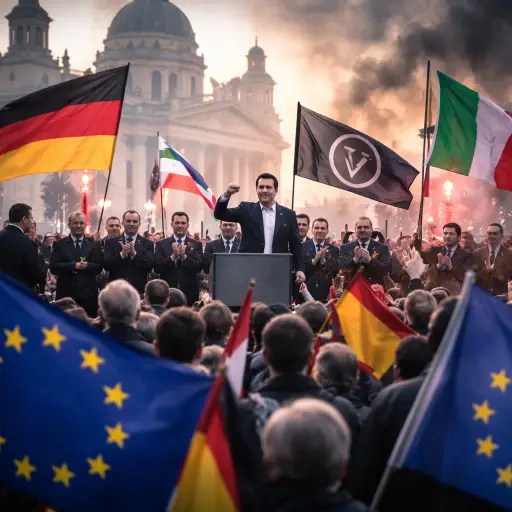
As a transnational far‑right movement reshapes political debate across the continent, Europe is being forced to confront a crisis rooted within its own liberal order.
Europe is once again talking about political threat, but the danger now being debated is not massed at its borders, nor orchestrated solely from rival capitals abroad. Instead, it is emerging from within: a loosely connected yet strikingly coherent “new right” movement that is reshaping public discourse, electoral politics, and cultural identity across the continent.
Commentary circulating in leading European media argues that this challenge cannot be reduced to familiar labels such as populism or protest voting. What is taking shape looks more like a global‑style ideological current—one that borrows language, symbols, and strategies across national lines while adapting itself to local grievances. From parliamentary chambers to online platforms, the movement presents itself not merely as opposition, but as an alternative worldview.
At its core is a sustained critique of liberalism. The new right portrays liberal democracy as hollowed out by technocracy, detached elites, and cultural homogenization. It frames individual rights as having eroded collective meaning, and global openness as having weakened national solidarity. This argument resonates in societies where economic anxiety, demographic change, and cultural fragmentation are felt as lived experiences rather than abstract trends.
What distinguishes this movement from earlier waves of far‑right politics is its sophistication. It does not rely solely on nostalgia or overt authoritarianism. Instead, it couches its message in the language of realism, sovereignty, and even democracy itself. Elections are embraced, not rejected. Institutions are contested from within rather than attacked from outside. The tone is often calm, ironic, and media‑savvy—designed to appear credible to voters who might once have recoiled from extremist rhetoric.
Culturally, the appeal is equally strategic. The new right invests heavily in storytelling: narratives of loss, decline, and betrayal are paired with promises of restoration and control. Online communities amplify these stories, creating a shared sense of belonging that transcends borders. A voter in southern Europe may recognize the same themes as one in the north or east, even if the national context differs.
This transnational quality is precisely what unsettles many European policymakers. While each country faces its own version of the phenomenon, the ideas travel quickly and reinforce one another. A policy debate in one capital becomes a talking point elsewhere within hours. Intellectual references, cultural grievances, and campaign tactics circulate in a common ecosystem, giving the impression of a movement larger than any single party or election.
The temptation for Europe’s mainstream political forces is to respond defensively: to dismiss supporters as misguided, to tighten legal boundaries, or to rely on moral condemnation. Yet critics argue that this approach misunderstands the nature of the challenge. The new right is not thriving solely because of misinformation or anger; it is gaining ground because it offers a coherent critique that many citizens feel has not been adequately answered.
Engagement, therefore, must be both intellectual and political. Europe’s liberal tradition cannot assume its own inevitability. It must articulate, with renewed clarity, why pluralism, open societies, and shared institutions remain capable of delivering meaning, security, and fairness. This requires confronting real failures—economic inequality, democratic distance, cultural dislocation—rather than denying them.
Politically, this also means competing rather than retreating. Voters drawn to the new right are not unreachable. Many are responding to questions about identity, community, and control that mainstream parties have struggled to address without reverting to technocratic language. Rebuilding trust will demand policies that are tangible, narratives that are emotionally literate, and leadership willing to engage beyond traditional comfort zones.
As Europe moves deeper into a period of political recalibration, the rise of the new right serves as a mirror as much as a warning. It reflects unresolved tensions within European societies and exposes the fragility of assumptions long taken for granted. Whether this moment becomes one of democratic renewal or further fragmentation will depend on Europe’s willingness to confront the challenge not as an external invasion, but as an internal reckoning.

 The Tower Post