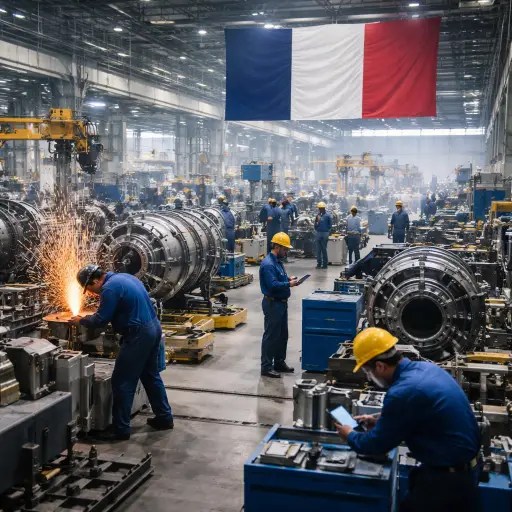
Defense-linked orders and strategic investment lift factory output, offering resilience amid regional headwinds
French factories began the year with an unexpected burst of momentum, recording their strongest expansion in nearly four years, according to closely watched purchasing managers’ surveys. The rebound, visible across several industrial segments, has revived hopes that parts of the country’s manufacturing base are regaining footing after a prolonged period of uncertainty.
The improvement was broad enough to be felt on factory floors from the north to the southeast, where managers reported faster output growth and a steadier flow of new orders. While demand from traditional consumer-facing industries remained uneven, executives pointed to a sharp pickup in contracts tied to defense, aerospace, and other strategic sectors as a key driver behind the surge.
Analysts say the timing is notable. Manufacturing across much of Europe has struggled to regain traction, weighed down by subdued investment, lingering supply-chain adjustments, and fragile confidence among exporters. France’s performance stands out as a reminder that targeted spending and policy-backed industries can still deliver growth even when the broader environment remains challenging.
Defense-related production has been particularly influential. Companies supplying equipment, components, and advanced materials linked to national and European security priorities reported fuller order books and improved visibility on future work. This has translated into longer production runs and, in some cases, the reactivation of capacity that had been underused in recent years.
Beyond defense, strategic industrial programs have also played a role. Public and private investment aimed at strengthening domestic capabilities in energy systems, transport equipment, and high-value manufacturing has provided a cushion against softer demand elsewhere. Managers noted that these projects tend to be less sensitive to short-term economic swings, helping to stabilize output.
Employment trends offered a more cautious signal. While hiring intentions improved marginally, many firms remained hesitant to add staff aggressively, citing cost pressures and uncertainty over how durable the current upswing will be. Instead, companies focused on optimizing existing workforces and improving productivity through incremental automation and process upgrades.
Input costs continued to moderate, easing some of the pressure that had squeezed margins in previous periods. However, selling prices showed only modest movement, reflecting competitive conditions and the need to secure long-term contracts. Several manufacturers said that maintaining pricing discipline remains a priority as they balance investment needs with profitability.
Economists warn that the sector’s renewed strength should not be overinterpreted. External demand conditions remain fragile, and any slowdown in global trade or tightening of financial conditions could quickly test the resilience of recent gains. Still, the latest data suggest that France’s industrial base is better positioned than many peers to benefit from targeted spending and strategic priorities.
For policymakers, the message is twofold. First, sustained investment in priority industries appears to be paying dividends in terms of output and confidence. Second, translating pockets of strength into a broader, self-sustaining recovery will require continued attention to competitiveness, skills, and innovation.
As factories move deeper into the year, managers will be watching whether the current momentum can be maintained. For now, the strongest production rise in years offers a rare bright spot, signaling that French manufacturing retains the capacity to surprise on the upside, even amid persistent regional challenges.


 The Tower Post