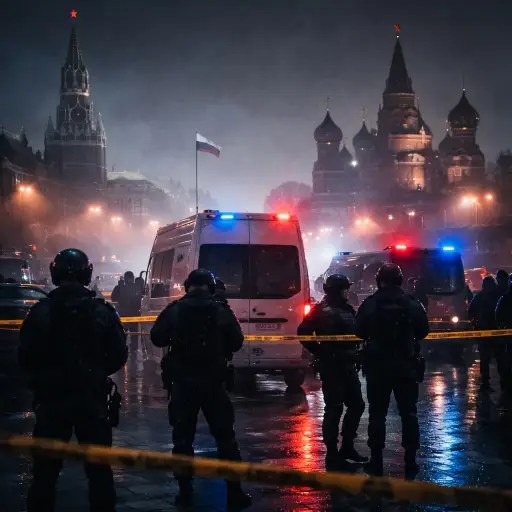
A rare shooting of a senior intelligence officer fuels accusations, denials, and speculation, intensifying pressure on fragile peace efforts around Ukraine.
A rare act of gun violence targeting a high-ranking military official has rattled Russia’s capital, adding fresh political tension at a moment when diplomacy and war uneasily overlap.
Lieutenant General Vladimir Alekseyev, a senior figure within Russia’s military intelligence apparatus, was left critically wounded after being shot in Moscow, according to official statements and media reports. The attack, carried out in a city where the security presence is both visible and formidable, has immediately triggered speculation over its authorship and meaning.
Russian authorities quickly suggested that Ukraine could be linked to the shooting, framing it as part of a broader pattern of covert actions extending beyond the front lines of the war. Kyiv, however, issued a swift and categorical denial, rejecting any involvement and warning against what it described as politically motivated accusations.
Beyond the exchange of claims and denials, the incident has opened a deeper debate among analysts and observers: whether the shooting points less to foreign intrigue and more to internal strains within Russia itself.
A Rare Breach in Moscow
Violent attacks on senior officials in Moscow are highly unusual, particularly since the start of the war in Ukraine. The capital has been portrayed by the Kremlin as secure and insulated from the conflict, even as fighting continues far from its streets. That narrative was shaken by news that a lieutenant general could be targeted and gravely injured in what appeared to be a deliberate attack.
Details surrounding the shooting remain tightly controlled. Authorities have released little information about the circumstances, the weapon used, or whether suspects have been identified. The scarcity of confirmed facts has only amplified rumors, with social media and independent outlets offering competing theories in the absence of clarity.
What is known is Alekseyev’s prominence. As a senior intelligence official, his role placed him near the center of Russia’s military decision-making at a time of heightened pressure, both on the battlefield and at the negotiating table.
Accusations and Denials
Moscow’s suggestion of Ukrainian involvement fits a familiar pattern of rhetoric since the war began, emphasizing external threats and alleged sabotage. Russian officials have repeatedly accused Kyiv of attempting operations on Russian soil, accusations that Ukraine has consistently denied.
Ukrainian officials responded to the shooting by reiterating that they do not conduct attacks in Moscow and by accusing Russia of using the incident to distract from setbacks and internal challenges. They also cautioned against drawing conclusions before an investigation has been completed.
For outside observers, the lack of publicly available evidence makes it difficult to assess either claim. Western governments have so far refrained from endorsing Moscow’s allegations, instead calling for restraint and transparency.
Internal Tensions in Focus
An alternative explanation gaining traction among analysts centers on internal Russian dynamics. The war has strained institutions, exposed rivalries, and placed enormous pressure on military and intelligence structures. In this reading, the shooting could reflect internal disputes, personal vendettas, or fractures within the security elite.
Such interpretations remain speculative, but they resonate in a context where Russia has faced reports of purges, reshuffles, and quiet power struggles since the conflict began. Even the perception of internal instability carries political weight, challenging the image of unity projected by the Kremlin.
Impact on Peace Efforts
The timing of the shooting is particularly sensitive. Diplomatic efforts aimed at exploring a possible framework for de-escalation in Ukraine have been ongoing, fragile, and politically charged. Any high-profile act of violence risks hardening positions and narrowing the space for compromise.
If framed as a foreign attack, the incident could strengthen hardline arguments in Moscow against concessions. If seen as evidence of internal discord, it could complicate Russia’s negotiating posture by exposing vulnerabilities.
Either way, the shooting injects uncertainty into an already volatile moment. Diplomats and analysts alike note that symbolism matters in conflicts, and the image of a wounded general in the capital is a powerful one.
Waiting for Clarity
As Lieutenant General Alekseyev remains in critical condition, attention is focused on the investigation and on how authorities choose to present its findings. In the absence of clear answers, the shooting functions less as a closed case than as a mirror, reflecting the anxieties, accusations, and tensions that surround the war and the uneasy search for peace.
For now, Moscow’s streets have returned to their routines, but the political aftershocks of the attack continue to ripple outward, reaching far beyond the site of the shooting itself.
 The Tower Post