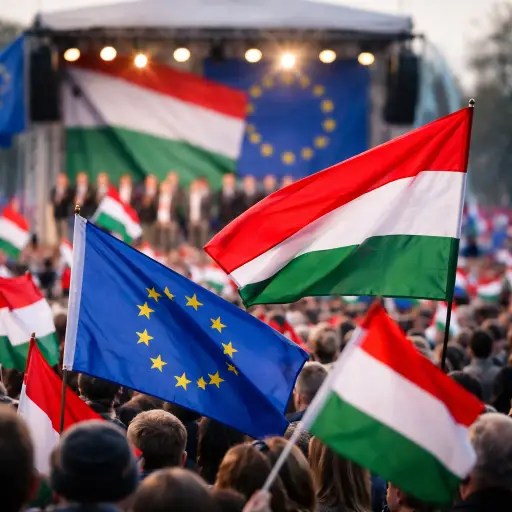
A sweeping program from the centre-right Tisza party signals a bid to realign Budapest with Europe and break years of entrenched rule.
Hungary’s political landscape entered a new phase as the opposition Tisza party unveiled an unusually detailed and ambitious election program, presenting itself as a credible alternative to the government that has dominated the country for well over a decade. The platform, running to hundreds of pages, sketches out a vision of economic redistribution, institutional reform and renewed Western alignment, marking the most comprehensive challenge yet to Prime Minister Viktor Orbán’s grip on power.
At the heart of Tisza’s proposal is a promise to rebalance Hungary’s economy in favour of broader social fairness while restoring trust in public institutions. The party argues that years of centralised decision-making and opaque governance have weakened competitiveness, discouraged investment and strained relations with key allies. Its program places anti-corruption measures and judicial independence at the centre of a broader democratic reset.
One of the most closely watched elements is the call for a targeted wealth tax aimed at the country’s richest households. Tisza leaders frame the idea not as punitive, but as a corrective tool to fund education, healthcare and regional development. The proposal reflects a broader European debate on inequality and public finances, and represents a sharp contrast with the government’s long-standing emphasis on flat taxes and incentives for large investors.
Equally symbolic is the party’s pledge to prepare Hungary for eventual adoption of the euro. While stopping short of promising immediate entry, the program outlines steps to stabilise public finances, strengthen the independence of the central bank and align fiscal policy more closely with eurozone norms. For supporters, the euro is presented as a safeguard against volatility and political interference; for critics, it raises concerns about sovereignty and economic flexibility.
Foreign policy occupies a prominent place in the platform. Tisza calls for repairing strained relations with the European Union and reaffirming Hungary’s commitment to NATO. The party argues that confrontational rhetoric and selective cooperation have left the country isolated at a time of heightened geopolitical uncertainty. Instead, it advocates pragmatic engagement, full compliance with EU rule-of-law standards and a more predictable diplomatic posture.
Energy and climate policy form another pillar of the program. Tisza proposes accelerating investment in renewables, modernising the electricity grid and reducing dependence on imported fossil fuels. The party links energy security directly to national security, arguing that diversification and green investment would shield households from price shocks while meeting European climate targets.
The scale and detail of the program underline Tisza’s determination to be seen as a government-in-waiting rather than a protest movement. Analysts note that the document’s breadth is designed to reassure undecided voters and international partners alike that an alternative administration could govern smoothly from day one.
For the ruling party, the challenge is significant. Viktor Orbán has built a durable political system combining electoral success with tight control over media and institutions. Yet rising living costs, concerns about corruption and fatigue with polarising politics have created openings for an opposition able to project unity and competence.
Whether Tisza can convert its policy-heavy approach into electoral momentum remains uncertain. Campaigning in Hungary has often rewarded simple messages over complex programs. Still, the release of such an extensive agenda has shifted the tone of the race, forcing a debate on substance and long-term direction.
As voters weigh their options, the contest increasingly appears less about individual policies than about Hungary’s place in Europe and the kind of state it aspires to be. Tisza’s program sets out one answer — a reanchoring to Western institutions, stronger checks on power and a more inclusive economic model — and challenges the electorate to decide whether it is time for change.


 The Tower Post