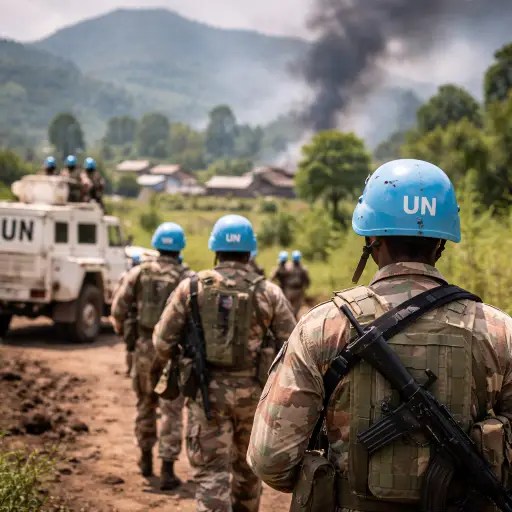
A strategic recalibration after decades in eastern Congo raises questions for regional security—and Europe’s stake in global peacekeeping
South Africa has announced it will withdraw its contingent of more than 700 troops from the United Nations peacekeeping mission in the Democratic Republic of the Congo, marking a significant shift in Pretoria’s long-standing engagement in one of Africa’s most protracted conflicts.
The decision ends nearly three decades of South African military involvement in efforts to stabilize eastern Congo, a region plagued by armed militias, cross-border tensions, and competition over mineral-rich territory. Government officials described the move as part of a broader reassessment of foreign deployments, driven by evolving domestic priorities and the need to modernize the country’s defense posture.
South African forces have been deployed under the banner of the United Nations since the late 1990s, contributing to what is now known as MONUSCO, one of the world’s largest and most complex peacekeeping operations. Despite sustained international presence, fighting among rebel groups has continued, displacing civilians and straining relations between Congo and its neighbors.
Pretoria emphasized that the withdrawal would be conducted in close coordination with the UN to avoid creating security vacuums. Officials said logistical planning is underway to ensure an orderly exit, while reaffirming support for diplomatic initiatives aimed at reducing violence in the region.
Analysts say the move reflects growing skepticism among troop-contributing countries about the effectiveness of large-scale peacekeeping missions in environments where political solutions lag behind military stabilization. South Africa has faced its own budgetary pressures at home, alongside increasing calls to redirect resources toward domestic security and economic recovery.
For the Democratic Republic of the Congo, the announcement adds to uncertainty at a time when armed groups remain active and local communities continue to bear the brunt of insecurity. Congolese authorities have urged international partners to maintain support, warning that a premature drawdown could embolden militias.
The implications extend well beyond Africa. European governments—many of which fund UN peacekeeping and depend on stability in Central Africa—are watching closely. Prolonged insecurity in Congo has ripple effects on global supply chains, particularly for critical minerals essential to European manufacturing and the green energy transition.
Europe also has a broader stake in the credibility of multilateral security frameworks. As debates intensify over the future of UN peace operations, South Africa’s decision underscores a wider trend among contributors to demand clearer mandates, measurable outcomes, and stronger political backing for missions deployed in volatile regions.
While Pretoria insists its commitment to peace on the continent remains firm, the withdrawal signals a turning point. After years on the front lines of Congo’s fragile peace, South Africa is stepping back—leaving the United Nations, regional actors, and global partners to confront enduring questions about how to secure stability in one of the world’s most complex conflict zones.


 The Tower Post