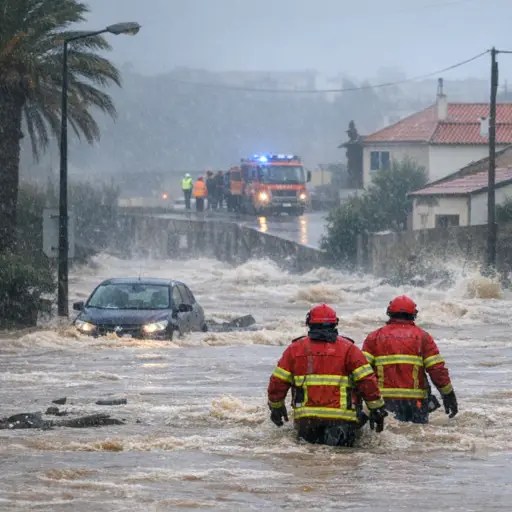
As destructive weather sweeps Iberia, authorities face pressure to balance democratic continuity with public safety, even as officials rule out delaying the vote.
Violent weather driven by Storm Leonardo has torn across Portugal and neighboring Spain, leaving a trail of destruction that has tested emergency services and reignited political debate at a delicate moment for Portuguese democracy. Torrential rain, powerful winds, and widespread flooding have forced evacuations, disrupted transport networks, and claimed lives, as the storm continues to lash southern Europe.
In Portugal, the impact has been severe enough to prompt public calls for postponing the second round of the presidential election. While officials have firmly rejected any delay, the discussion itself underscores how deeply the storm has unsettled daily life and raised concerns about voter safety and access to polling stations.
Across coastal and inland regions alike, rivers have burst their banks, roads have collapsed under landslides, and entire neighborhoods have been cut off by floodwaters. Civil protection authorities have deployed rescue teams around the clock, evacuating thousands from low-lying areas and reinforcing dams and levees strained by relentless rainfall. Emergency shelters have filled quickly, particularly in communities where homes were rendered uninhabitable overnight.
Spain has faced parallel devastation. In several regions, emergency alerts have warned residents to remain indoors as flash floods swept through towns and rural areas, submerging vehicles and agricultural land. Cross-border coordination between Portuguese and Spanish authorities has intensified, reflecting the shared scale of the crisis and the likelihood of further deterioration as the storm system persists.
The political reverberations in Portugal have been swift. Social media platforms and talk shows have echoed with arguments that holding a national vote during such conditions could suppress turnout or endanger voters, particularly the elderly and those in remote areas. Some local officials have quietly expressed concern about staffing polling stations if transport disruptions continue.
National authorities, however, have drawn a clear line. The government and the electoral commission have stated that constitutional timelines must be respected and that contingency plans are in place to ensure voting can proceed safely. Measures under consideration include extending public transport hours, relocating vulnerable polling stations, and issuing real-time guidance to voters in affected regions.
Legal experts note that postponing a presidential election would require extraordinary circumstances and could itself trigger institutional uncertainty. “The threshold for delaying a national vote is extremely high,” said one constitutional scholar, noting that emergency frameworks are designed to adapt logistics rather than suspend democratic processes.
Still, the optics are delicate. Images of flooded streets and emergency rescues dominate news broadcasts, creating a stark contrast with campaign messages urging civic participation. Opposition figures have been cautious, stopping short of formally demanding a delay while emphasizing the need for maximum flexibility and transparency.
Meteorologists warn that Storm Leonardo is part of a broader pattern of intense winter systems affecting the Mediterranean basin. Warmer sea temperatures and unstable atmospheric conditions have increased the likelihood of slow-moving storms that release vast amounts of rain over short periods. Authorities across southern Europe remain on high alert, bracing for additional flooding and secondary hazards such as landslides and infrastructure failures.
For residents in the hardest-hit areas, the election debate feels distant compared with immediate concerns about safety, housing, and recovery. “Right now, people are worried about getting back into their homes,” said a volunteer coordinator in central Portugal. “Politics can wait, but the water keeps rising.”
As the storm continues to batter the region, Portugal finds itself navigating two parallel imperatives: responding to a fast-moving natural emergency and safeguarding the continuity of its democratic process. In the coming days, both will test the resilience of institutions — and of the communities caught in Storm Leonardo’s path.

 The Tower Post