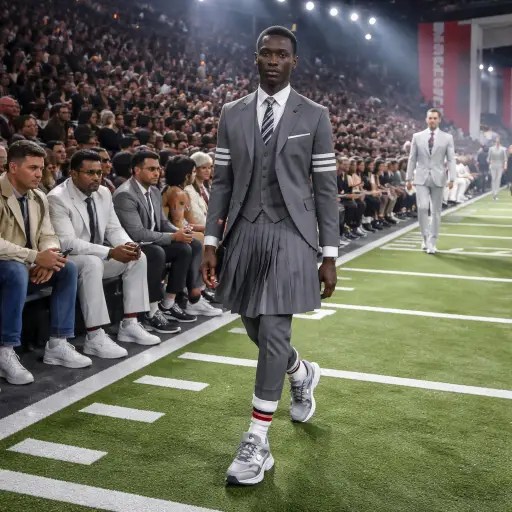
Thom Browne’s GQ Bowl turns Super Bowl culture into a runway spectacle on the West Coast
During Super Bowl week, the Bay Area is usually defined by shoulder pads, statistics, and stadium lights. This season, it also belonged to tailoring. In a cavernous industrial venue on the edge of the city, designer Thom Browne staged his GQ Bowl runway show, transforming one of America’s most athletic weekends into a sharply dressed cultural crossroads.
The GQ Bowl, now a fixture on the fashion-and-sports calendar, arrived on the West Coast with uncommon ambition. Timed to the Super Bowl LX weekend, the show leaned directly into the energy of football culture while reframing it through Browne’s precise, experimental lens. Models walked with the focus of athletes heading into a championship, their uniforms replaced by meticulously constructed looks that nodded to sports ritual without ever slipping into costume.
Browne’s fascination with uniforms has long been central to his work, and the GQ Bowl felt like a natural extension of that obsession. Gray tailoring, his signature, was reworked with exaggerated proportions and unexpected layering. Skirts worn over trousers — once a provocation, now a confident statement — moved easily down the runway, paired with sharply pressed shirts and structured jackets that suggested both locker-room discipline and couture-level control.
Sneakers, too, played a starring role. Collaborations designed specifically for the event blurred the line between performance footwear and luxury object. On the runway, they grounded the looks in contemporary street culture, acknowledging that modern fashion authority often starts at ground level. The effect was intentional: this was a show that understood how men dress now, not just how they might dress for a fashion fantasy.
The front row reflected that philosophy. NFL players, former champions, and current stars sat alongside actors, musicians, and editors, creating a crowd that felt less like a traditional fashion audience and more like a snapshot of modern American influence. Cameras flashed as readily for athletes as they did for celebrities, reinforcing the idea that style capital today is shared between locker rooms and red carpets.
GQ’s role in orchestrating the event was crucial. The publication has spent years positioning itself at the intersection of menswear, culture, and sport, and the GQ Bowl has become its most visible expression of that strategy. By inviting a designer as conceptually rigorous as Browne into the Super Bowl orbit, GQ signaled that fashion no longer needs to orbit sports cautiously. It can meet it head-on.
What made the show resonate most was its refusal to treat football as a novelty. Instead of borrowing logos or leaning on obvious references, Browne focused on the emotional architecture of sport: preparation, repetition, and the quiet intensity before competition. The models’ synchronized pacing, the disciplined styling, and the restrained palette all echoed the mindset of elite athletes preparing for the biggest game of the year.
Critics responded quickly. Reviews praised the collection’s confidence and clarity, noting how seamlessly Browne translated athletic energy into high fashion without diluting either. The skirts-over-pants silhouettes, once divisive, were singled out as emblematic of Browne’s influence on contemporary menswear — proof that ideas once considered fringe can become mainstream through persistence and precision.
Beyond the clothes, the GQ Bowl captured a broader cultural shift. Fashion and sports are no longer parallel industries occasionally crossing paths; they are deeply intertwined ecosystems shaping taste, identity, and aspiration. Athletes launch fashion labels, designers collaborate with teams, and style conversations unfold on sidelines as much as on runways.
As Super Bowl festivities continued across the region, Browne’s show lingered in the conversation. It suggested a future where the most compelling fashion moments don’t compete with sports’ biggest stages — they inhabit them. In San Francisco, tailoring met touchdown culture and didn’t blink. The result was a reminder that the most powerful uniforms are the ones that know exactly where they belong.



 The Tower Post