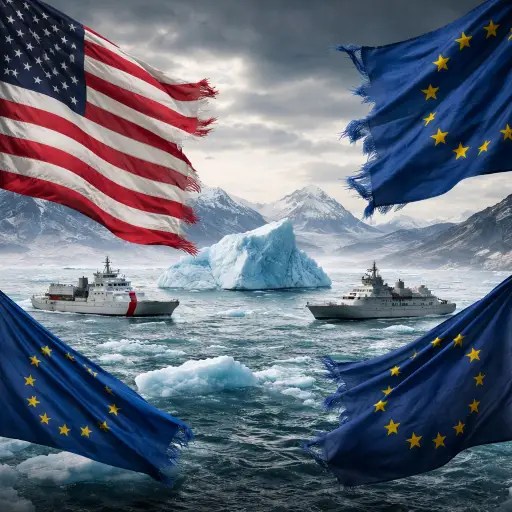
A YouGov survey across six countries points to a sharp cooling of sentiment toward Washington, as debates over autonomy and alliance politics reshape Europe’s outlook.
By early February 2026, a noticeable shift has taken hold in Western European public opinion toward the United States. A recent YouGov poll conducted across Denmark, France, Germany, Italy, Spain and the United Kingdom shows a steep decline in favorable views of Washington, marking one of the most significant drops in years.
The cooling of sentiment follows a period of political friction, crystallised by a controversial episode involving Greenland that reignited long‑standing European sensitivities about sovereignty, consultation and respect between allies. While the dispute itself was limited in scope, its symbolic weight proved far greater, acting as a catalyst for broader unease about the direction of U.S. foreign policy and its implications for Europe.
Across the six countries surveyed, voters expressed growing skepticism about Washington’s reliability as a partner. In Denmark, where Greenland holds particular national and strategic significance, reactions were especially pronounced. Many respondents described the episode as emblematic of an increasingly transactional U.S. approach to international relations—one that places strategic advantage above alliance norms.
In France and Germany, the poll results reflect a longer‑running debate. For years, political leaders and analysts in both countries have argued for greater European “strategic autonomy.” The latest findings suggest that this idea is no longer confined to elite circles. A substantial share of the public now agrees that Europe should be more capable of acting independently of the United States, particularly in diplomacy and security.
Southern European countries show a similar, if slightly more nuanced, pattern. In Italy and Spain, favorable views of the U.S. have fallen markedly, driven less by the Greenland dispute itself than by a perception of unpredictability in Washington. Respondents in both countries voiced concern that sudden policy shifts could leave allies exposed, reinforcing the case for stronger European coordination.
The United Kingdom stands out as a special case. Traditionally the most Atlanticist of the six, British public opinion has also cooled, though support for close ties with Washington remains higher than on the continent. Even so, the poll indicates that a growing number of UK voters now favor balancing the transatlantic relationship with deeper engagement in European security frameworks.
Despite the souring mood, the survey does not suggest a wholesale rejection of the U.S. alliance. Defence cooperation still enjoys broad backing across Western Europe. Many respondents distinguish between political trust and practical necessity, acknowledging that cooperation with Washington remains central to Europe’s security architecture, particularly within NATO.
What has changed is the hierarchy of priorities. Where maintaining strong U.S. ties once dominated, many Europeans now place European autonomy at the top of the agenda. This does not mean turning away from Washington, but rather recalibrating the relationship to reduce dependency and increase Europe’s capacity to act on its own terms.
Analysts note that public opinion often lags behind political discourse; in this case, it may be catching up. Calls for greater defence spending, joint procurement and coordinated foreign policy have circulated in European capitals for years. The Greenland episode appears to have translated these abstract discussions into a tangible moment for voters, sharpening perceptions of vulnerability.
The implications for transatlantic relations are significant. A Europe more confident in its own capabilities could become a stronger partner for the United States, but only if mutual trust is rebuilt. Without that trust, cooperation risks becoming more conditional and transactional on both sides.
As February unfolds, the message from Western European voters is clear: the alliance with the United States still matters, but it can no longer be taken for granted. Respect, consultation and predictability are now seen as prerequisites, not optional extras. The Greenland episode may fade from headlines, but its impact on European attitudes toward Washington is likely to endure.


 The Tower Post