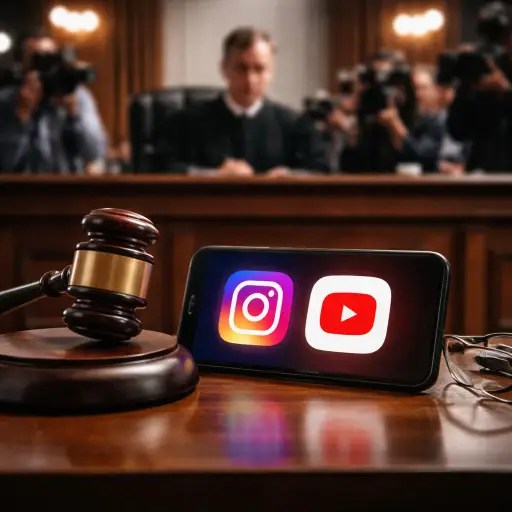
A landmark case in California probes whether Instagram and YouTube’s design choices harmed young users—and what that means for Big Tech’s future.

A closely watched state court trial is underway in California, placing two of the world’s most influential social platforms under an unusually bright legal spotlight. At the center of the case is a question that has long hovered over the digital lives of young people: did Instagram and YouTube intentionally design their products to be addictive, and if so, should they be held responsible for the mental-health consequences experienced by minors?
The proceedings mark one of the most ambitious attempts yet to translate years of academic research, whistleblower testimony, and parental concern into courtroom accountability. Plaintiffs argue that features such as infinite scroll, algorithmic recommendations, and persistent notifications were not neutral design decisions, but deliberate mechanisms to maximize engagement—often at the expense of adolescent well-being.
Defense attorneys counter that social media platforms are expressive services protected by existing law, widely used for creativity, learning, and connection. They say responsibility ultimately lies with families and users, not the tools themselves. The outcome could help define the boundaries of platform liability in the digital age.
A courtroom built on research and personal stories
The trial is expected to unfold through a blend of expert testimony and deeply personal accounts. Psychologists and neuroscientists are poised to explain how adolescent brains respond to variable rewards, social validation, and algorithmic feedback loops. Internal company documents and product-development discussions may be scrutinized to determine whether risks to youth mental health were understood—and how they were weighed against business incentives.
Alongside the technical evidence, the court will hear from families describing struggles with anxiety, sleep disruption, compulsive use, and social withdrawal. These stories are intended to give human texture to abstract debates about engagement metrics and design architecture.
The plaintiffs’ legal strategy reflects a shift away from earlier arguments that focused primarily on content moderation. Instead of asking why harmful material appeared on feeds, the case zeroes in on how the platforms themselves functioned: how they nudged users to stay longer, return more often, and measure self-worth through likes, views, and follower counts.
A challenge to long-standing legal shields
For decades, U.S. courts have treated digital platforms differently from traditional publishers, granting broad protections that limit liability for user-generated content. This case tests whether those protections also extend to product design choices that allegedly encourage compulsive behavior.
Legal analysts note that the distinction matters. If a court finds that certain features constitute a defective or harmful product rather than protected speech, it could open a new pathway for lawsuits—not only against social media companies, but against other digital services built around engagement-driven models.
The companies involved insist that existing safeguards, parental controls, and wellness tools demonstrate good-faith efforts to address concerns. They also point to the difficulty of drawing a clear causal line between platform use and mental-health outcomes, citing broader social and environmental factors affecting youth.
Why this trial matters beyond California
Although the case is being heard in a state court, its implications are national—and potentially global. Regulators in multiple jurisdictions have been circling similar issues, from age-appropriate design codes to restrictions on targeted recommendations for minors. A verdict that recognizes liability tied to addictive design could accelerate legislative efforts already in motion.
The timing is significant. Public skepticism toward Big Tech has hardened, fueled by years of data-privacy controversies, antitrust actions, and revelations from former employees. Lawmakers increasingly frame digital platforms not just as innovative services, but as powerful infrastructures shaping behavior at scale.
This trial fits squarely into that broader trend. Rather than proposing new rules from scratch, it asks whether existing consumer-protection and product-liability principles can be applied to software experiences that are intangible yet deeply influential.
The defense of engagement
From the companies’ perspective, engagement is not a vice but a sign of value. Lawyers argue that recommending videos or posts users might enjoy is no different in principle from a bookstore highlighting popular titles. They warn that penalizing engagement-driven design could stifle innovation and blur the line between helpful personalization and unlawful manipulation.
They also stress the benefits these platforms provide to young people: creative outlets, educational content, social support networks, and exposure to diverse viewpoints. Any harms, they argue, must be weighed against these advantages.
Still, critics note that the analogy to traditional media breaks down when algorithms adapt in real time, optimizing for attention with a level of precision never before possible. The question before the court is whether that difference is merely technological—or legally meaningful.
A bellwether moment
Whatever the verdict, the trial is already shaping the conversation around youth, technology, and responsibility. Companies across the tech sector are watching closely, aware that a finding against Instagram or YouTube could ripple outward, influencing product roadmaps, risk assessments, and investor expectations.
For parents and advocates, the case represents a long-sought opportunity to move beyond warnings and wellness tips toward enforceable standards. For the platforms, it is a test of whether the business models that defined the social media era can withstand a new phase of scrutiny.
As testimony continues, one thing is clear: the courtroom has become the latest arena in a cultural reckoning over how much responsibility technology companies bear for the effects of their designs—and how society chooses to protect its youngest users in a hyperconnected world.