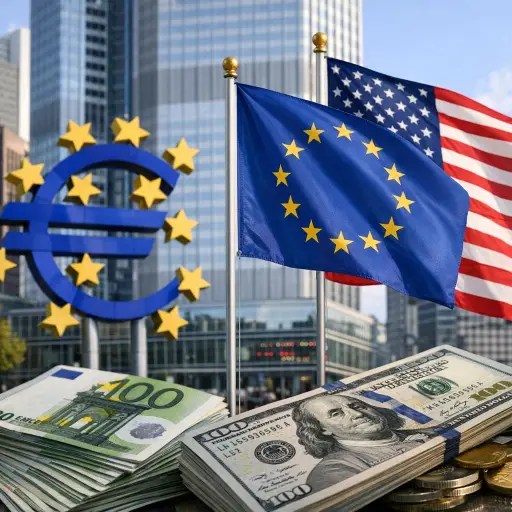
As confidence in the U.S. dollar shows signs of strain, European policymakers argue the euro and the continent’s financial infrastructure must be ready to shoulder greater global responsibility.
Europe is being urged to prepare for a larger role in global finance as the long-standing dominance of the U.S. dollar shows signs of erosion. Policymakers at the European Central Bank say shifting geopolitical realities, rising fiscal uncertainty in the United States, and a fragmented global economy are opening a window for the euro to take on greater international importance.
Martin Kocher, an ECB policymaker and Austria’s former economy minister, said Europe must act decisively if it wants to turn the euro’s growing appeal into lasting strategic influence. The weakening of the dollar, he argued, is not merely a currency story but a structural moment that could redefine how global trade, reserves, and financial stability are managed.
“For decades, Europe has benefited from a dollar-centric system without fully preparing alternatives,” Kocher said. “If that system is now gradually rebalancing, Europe needs to ensure its own financial architecture is strong, credible, and ready for scale.”
A Shifting Global Currency Landscape
The U.S. dollar remains the world’s dominant reserve and transaction currency, but its supremacy is no longer unquestioned. Persistent political polarization in Washington, repeated debt ceiling standoffs, and the extensive use of financial sanctions have led some governments and central banks to seek diversification away from the dollar.
At the same time, global trade is becoming more regionalized. Energy markets, supply chains, and strategic commodities are increasingly priced and settled in a wider range of currencies. In this environment, the euro has quietly gained traction as a partial alternative, particularly among countries looking for stability without overexposure to U.S. policy risk.
According to Kocher, the euro’s appeal lies less in ambition and more in predictability. The euro area’s large economic base, independent central bank, and relatively conservative monetary framework make it attractive as a store of value during periods of volatility. But credibility alone will not be enough.
“The euro can only function as a true safe-haven currency if markets know they can rely on deep liquidity, seamless cross-border payments, and robust crisis-management tools,” he said.
Infrastructure Before Ambition
Kocher stressed that Europe must invest in the basic infrastructure of global finance before expecting broader adoption of the euro. This includes strengthening market plumbing, improving clearing and settlement systems, and ensuring that European capital markets can absorb large international flows without destabilization.
A major priority is the expansion of global liquidity swap lines. These mechanisms allow central banks to exchange currencies during times of stress and were instrumental in stabilizing markets during past crises. Kocher argued that Europe should be prepared to use these tools more proactively as part of a standing framework for global financial stability.
“If Europe wants the euro to play a stabilizing role globally, it must be prepared to act as a liquidity provider, not only as a regulator,” he said.
Strategic Gains and Political Limits
A stronger international role for the euro could reduce exchange-rate risks for European firms, lower borrowing costs, and strengthen the EU’s strategic autonomy. However, Kocher acknowledged that such a shift would also require difficult political choices.
Deeper financial integration would likely demand progress on capital markets union, more fiscal coordination, and greater risk-sharing among member states. Some governments remain cautious, concerned about exposure to external shocks or the domestic political costs of integration.
“These are not purely technical decisions,” Kocher said. “They involve fundamental questions about solidarity and shared responsibility.”
Toward a Multipolar Monetary Order
ECB officials are careful to emphasize that this moment does not signal the imminent collapse of the dollar. Instead, Kocher described a slow transition toward a more multipolar monetary system in which the euro, alongside the dollar and possibly other currencies, shares responsibility for global liquidity and stability.
“The issue is not replacing the dollar,” he said. “It is whether Europe is ready to step up when global conditions require it.”
As financial markets adapt to a world of higher uncertainty and geopolitical fragmentation, Europe faces a defining choice. By strengthening its financial infrastructure and policy coordination, the continent can ensure that the euro’s growing global profile becomes a source of resilience rather than vulnerability.


 The Tower Post