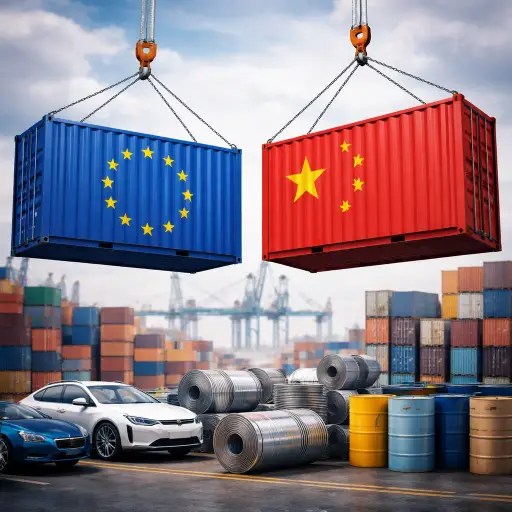
A confidential strategy paper circulating in government circles revives radical ideas as European officials search for ways to slow China’s advance across key industries.
By early February, a sense of urgency has settled over Europe’s industrial policy debate. A strategy report prepared by advisers close to the French government is forcing uncomfortable questions onto the European agenda: how far should the continent go to protect its manufacturing base from intensifying competition from China?
According to officials familiar with the document, the report outlines two stark options that would have been unthinkable in mainstream European policy discussions only a few years ago. One is the imposition of tariffs of up to 30 percent on a broad range of Chinese imports. The other is a deliberate weakening of the euro — potentially allowing it to depreciate by 20 to 30 percent against the Chinese renminbi — in order to restore price competitiveness for European producers.
The proposals are framed not as immediate policy recommendations, but as a stress test for Europe’s economic strategy. Their authors argue that incremental measures may no longer be sufficient as Chinese firms continue to gain market share in sectors long considered pillars of Europe’s industrial strength, including automobiles, chemicals, machinery, and clean-energy technologies.
For European carmakers, the challenge has become particularly visible. Chinese electric vehicle manufacturers have moved rapidly from niche players to serious competitors, combining scale, aggressive pricing, and strong state backing. Similar dynamics are playing out in chemicals and basic materials, where European producers complain of chronic overcapacity in China spilling into global markets at prices they struggle to match.
The report’s authors contend that Europe is facing a structural shock rather than a cyclical one. In their view, Chinese industrial policy — characterized by heavy subsidies, preferential financing, and strategic coordination — has altered the competitive landscape in ways that conventional trade defenses cannot fully address. Anti-dumping cases and targeted safeguards, they argue, risk being too slow, too narrow, and too fragmented.
Tariffs on the scale discussed in the report would represent a dramatic departure from Europe’s traditional role as a champion of open markets. A blanket duty of around 30 percent on Chinese imports would almost certainly provoke retaliation, disrupt supply chains, and raise costs for European consumers and companies alike. The report acknowledges these risks explicitly, warning that such a move could strain relations with trading partners and test the resilience of the global trading system.
The alternative scenario — a significantly weaker euro — is no less controversial. Allowing the currency to depreciate sharply against the renminbi could, in theory, improve the competitiveness of European exports without explicitly violating trade rules. But it would also carry consequences for inflation, financial stability, and the credibility of Europe’s monetary framework. The report notes that engineering or tolerating such a depreciation would be politically sensitive and institutionally complex, given the independence of the European Central Bank.
Behind these radical ideas lies a broader concern about deindustrialization. Advisers warn that without a stronger response, Europe risks a gradual erosion of its industrial ecosystem, with knock-on effects for employment, technological capacity, and strategic autonomy. Once lost, they argue, industrial capabilities are difficult and costly to rebuild.
The document also reflects a shifting political mood. Across several European capitals, skepticism is growing about the assumption that deeper economic integration with China will naturally converge toward fair competition. Instead, there is increasing acceptance of the idea that Europe must defend its interests more assertively, even at the cost of friction.
Still, the report stops short of advocating immediate action. Its authors emphasize the formidable obstacles any such measures would face. Tariffs of the proposed magnitude would require broad political consensus among European Union member states, many of which remain deeply divided over how confrontational a stance to take toward Beijing. A weaker euro, meanwhile, would raise questions about the limits of political influence over monetary policy.
In that sense, the value of the report may lie less in its specific proposals than in the debate it seeks to provoke. By putting previously taboo options on the table, French advisers are signaling that the status quo is no longer seen as sustainable. The choice, as the report frames it, is not between protectionism and free trade, but between managed adjustment and unmanaged decline.
As Europe weighs its next steps, officials insist that dialogue and negotiation with China remain essential. Yet the message from Paris is clear: without credible leverage, Europe’s calls for reciprocity may continue to fall on deaf ears. Whether through tougher trade defenses, industrial policy, or macroeconomic adjustment, the continent is being forced to reconsider how it competes in a world of increasingly hard-edged economic rivalry.


 The Tower Post