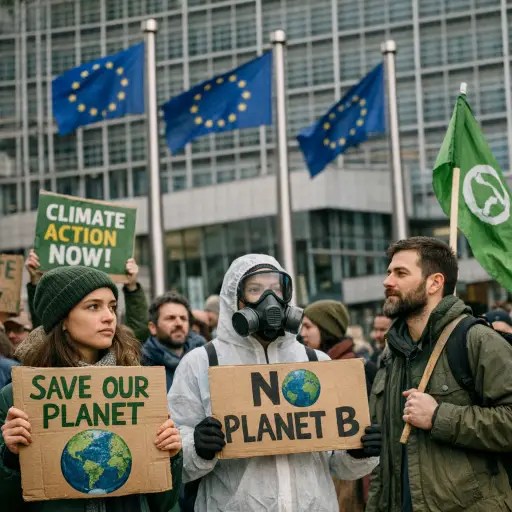
Campaigners warn that weakening climate rules to revive growth would undermine Europe’s long-term competitiveness and clean innovation
As European leaders search for ways to revive a sluggish economy, environmental campaigners are intensifying pressure on the European Union not to retreat from its green agenda. With competitiveness and industrial policy climbing the political agenda, activists fear that environmental protections could become an early casualty of efforts to stimulate growth.
Across Brussels and national capitals, the debate has sharpened ahead of high-level discussions on Europe’s economic direction. Business groups and several governments have argued that regulatory burdens are stifling investment and slowing industrial recovery. Environmental organizations counter that easing climate and environmental rules would offer only short-term relief while weakening the foundations of future growth.
“The idea that environmental standards are a drag on the economy is outdated,” said one senior campaigner involved in recent advocacy efforts. “Europe’s best chance of remaining competitive lies in accelerating the transition to clean technologies, not postponing it.”
Environmentalists point to renewable energy, clean manufacturing, and circular economy industries as areas where Europe has already built significant expertise. Rolling back regulations now, they argue, would send confusing signals to investors just as global competition for green capital is intensifying. Instead of regulatory retreat, they are calling for clearer long-term policy commitments that reduce uncertainty and unlock private investment.
The concern is not only about climate targets, but also about broader environmental safeguards, including rules on pollution, biodiversity protection, and sustainable resource use. Campaigners warn that weakening these frameworks could increase future costs, from public health impacts to environmental damage that would require expensive remediation.
Economic anxieties have nevertheless given momentum to calls for a “pause” or “simplification” of some green measures. Several industry representatives argue that high energy prices, supply chain disruptions, and slowing demand have left European companies struggling to compete with rivals in other regions. In their view, flexibility on environmental rules could provide breathing space.
Environmental groups respond that the problem lies less with green policy itself than with uneven implementation and insufficient investment. They argue that companies face challenges because promised support mechanisms, such as infrastructure upgrades and coordinated industrial planning, have lagged behind ambitions.
A recurring demand from campaigners is for stronger industrial investment plans that align competitiveness with sustainability. Rather than diluting standards, they want the EU to accelerate funding for clean energy grids, low-carbon transport, and next-generation manufacturing. Such investments, they say, would lower costs for businesses while reinforcing Europe’s climate commitments.
There is also a geopolitical dimension to the debate. Environmental advocates warn that stepping back from climate leadership would weaken Europe’s influence in global negotiations and technology markets. As other major economies pour resources into clean industries, the EU risks falling behind if it signals wavering commitment.
Public opinion remains an important factor. Surveys and recent mobilizations suggest that climate action still commands broad support across much of Europe, even amid economic uncertainty. Activists argue that policymakers underestimate voters’ willingness to back long-term environmental strategies if they are paired with credible plans for jobs and social protection.
At the heart of the dispute is a question of timing and vision. Critics of the green agenda see environmental policy as something that can be slowed and restarted later. Environmentalists reject this framing, insisting that delays today will make future transitions more abrupt and costly.
“Every year of hesitation locks in outdated infrastructure and higher emissions,” said a policy analyst at a European environmental think tank. “That is not a recipe for stability or prosperity.”
As EU leaders weigh their options, campaigners are urging them to resist what they see as a false choice between economic recovery and environmental responsibility. In their view, the real risk lies in abandoning a strategy that could deliver both.
The coming weeks will test whether Europe’s green ambitions can withstand economic headwinds. For environmentalists, the message is clear: holding the line on climate and environmental standards is not an obstacle to growth, but a prerequisite for a resilient and competitive European economy.
 The Tower Post