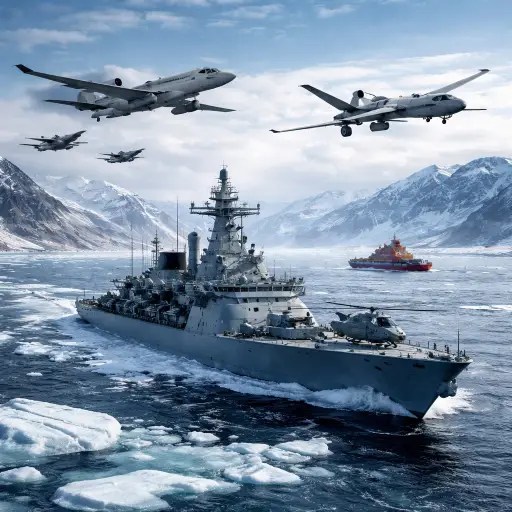
An expanded surveillance and deterrence mission signals a strategic shift as allied planners respond to rising geopolitical friction across the Arctic.
As winter light barely lifts over the High North, NATO military planners are preparing a new chapter in the alliance’s northern posture. The initiative, informally referred to by officials as “Arctic Sentry,” is designed to expand surveillance, situational awareness, and defensive coordination across a region that is no longer viewed as a geopolitical backwater.
Once defined by scientific cooperation and low military visibility, the Arctic is rapidly becoming a space of strategic competition. Melting sea ice is opening new maritime corridors, exposing undersea infrastructure, and sharpening questions of sovereignty. Against this backdrop, NATO’s move reflects a growing consensus among allied capitals that deterrence in the Arctic now requires persistent presence rather than episodic patrols.
At the core of Arctic Sentry is an enhanced network of intelligence, surveillance, and reconnaissance assets. Allied officials describe a layered approach that blends long‑endurance drones, maritime patrol aircraft, surface vessels, and space‑based sensors. The aim is not to militarize the region in a dramatic fashion, planners insist, but to ensure that the alliance can see, understand, and respond to developments across vast and sparsely populated territory.
Recent diplomatic friction has accelerated these preparations. Discussions among European NATO members and the United States over security responsibilities linked to Greenland have exposed differing perspectives on how best to manage the island’s strategic importance. While the talks have remained within alliance channels, they have underscored the sensitivity of Arctic governance at a moment when external pressure is increasing.
Greenland’s geographic position makes it a linchpin for transatlantic security. It sits astride critical air and sea routes connecting North America and Europe, and hosts infrastructure essential for early warning and missile defense. As competition intensifies, allied officials say coordination around Greenland is less about ownership and more about assurance—ensuring that gaps do not emerge in collective defense.
Arctic Sentry is expected to operate across a broad swath of the High North, from the North Atlantic approaches to the Arctic Ocean itself. Unmanned aerial systems will provide persistent coverage over remote waters, while patrol aircraft will monitor submarine and surface activity. Naval units, including ice‑capable vessels, will contribute to presence missions and search‑and‑rescue readiness, reinforcing the message that NATO remains engaged even in the harshest environments.
Military planners emphasize that the mission’s posture is defensive. Yet deterrence, they argue, is built as much on clarity as on capability. By demonstrating the ability to monitor activity and coordinate responses, the alliance hopes to reduce the risk of miscalculation. In a region where distances are vast and communication can be limited, the margin for error is thin.
The Arctic’s transformation has been driven in part by climate change. Receding ice has shortened shipping routes and expanded access to natural resources, attracting commercial interest and strategic attention. What was once seasonally inaccessible is increasingly navigable, raising the stakes for states with Arctic ambitions. For NATO, this means adapting long‑standing defense concepts to an environment that is changing faster than doctrine.
Officials involved in the planning process note that Arctic Sentry builds on existing cooperation rather than replacing it. Joint exercises, information sharing, and bilateral arrangements among Arctic allies have laid the groundwork. The new mission seeks to knit these efforts together under a more coherent operational framework, allowing faster decision‑making and clearer lines of responsibility.
Still, the initiative is not without internal debate. Some allies are wary of provoking escalation, arguing that the Arctic has remained relatively stable precisely because it avoided overt militarization. Others counter that the absence of a visible NATO posture could invite opportunistic behavior by competitors. The compromise, reflected in Arctic Sentry’s design, leans toward transparency and monitoring rather than permanent basing or large troop deployments.
From Washington to European capitals, officials stress that diplomacy remains central. Confidence‑building measures, adherence to international law, and continued engagement through multilateral forums are seen as essential complements to military preparedness. Arctic Sentry, in this view, is an insurance policy—one intended to preserve stability rather than undermine it.
As preparations advance, the timing is deliberate. Mid‑winter conditions offer a stark reminder of the operational challenges the Arctic presents, while recent political signals have sharpened awareness of what is at stake. By moving now, NATO aims to demonstrate that it can adapt to a changing strategic landscape without abandoning its emphasis on collective defense and restraint.
Whether Arctic Sentry will succeed in balancing deterrence and stability remains an open question. What is clear is that the High North has moved firmly onto the alliance’s strategic map. In the quiet expanse of ice and sea, NATO is preparing to watch more closely than ever before.




 The Tower Post