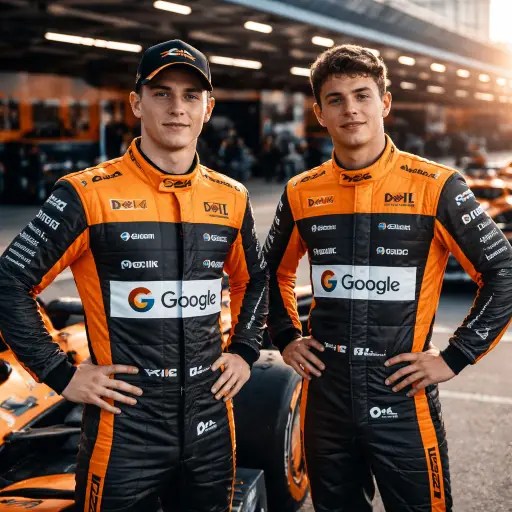
McLaren chief Zak Brown believes the Australian is following a championship-shaped path as Formula One prepares for a decisive new phase
In the final calm moments before Formula One engines return to life, one name keeps surfacing in paddock conversations with growing insistence: Oscar Piastri. Calm, methodical and increasingly ruthless when opportunity presents itself, the McLaren driver is no longer framed as a promising understudy. He is being discussed, openly and seriously, as a future title contender — perhaps sooner than expected.
McLaren team principal Zak Brown added fuel to that discussion this week, suggesting Piastri’s development mirrors the rise of his teammate Lando Norris, now widely regarded as a fully fledged championship benchmark. Brown’s assessment, offered as teams ready themselves for crucial pre‑season testing, was measured rather than sensational. Yet its implications were unmistakable: McLaren believes it may have two drivers capable of fighting at the front this season.
Piastri’s trajectory has been anything but accidental. Since arriving in Formula One with a formidable junior résumé, he has combined technical precision with a temperament that has impressed engineers and rivals alike. Where others have required time to adapt to the political and psychological pressures of the sport, Piastri has appeared almost preternaturally composed, absorbing information, responding to feedback and executing race strategies with minimal drama.
Brown’s comparison with Norris is rooted in more than statistics. Norris’s early seasons were defined by speed tempered by inconsistency, flashes of brilliance punctuated by lessons learned the hard way. Over time, those lessons hardened into confidence, race craft and leadership. Piastri, according to McLaren’s internal assessments, is tracing a similar arc — but on a steeper incline.
“Drivers don’t all mature at the same rate,” one senior engineer noted privately. “Oscar processes weekends like a veteran. That doesn’t mean he’s finished developing — it means the ceiling is very high.”
That ceiling matters because Formula One is entering a phase where marginal gains decide championships. The grid has compressed, technical regulations have stabilized, and operational excellence now carries as much weight as outright car performance. In such an environment, a driver capable of extracting performance consistently, without emotional spikes, becomes a strategic asset.
Piastri’s on-track evolution has been most evident in wheel‑to‑wheel combat. Early caution has given way to calculated assertiveness. He chooses battles carefully, but when he commits, he does so decisively. Rivals have noticed. So have analysts, who point to his ability to adapt driving style across varying track conditions — a hallmark of elite championship contenders.
For McLaren, the internal dynamic is delicate but potentially transformative. Norris remains the team’s established reference point, the driver around whom development cycles have traditionally revolved. Yet Brown has made it clear that performance, not seniority, will dictate opportunity. The message is subtle but firm: McLaren is preparing for a future in which intra‑team competition is not a risk, but a strength.
This approach echoes successful models from previous championship eras, where strong pairings pushed teams beyond their perceived limits. The challenge lies in maintaining equilibrium — ensuring that competitive tension fuels progress rather than friction. McLaren insiders insist the relationship between Norris and Piastri is respectful, professional and increasingly collaborative.
As teams prepare for the first meaningful running of the year, expectations remain carefully managed. No one at McLaren is declaring a title charge outright. Testing can mislead, and early narratives have a habit of collapsing once racing begins. Still, Brown’s words were not accidental. In Formula One, public confidence often reflects private conviction.
Piastri himself has remained characteristically understated. When asked about championship ambitions, he speaks in process-driven language: improvement, consistency, execution. It is the rhetoric of a driver who understands that titles are not won by declarations, but by accumulation — of points, of trust, of performance delivered when it matters most.
The broader paddock senses a shift. McLaren is no longer discussed as a team waiting for the next regulation reset. It is seen as a present‑tense contender, armed with technical momentum and a driver line‑up that rivals any on the grid. In that context, Piastri’s rise is not merely a personal success story; it is a strategic inflection point.
Whether this season becomes a genuine title campaign remains to be seen. Formula One rarely follows clean scripts. But the signs are increasingly difficult to ignore. Oscar Piastri is no longer just learning from a championship-caliber teammate. According to those who know him best, he is beginning to look like one himself.



 The Tower Post