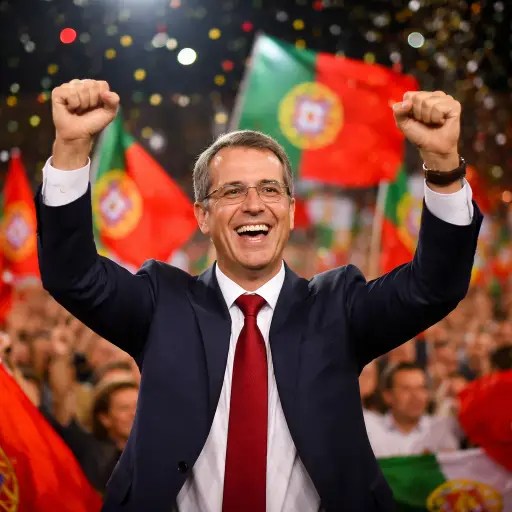
António José Seguro’s landslide presidential victory signals a renewed confidence in democratic centrism across Europe
Portugal has elected a new head of state in a decisive vote that many observers see as a statement of political values as much as a choice of leadership. Moderate Socialist António José Seguro secured an emphatic victory in the presidential election, winning close to two-thirds of the ballots cast and comfortably defeating far-right challenger André Ventura.
Although the Portuguese presidency is largely ceremonial, the scale of Seguro’s triumph has resonated far beyond the confines of the Belém Palace. In a European context marked by polarization, distrust of institutions, and the steady rise of populist movements, the result has been widely interpreted as a rebuke to radical rhetoric and an affirmation of democratic norms.
Seguro, a veteran of the Socialist Party known for his conciliatory tone and institutional loyalty, ran a campaign focused on unity, constitutional stability, and respect for pluralism. Avoiding incendiary language, he presented himself as a guarantor of dialogue at a time when political discourse across the continent has grown increasingly abrasive. His message appears to have mobilized a broad coalition of voters, from the center-left to moderate conservatives, determined to block the advance of the far right.
In contrast, Ventura’s campaign leaned heavily on themes of law and order, cultural identity, and opposition to what he describes as an entrenched political elite. His performance, while falling well short of victory, nonetheless marked the strongest showing ever for a far-right candidate in a Portuguese presidential race. Roughly a third of voters backed him, underscoring that Portugal is not immune to the political currents reshaping parts of Europe.
For many analysts, this dual reality defines the election’s significance. On one hand, Seguro’s landslide suggests that when mainstream forces coalesce, they can still command overwhelming support. On the other, Ventura’s result points to a durable and vocal minority receptive to populist narratives, particularly in regions grappling with economic insecurity and social change.
European leaders and pro-democracy advocates have been quick to welcome the outcome. At a moment when several countries are wrestling with democratic backsliding, Portugal’s vote has been framed as a hopeful counterexample — proof that voters can push back against extremism without abandoning electoral participation or democratic institutions.
Seguro is expected to use the moral authority of the presidency to encourage consensus and to act as a stabilizing presence amid an often-fragmented parliamentary landscape. While he will not set government policy, his influence over public debate, combined with the symbolism of his mandate, could shape the tone of Portuguese politics in the years ahead.
Yet challenges remain. The election has revealed a society that is broadly committed to democratic moderation but increasingly divided in its frustrations. Addressing the concerns that fuel far-right support — from inequality to perceptions of political distance — will fall largely to the government and parliament, not the president alone.
As Portugal turns the page, the message of this election is both reassuring and cautionary. The electorate has clearly rejected populism at the highest institutional level, but it has also signaled that discontent persists beneath the surface. How the country’s leaders respond may determine whether this decisive vote marks a lasting reaffirmation of democratic confidence or merely a pause in a deeper political struggle.



 The Tower Post