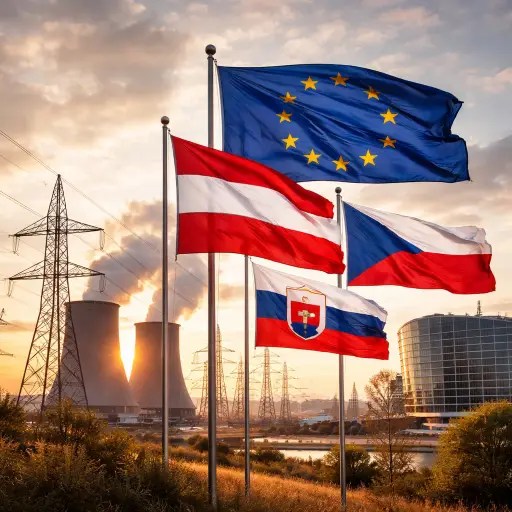
Austria, the Czech Republic and Slovakia press Brussels to rethink energy and carbon policies as high electricity costs weigh on European industry
As European leaders gather in Brussels this week, energy costs have surged to the top of the political agenda. Prime ministers from Austria, the Czech Republic and Slovakia are calling on the European Union to take urgent steps to bring down electricity prices, warning that persistently high power costs are eroding the competitiveness of European industry at a critical moment for the continent’s economy.
In a coordinated push ahead of the summit, the three Central European governments argue that energy has become a strategic vulnerability for the EU. Manufacturers across sectors ranging from steel and chemicals to automotive and advanced engineering, they say, are struggling to compete with rivals in regions where electricity is significantly cheaper and more predictable.
At the heart of their message is a demand for a recalibration of EU energy and climate policy. While reaffirming their commitment to long-term decarbonisation goals, the leaders insist that the current framework for electricity pricing and carbon costs is placing a disproportionate burden on European producers, particularly those with energy‑intensive operations.
Electricity prices across much of the EU remain structurally higher than in key competing economies. Central European officials point to the lingering effects of market volatility, the design of wholesale power pricing, and the cumulative impact of carbon pricing mechanisms. In their view, these factors combine to inflate costs well beyond what many firms can absorb or pass on to customers.
The prime ministers are expected to raise concerns about the EU’s emissions trading system and its interaction with power markets. They argue that while carbon pricing has been an effective tool for reducing emissions, its impact on electricity bills now needs closer scrutiny. Without adjustments or compensatory measures, they warn, production may increasingly shift outside Europe, undermining both economic strength and environmental objectives.
Their intervention reflects broader unease within European business circles. Industry groups have repeatedly cautioned that investment decisions are being delayed or redirected as companies reassess the viability of operating in Europe. Some executives have openly compared the EU’s energy landscape unfavorably with that of North America and parts of Asia, where lower energy costs are seen as a decisive competitive advantage.
Central Europe’s economies are particularly exposed to these pressures. Austria, the Czech Republic and Slovakia all host significant manufacturing bases that are deeply integrated into European and global supply chains. Any sustained loss of competitiveness, their leaders argue, would ripple across employment, exports and public finances, with consequences extending far beyond national borders.
The call for lower power prices does not amount to a rejection of Europe’s green transition. Instead, the three governments are urging a more pragmatic sequencing of policies, combining climate ambition with safeguards for industrial resilience. Proposals under discussion include changes to market design, greater support for long‑term power contracts, and targeted relief for sectors most affected by high electricity costs.
As EU leaders debate the issue, the outcome is far from certain. Some member states remain cautious about altering carbon pricing, fearing it could weaken climate commitments or distort markets. Others, however, share the concern that Europe risks pricing itself out of global competition if energy costs remain unchecked.
For the Central European leaders, the message is clear: competitiveness and climate policy must move forward together. If the EU fails to address electricity prices, they argue, it risks hollowing out its industrial base at a time when economic strength is essential for maintaining influence on the global stage.


 The Tower Post