Silicon Valley tech workers push back against a controversial immigration enforcement app, exposing a widening rift between innovation and civil liberties.

This month, a quiet but determined campaign has been rippling through Silicon Valley. Software engineers, data scientists, and product designers—many of them veterans of the region’s most powerful firms—are publicly challenging their industry’s role in building a new generation of government surveillance tools.
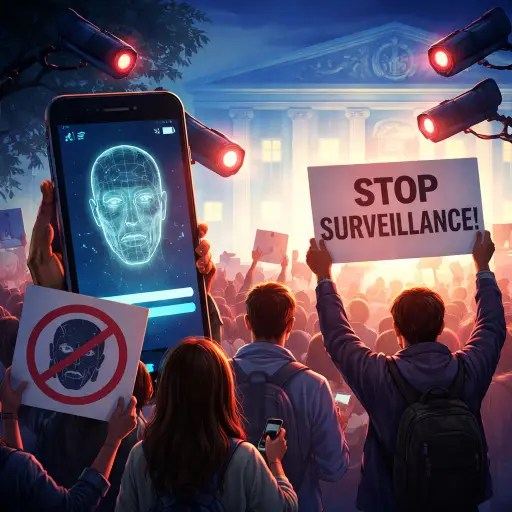
At the center of the controversy is a facial-recognition and digital identity application reportedly used by U.S. immigration authorities. According to reporting by WIRED, the app enables rapid identification of individuals by cross-referencing live images with federal databases. Supporters inside government agencies describe it as a modernization effort. Critics inside the tech community see something else entirely: a normalization of mass biometric surveillance with limited oversight.
The pushback did not begin with a single whistleblower or viral post. Instead, it has taken the shape of coordinated letters, internal petitions, and quiet refusals to work on related contracts. In encrypted group chats and after-hours meetups, workers are sharing legal analyses, ethics frameworks, and personal concerns about how their code could be used.
“This isn’t about politics—it’s about responsibility,” said one senior software engineer at a major cloud provider, who requested anonymity for fear of professional repercussions. “When you build tools that can track people in real time, you’re shaping power. And power needs limits.”
Privacy advocates argue that the app exemplifies a broader trend toward overreach in digital identification technologies. Unlike traditional IDs, biometric systems are difficult—if not impossible—to revoke once compromised. Facial data, critics warn, can be repurposed far beyond its original scope, enabling tracking across public and private spaces.
Developers involved in the campaign point out that many facial-recognition systems still show measurable accuracy gaps across race, age, and gender. In the context of immigration enforcement, those gaps carry serious consequences. “A false match isn’t a bug,” said a machine-learning researcher who has joined the opposition effort. “It’s a life-altering error.”
The movement echoes earlier moments in Silicon Valley’s recent history, when workers organized against military drone software, predictive policing tools, and large-scale data sharing with law enforcement. What feels different now, participants say, is the sense that these debates are no longer hypothetical. The infrastructure is already built, deployed, and expanding.
Company leadership has largely responded with carefully worded statements emphasizing compliance with the law and the importance of government partnerships. Privately, some executives acknowledge the internal strain. Recruiting teams report candidates asking pointed questions about ethical review processes, while managers navigate teams divided over contract work.
Civil liberties groups have seized on the moment, urging lawmakers to impose clearer boundaries on biometric surveillance. They argue that existing regulations were written for a pre-AI era and offer little protection against real-time identification systems integrated into everyday policing and immigration workflows.
For many tech workers, the campaign is also personal. Silicon Valley’s workforce includes large immigrant communities, and engineers describe seeing friends and family reflected in the faces captured by these systems. That proximity, they say, makes abstraction impossible.
Whether the opposition will slow or reshape government use of facial recognition remains uncertain. What is clear is that a new line has been drawn inside the tech industry itself—between those who view technological capability as a mandate to build, and those who insist that restraint is also a form of innovation.
As the debate continues, Silicon Valley finds itself confronting an old question in a sharper light: just because something can be engineered, should it be?