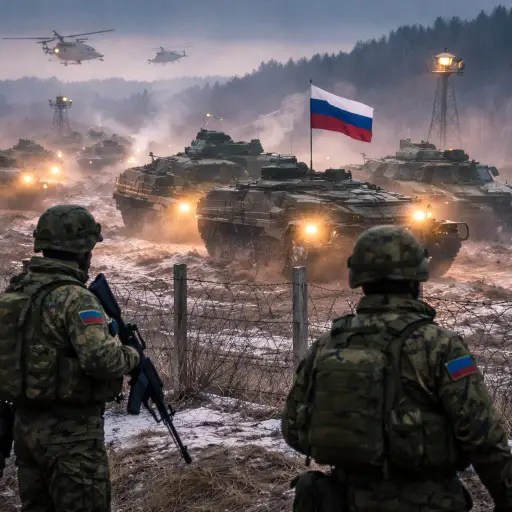
Intelligence officials in Tallinn say Moscow is accelerating force regeneration and ammunition output to counter European rearmament, while avoiding a near-term clash with NATO.
Estonia’s foreign intelligence service has issued a stark assessment of Russia’s military trajectory, warning that Moscow is rapidly rebuilding its forces with the long-term aim of reshaping the balance of power in Europe and loosening transatlantic security ties.
According to the annual threat review released in Tallinn, Russian military planning has entered a new phase following the attrition suffered in Ukraine. While the report judges that Russia is unlikely to initiate a direct military confrontation with NATO states in the immediate term, it argues that the Kremlin is laying the groundwork for a future in which European deterrence is tested more aggressively and more independently of the United States.
At the heart of the assessment is a conclusion that Russia has adapted faster than many European capitals expected. Western sanctions and battlefield losses initially constrained Moscow’s ability to regenerate its forces, but Estonian analysts now say those limits are being steadily eroded. Industrial capacity has been redirected toward sustained war production, particularly in ammunition and unmanned systems, with output levels described as sufficient not only to replenish existing units but to expand them.
The report highlights a sharp rise in artillery shell manufacturing and a maturing drone ecosystem that blends mass-produced, low-cost platforms with more capable long-range systems. Estonian officials say this combination reflects lessons learned from Ukraine: overwhelm air defenses, exhaust ammunition stockpiles, and apply constant pressure rather than seeking rapid breakthroughs.
While the immediate focus of Russia’s force posture remains its western military districts, the assessment places particular emphasis on the Baltic region. Estonia, Latvia, and Lithuania are described as central to Moscow’s strategic signaling toward NATO—geographically exposed, politically symbolic, and militarily relevant as a test of alliance cohesion.
Estonian intelligence stops short of predicting an imminent attack on the Baltics. Instead, it outlines a strategy of calibrated intimidation: snap exercises near borders, persistent airspace and maritime probing, cyber and information operations, and the visible forward positioning of newly reconstituted units. The aim, the report suggests, is to normalize a higher level of military pressure while keeping actions below the threshold that would trigger a collective NATO response.
A key element of this approach is the deliberate effort to exploit perceived differences between the United States and Europe. Tallinn’s analysts argue that Moscow views European rearmament—particularly in Germany, Poland, and the Nordic states—not as a unified project, but as a collection of national efforts that can be politically strained and strategically fragmented.
In this reading, Russia’s long-term objective is less about battlefield dominance and more about political leverage. By demonstrating an ability to regenerate forces and sustain high-intensity military production, Moscow seeks to persuade European publics and governments that deterrence will be costly, prolonged, and uncertain without U.S. leadership.
The report also notes a growing emphasis on command-and-control resilience and internal security within Russia’s armed forces. Measures introduced after earlier mutinies and internal disruptions are said to have tightened political oversight of military units, even as operational autonomy has increased at lower tactical levels.
For Estonia, the assessment carries immediate policy implications. Officials argue that the absence of an imminent attack window should not be mistaken for reduced risk. On the contrary, the current period is described as a strategic pause that favors preparation—by both Russia and Europe.
Tallinn has reiterated calls for sustained European defense investment, deeper integration of air and missile defense, and accelerated ammunition stockpiling. The report underscores that Russia’s expanding production base is designed for endurance, not short wars, and that matching this reality will require long-term planning rather than crisis-driven responses.
Estonia’s warning lands amid a broader debate across Europe about strategic autonomy and the future of NATO. While U.S. military support remains central to European security, the intelligence assessment suggests that Moscow is betting on political fatigue and shifting priorities on both sides of the Atlantic.
The message from Tallinn is measured but unambiguous: Russia is not preparing for peace. It is preparing for a Europe in which military power once again plays a decisive role—and where the balance of that power is still being contested.



 The Tower Post