Capitals seek deeper single market integration and resilience as global competition intensifies

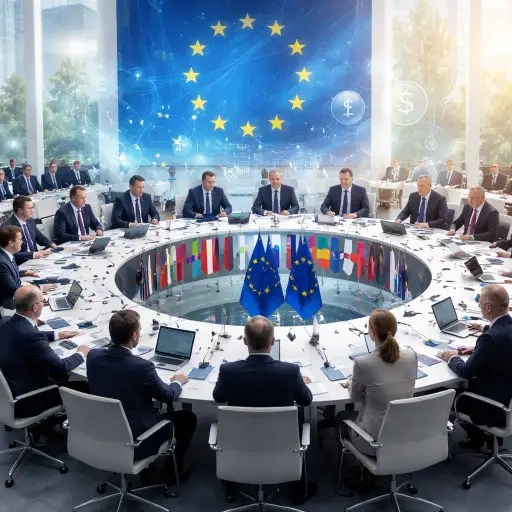
European Union leaders are gathering informally this week with a shared sense of urgency: Europe’s economic model needs reinforcing. Facing slower growth, rising global competition, and mounting geopolitical uncertainty, heads of state and government are using the meeting to sketch out a stronger, more cohesive economic agenda for the bloc.
The talks, hosted outside the formal structures of EU summits, are designed to encourage frank discussion rather than final decisions. Still, the ambition is clear. Leaders want to identify the political priorities that should guide economic policymaking over the coming years, with a particular focus on strengthening the single market, boosting industrial capacity, and improving financial cooperation across borders.
At the heart of the debate lies the single market, long considered the EU’s greatest economic asset. While it has enabled the free movement of goods, services, capital, and people for decades, leaders acknowledge that fragmentation persists. Differences in regulation, uneven enforcement of rules, and barriers in services and digital markets continue to limit its full potential.
Several capitals are expected to push for a renewed political commitment to removing these obstacles. The argument is that a more integrated market would allow European companies to scale up more easily, innovate faster, and compete more effectively with rivals from other major economies. For policymakers, deepening the single market is not just an internal reform, but a strategic response to external pressures.
Industrial strategy is another central theme. The EU has spent recent years rethinking its approach to industry, moving away from a purely competition-driven model toward one that also values resilience and strategic autonomy. Leaders are now debating how far this shift should go.
Key questions include how to support critical industries without distorting competition, how to secure supply chains for essential technologies and materials, and how to align national industrial policies with EU-wide objectives. There is broad agreement that Europe must retain and develop industrial capabilities in areas seen as vital for long-term prosperity and security, even as it remains open to global trade.
Competitiveness cuts across all of these discussions. Business leaders have repeatedly warned that high energy costs, regulatory complexity, and slower innovation risk leaving Europe behind. EU leaders are using the informal meeting to exchange views on how to address these concerns while staying true to the bloc’s social and environmental ambitions.
Some argue that simplification should be a priority, with a careful review of existing rules to ensure they are fit for purpose. Others stress the need for greater investment in skills, research, and infrastructure to underpin productivity growth. While approaches may differ, there is a shared recognition that competitiveness must be treated as a strategic objective rather than a by-product of other policies.
Financial cooperation is also high on the agenda. Despite progress in recent years, Europe’s financial system remains fragmented along national lines. Leaders are discussing ways to better mobilize private capital, deepen capital markets, and improve cross-border financing for businesses.
A more integrated financial landscape is seen as essential to funding Europe’s investment needs, from industrial modernization to innovation and infrastructure. Without it, many warn, even the best industrial strategies will struggle to deliver results.
Underlying the entire discussion is the idea of Europe as a power bloc. In a world increasingly shaped by economic rivalry and geopolitical tension, EU leaders want to ensure that Europe can act collectively to defend its interests and values. Economic strength is viewed as a prerequisite for political influence and strategic autonomy.
The informal nature of the meeting means that concrete decisions are unlikely to emerge immediately. Instead, the outcome will likely be a shared understanding of priorities that can feed into upcoming legislative and policy initiatives. For many participants, the real value lies in aligning national perspectives and building momentum for reforms that have long been discussed but proved difficult to implement.
As the meeting concludes, the challenge for EU leaders will be to translate broad agreement into action. Strengthening the single market, sharpening industrial strategy, and deepening financial cooperation all require political will and sustained coordination. The discussions this week suggest that, at least in principle, there is a growing consensus that Europe cannot afford to stand still.