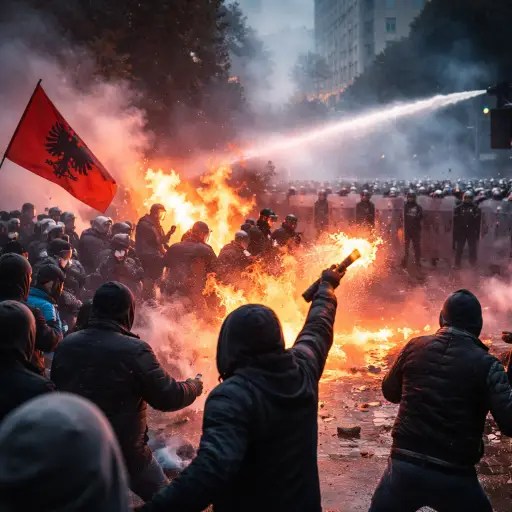
Clashes erupt in the capital as thousands demand accountability, but analysts question whether political transformation is within reach
Albania’s capital has been gripped by some of the most intense anti-government demonstrations in recent years, as thousands of protesters poured into the streets demanding the resignation of Prime Minister Edi Rama. The unrest follows corruption allegations involving a senior cabinet minister, accusations that have reignited long-simmering public frustration over governance, transparency, and economic inequality.
The protests, centered around key government buildings in Tirana, escalated rapidly from peaceful marches into violent confrontations. Groups of demonstrators hurled petrol bombs toward police lines, while security forces responded with water cannon and tear gas in an effort to disperse the crowds. Thick plumes of smoke rose above the capital as sirens echoed through the city center, underscoring the volatility of the situation.
At the heart of the unrest are allegations that a high-ranking minister close to the prime minister was involved in illicit financial dealings linked to public contracts. Opposition leaders seized on the claims, accusing the government of fostering a culture of impunity and shielding political allies from scrutiny. Though the administration has denied wrongdoing and pledged cooperation with judicial authorities, many protesters say they no longer trust official assurances.
“We are here because we feel betrayed,” said one demonstrator wrapped in the Albanian flag. “Corruption has become normal, and we are tired of promises that lead nowhere.”
Public anger has been building for months, fueled by rising living costs, youth unemployment, and perceptions that political elites remain insulated from the hardships facing ordinary citizens. Albania’s long and often turbulent transition from its communist past has left deep institutional scars, and critics argue that reforms have stalled in recent years.
The scale of the demonstrations reflects a broader erosion of public confidence. Crowds gathered in central squares before marching toward parliament and the prime minister’s office, chanting slogans and demanding immediate political accountability. By evening, tensions had escalated into clashes that left several people injured, including both protesters and police officers.
Authorities condemned the violence, calling it an attack on democratic institutions. In a televised statement, Prime Minister Rama urged calm and warned that acts of destruction will not serve the interests of the Albanian people. He emphasized that legal processes must take their course and insisted that his government remains committed to European integration and institutional reform.
Yet opposition figures argue that the unrest is symptomatic of deeper systemic failures. They claim that the justice system remains vulnerable to political pressure and that anti-corruption measures lack enforcement. Calls for an interim administration and early elections have grown louder, though such demands face significant constitutional and political hurdles.
Analysts caution that while the protests are significant, they do not necessarily signal imminent political transformation. Albania’s political landscape has long been characterized by sharp polarization between major parties, often resulting in cycles of confrontation without structural change. Previous waves of demonstrations have produced limited long-term reforms.
The anger is real and widespread, said a regional political analyst based in the Balkans. But translating street mobilization into lasting institutional change is much more complex. It requires sustained pressure, credible leadership alternatives, and functioning democratic mechanisms.
International observers are closely monitoring developments. Albania’s aspirations for deeper integration with European institutions hinge in part on strengthening the rule of law and combating corruption. Diplomatic representatives have called for restraint on all sides, urging dialogue and adherence to democratic norms.
For many citizens, however, patience is wearing thin. Small business owners report declining activity as uncertainty weighs on the economy. University students have joined labor groups and civil society organizations in amplifying demands for transparency and accountability. Social media platforms have been flooded with images and videos of the clashes, galvanizing support beyond the capital.
Despite the intensity of the confrontations, there is no immediate indication that the government’s position is untenable. The ruling party retains a parliamentary majority, and internal fractures have yet to materialize publicly. Still, the events unfolding in Tirana have exposed vulnerabilities in Albania’s political fabric and underscored the depth of public discontent.
As night falls over the capital, the question facing Albania is not only whether the protests will continue, but whether they will reshape the country’s political trajectory. For now, uncertainty prevails. The streets of Tirana remain tense, and the coming days may prove decisive in determining whether this surge of unrest becomes a turning point—or another chapter in a protracted struggle for accountability and reform.

 The Tower Post