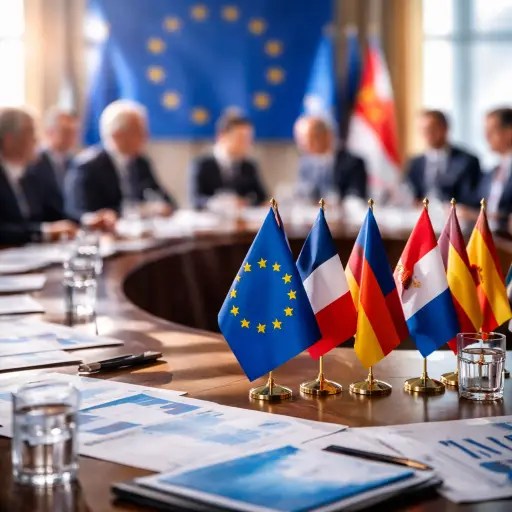
Leaders push for deeper integration, fewer internal barriers and a stronger single market amid widening economic gaps
European Union leaders are rallying behind a renewed push for economic integration, warning that the bloc risks drifting into a “two-speed” reality if internal reforms are delayed. As high-level winter meetings continue in the Belgian capital, policymakers are converging around an end-of-year horizon to deliver concrete measures aimed at narrowing the gap between faster-growing northern economies and their southern and eastern counterparts.
The urgency reflects mounting concern that persistent disparities in productivity, investment flows and access to capital could erode the foundations of the single market. Officials familiar with the discussions say the objective is clear: remove internal bottlenecks that fragment the bloc’s economy and restore momentum to cross-border business activity before divergence becomes entrenched.
At the heart of the debate lies a politically sensitive question. Can the European Union preserve cohesion in an era of intensifying global competition without deepening economic integration among its members? For many in Brussels, the answer is increasingly unequivocal. Without structural reforms to improve convergence, the risk of a durable economic divide could undermine both growth and solidarity.
Over the past decade, the EU economy has weathered successive shocks, from financial turbulence to pandemic disruption and energy volatility. Although recovery has taken hold across much of the bloc, it has been uneven. Wealthier member states have rebounded more swiftly, benefiting from stronger fiscal buffers, deeper capital markets and diversified industrial bases. Others continue to struggle with lower productivity growth, constrained investment capacity and structural vulnerabilities that slow their path forward.
The emerging integration drive seeks to address these imbalances head-on. Among the priorities under discussion are further harmonization of capital markets, streamlined regulatory frameworks for cross-border services and renewed efforts to complete the banking union. Supporters argue that a more unified financial system would unlock private investment, reduce borrowing costs and foster innovation across the bloc, particularly in regions that have traditionally faced higher financing hurdles.
“The single market remains Europe’s greatest economic achievement,” said one senior EU official involved in the preparatory talks. “But it is still incomplete. Internal barriers, from regulatory divergence to administrative complexity, continue to hold back growth and competitiveness.”
Business leaders share that assessment. Companies operating across multiple member states frequently cite differing standards, tax regimes and licensing requirements as obstacles that inflate costs and deter expansion. For small and medium-sized enterprises, navigating fragmented regulatory landscapes can be especially burdensome. In high-growth sectors such as digital services, advanced manufacturing and clean technologies, fragmentation has also slowed scaling, limiting Europe’s ability to compete with larger, more unified markets abroad.
The reform agenda now taking shape aims to tackle precisely these issues. One strand focuses on simplifying rules for cross-border investment, making it easier for startups and established firms alike to raise capital beyond their home markets. Another centers on reducing red tape in public procurement and infrastructure development, areas seen as crucial for attracting long-term funding and accelerating strategic projects.
Behind the policy details lies a broader strategic calculation. EU officials fear that without decisive action, divergence could harden into a structural divide. A “two-speed” Europe, in which a core group of countries pulls ahead economically while others lag persistently behind, would not only undermine cohesion but also weaken the bloc’s collective influence on the global stage. Economic fragmentation would translate into diminished bargaining power, slower innovation and reduced resilience.
Such fragmentation carries political risks as well. Economic disparities have historically fueled domestic discontent and eurosceptic sentiment in several member states. By prioritizing convergence, leaders hope to reinforce trust in the European project at a time when geopolitical tensions and technological competition demand unity and strategic clarity.
The discussions in Brussels also reflect a growing awareness that external competitiveness is inseparable from internal coherence. As major economies invest heavily in strategic sectors, from green energy to semiconductor production, Europe must ensure that its own market operates efficiently and at scale. Fragmentation within the single market effectively shrinks Europe’s economic footprint, policymakers argue, and makes it harder to mobilize resources quickly in response to global shifts.
Efforts to deepen integration are not new. The creation of the euro, the establishment of the banking union and ongoing initiatives to build a capital markets union all aimed to tighten economic ties. Yet progress has often been incremental and uneven, slowed by divergent national interests and concerns over sovereignty. The current push is marked by a sharper tone and a clearer sense of deadline, reflecting the belief that gradualism may no longer suffice.
The geopolitical backdrop has amplified that sense of urgency. Supply chain disruptions, shifting trade alliances and rapid technological change have underscored the importance of resilience. A more integrated internal market is viewed as a buffer against external shocks, enabling capital, labor and goods to move more swiftly to where they are most needed. In that sense, integration is being framed not merely as an economic reform, but as a strategic necessity.
Still, consensus will not come easily. Some member states worry that deeper harmonization could dilute national regulatory autonomy or disproportionately benefit larger economies with established industrial champions. Others emphasize that convergence cannot be achieved through market integration alone, but requires sustained investment in education, research and infrastructure to lift productivity in less developed regions.
To address these concerns, proposals under review include targeted support mechanisms for regions facing structural challenges, alongside common standards designed to level the playing field. Officials stress that the objective is not uniformity for its own sake, but a framework that allows diverse economies to thrive within a shared market governed by transparent and predictable rules.
Financial markets are monitoring the debate closely. Greater clarity on the reform trajectory could bolster investor confidence, particularly if measures succeed in reducing regulatory uncertainty and facilitating cross-border financing. Analysts note that a credible roadmap toward integration may help stabilize long-term growth expectations and attract capital that might otherwise flow to more streamlined jurisdictions.
As discussions continue, the message from Brussels is unmistakable. Leaders are signaling that the cost of inaction is rising. By defining a horizon for reform and emphasizing delivery within a set timeframe, they aim to galvanize political momentum and demonstrate that the European Union can adapt to changing economic realities.
Whether the initiative will translate into tangible legislative breakthroughs remains uncertain. Achieving agreement among member states with varying fiscal positions and political priorities has never been straightforward. Yet the current debate suggests a growing recognition that preserving cohesion is not optional, but essential for Europe’s prosperity and stability.
For the European Union, the stakes extend beyond macroeconomic indicators. The single market has long been a cornerstone of integration, binding together countries with different histories, economic models and development paths. Ensuring that it functions effectively for all members is central to the bloc’s credibility at home and abroad.
As winter deliberations in Brussels intensify, the choice confronting EU leaders is stark. Allow economic divergence to deepen, risking fragmentation and diminished influence, or commit to a renewed phase of integration designed to secure shared growth. The emerging deadline signals that, at least for now, the political will leans decisively toward convergence rather than complacency.
 The Tower Post