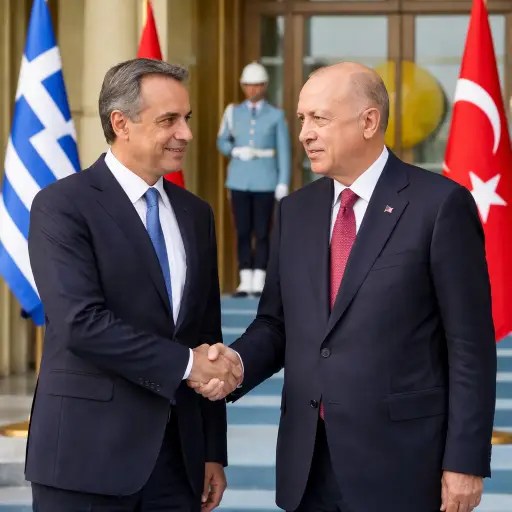
Mitsotakis and Erdoğan Renew Dialogue on Migration, Maritime Disputes and Regional Stability
In a carefully choreographed meeting in the Turkish capital in mid-February, Greek Prime Minister Kyriakos Mitsotakis and Turkish President Recep Tayyip Erdoğan sought to lower the temperature between two NATO allies whose relations have often veered between cautious engagement and open confrontation.
The talks, held at the presidential complex in Ankara, marked the latest attempt to sustain a fragile thaw that began after years of heightened tensions in the Aegean Sea and the Eastern Mediterranean. While expectations for a dramatic breakthrough were modest, both leaders underscored the strategic necessity of dialogue at a time of regional uncertainty and global instability.
At the heart of the discussions were three interlocking issues that have long defined Greek–Turkish relations: migration management, maritime boundaries and energy exploration rights. The divided island of Cyprus — a perennial source of friction — also featured prominently, alongside efforts to expand trade and cultural cooperation.
“We may not agree on everything,” Mitsotakis said following the meeting, “but we agree that dialogue is the only path that prevents crises and strengthens stability.” Erdoğan echoed the sentiment, describing open channels of communication as “essential for peace in our shared geography.”
Migration Cooperation Under Scrutiny
Migration remains one of the most sensitive and politically charged topics for both governments. Greece, positioned at the European Union’s southeastern frontier, continues to serve as a primary entry point for migrants and asylum seekers traveling from the Middle East, Asia and Africa. Turkey, which hosts millions of refugees, plays a pivotal role in controlling onward flows toward Europe.
Officials from both sides discussed mechanisms to strengthen coordination between coast guards, enhance information-sharing networks and prevent dangerous sea crossings. The Aegean has witnessed repeated humanitarian tragedies, with overcrowded boats capsizing amid perilous journeys.
Greek authorities have long called for more consistent enforcement of existing agreements, arguing that reduced departures from Turkish shores would ease pressure on island communities. Turkish officials, for their part, emphasize the financial and social burden of hosting large refugee populations and urge greater European solidarity.
Diplomats familiar with the talks described the tone as pragmatic. While no new migration pact was announced, both sides signaled readiness to maintain operational cooperation and to avoid politicizing the issue — a notable shift from periods when migration became entangled in broader geopolitical disputes.
Maritime Boundaries and Energy Rights
Far more complex are the disputes over maritime zones and energy exploration in the Eastern Mediterranean. Competing claims over continental shelves and exclusive economic zones have fueled tensions for decades, occasionally bringing naval forces into close proximity.
The discovery of natural gas reserves in the region intensified disagreements, with both countries asserting rights to explore and exploit subsea resources. Greece insists that its islands generate full maritime entitlements under international law, while Turkey challenges that interpretation, arguing it leads to inequitable outcomes.
During the Ankara talks, both leaders agreed to continue exploratory contacts between technical delegations. These discussions aim to narrow differences sufficiently to allow for potential recourse to international adjudication — an option Athens has long supported but Ankara approaches with caution.
Analysts say even the continuation of structured dialogue represents progress. The fact that both governments are willing to keep talking reduces the risk of sudden escalation. It does not resolve the underlying disagreements, but it builds predictability.
Cyprus and the Broader Regional Context
The unresolved status of Cyprus remains a core obstacle. The island has been divided for decades between the internationally recognized Republic of Cyprus and the Turkish Cypriot north, recognized only by Ankara. Efforts under United Nations auspices to reunify the island have repeatedly stalled.
While neither leader signaled a shift in long-standing positions, both acknowledged that renewed diplomatic energy is needed. Mitsotakis reiterated Greece’s support for a bizonal, bicommunal federation framework, while Erdoğan maintained Turkey’s backing for a two-state vision — positions that reflect deep structural differences.
Beyond bilateral disputes, the meeting unfolded against a backdrop of wider regional challenges. Conflicts in the Middle East, shifting alliances in the Eastern Mediterranean and the ongoing recalibration of NATO’s strategic posture have elevated the importance of cohesion among alliance members.
Both Greece and Turkey play critical roles in the alliance’s southeastern flank. With security dynamics evolving rapidly, Western partners have quietly encouraged sustained engagement between Athens and Ankara to avoid distractions from broader defense priorities.
Economic and Cultural Openings
Despite political tensions, economic ties between the two countries have grown steadily in recent years. Trade volumes have expanded, and tourism flows have rebounded, benefiting local economies on both sides of the Aegean.
In Ankara, officials discussed easing certain bureaucratic hurdles for business exchanges and promoting joint initiatives in renewable energy, infrastructure and technology. Cultural cooperation — including academic exchanges and heritage preservation projects — was also highlighted as a means of fostering people-to-people trust.
These are areas where both sides believe progress is possible even as more complex issues remain under discussion.
Managing Expectations
Few observers expect rapid transformation in a relationship shaped by history, geography and domestic political pressures. National narratives in both countries remain sensitive to perceived concessions on sovereignty and security.
Yet the symbolism of sustained high-level engagement carries weight. In previous years, inflammatory rhetoric and military maneuvers risked spiraling into confrontation. The current emphasis on institutionalized dialogue reflects lessons learned from those episodes.
In their joint appearance, Mitsotakis and Erdoğan avoided sharp exchanges. Instead, they framed their meeting as part of a longer-term process aimed at stabilizing ties and reducing misunderstandings.
Whether that process will yield concrete agreements remains uncertain. But for now, the two leaders appear aligned on one principle: sustained communication is preferable to silence.
In a region where crises can escalate quickly, the mere act of sitting at the same table may itself represent cautious but meaningful progress.
 The Tower Post