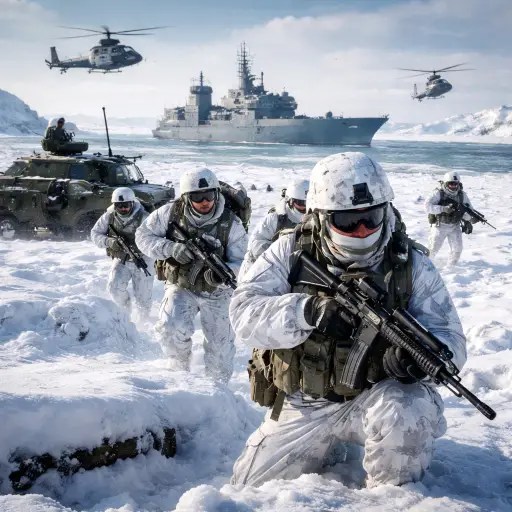
European allies step up presence in the Arctic as the Alliance reinforces its northern flank amid rising geopolitical strain
As winter tightens its grip across the polar expanse, the North Atlantic Treaty Organization has unveiled a sweeping new military initiative aimed at strengthening security across the Arctic. The operation, dubbed Arctic Sentry, represents one of the most consequential strategic recalibrations in recent years, underscoring the Alliance’s growing concern over mounting geopolitical friction in the High North.
The Arctic, once regarded primarily as a remote and frozen frontier, has become a focal point of global competition. Climate change has accelerated the melting of sea ice, gradually opening new maritime routes and exposing untapped natural resources. These developments have sharpened the strategic value of the region, prompting NATO to intensify its posture and signaling that the High North is no longer peripheral to Euro-Atlantic security calculations.
Arctic Sentry is designed as a coordinated framework of expanded exercises, rotational troop deployments, maritime patrols, and enhanced intelligence-sharing mechanisms. According to senior NATO officials, the initiative is not an escalation but a reinforcement—intended to deter potential adversaries, reassure member states bordering the Arctic, and safeguard freedom of navigation along emerging sea lanes.
European members are at the forefront of the effort. The United Kingdom has increased naval patrols and committed additional surveillance assets to the North Atlantic approaches. France has pledged specialized cold-weather units and expanded participation in joint exercises. Germany, traditionally less active in Arctic defense operations, has stepped up logistical support and committed forces to multinational training missions. Together, these moves signal a collective determination to fortify Europe’s northern flank.
The strategic logic behind Arctic Sentry rests on deterrence through presence. By increasing the visibility and readiness of allied forces, NATO aims to reduce the risk of miscalculation and underscore its commitment to collective defense. Military planners emphasize interoperability, ensuring that forces from different nations can operate seamlessly in extreme cold-weather conditions—a capability that requires rigorous preparation and sustained investment.
Beyond troop deployments, Arctic Sentry encompasses technological modernization. Enhanced satellite monitoring, improved maritime domain awareness systems, and next-generation reconnaissance aircraft are being integrated into Arctic operations. The initiative also seeks to bolster resilience against hybrid threats, including cyber intrusions and infrastructure sabotage in vulnerable northern communities.
The High North’s geography presents unique challenges. Harsh weather, limited infrastructure, and vast distances complicate rapid response. For this reason, Arctic Sentry includes expanded pre-positioning of equipment and the development of Arctic-capable logistics hubs. NATO officials stress that preparedness in such an environment is as much about endurance as it is about firepower.
While NATO frames Arctic Sentry as defensive in nature, the initiative unfolds against a backdrop of intensified activity by rival powers in the region. Increased military exercises, expanded icebreaker fleets, and renewed infrastructure projects have heightened tensions. Analysts note that the Arctic is emerging as a theater where strategic competition is unfolding incrementally rather than explosively—through patrol patterns, infrastructure investments, and legal claims over maritime boundaries.
For Nordic and Baltic member states, the reassurance factor is significant. Arctic Sentry reinforces the message that collective defense commitments extend fully into the polar domain. Leaders from northern European capitals have welcomed the initiative as evidence that NATO is adapting to shifting security dynamics and responding proactively rather than reactively.
The launch of Arctic Sentry also reflects a broader evolution within the Alliance. In recent years, NATO has sought to rebalance its strategic focus, addressing challenges along multiple axes—from eastern deterrence to southern instability and now the northern frontier. The Arctic component underscores recognition that emerging security risks are multidimensional and interconnected.
Critics caution that increased militarization could further strain regional stability. However, proponents argue that credible deterrence reduces the likelihood of confrontation by clarifying red lines and maintaining open channels of communication. NATO officials reiterate that dialogue and transparency remain integral to the Alliance’s approach, even as it strengthens operational readiness.
As Arctic Sentry moves from announcement to implementation, attention will turn to how effectively the initiative translates strategic intent into sustainable capability. The Arctic’s evolving landscape demands adaptability, coordination, and sustained political will. For NATO, the message is clear: the High North is no longer a distant horizon but a central pillar of collective security.
In the frozen silence of the polar night, where shifting ice mirrors shifting geopolitics, Arctic Sentry signals that the Alliance is determined to remain vigilant. The Arctic may be changing rapidly, but NATO’s commitment to defend its northern allies is intended to remain constant.



 The Tower Post